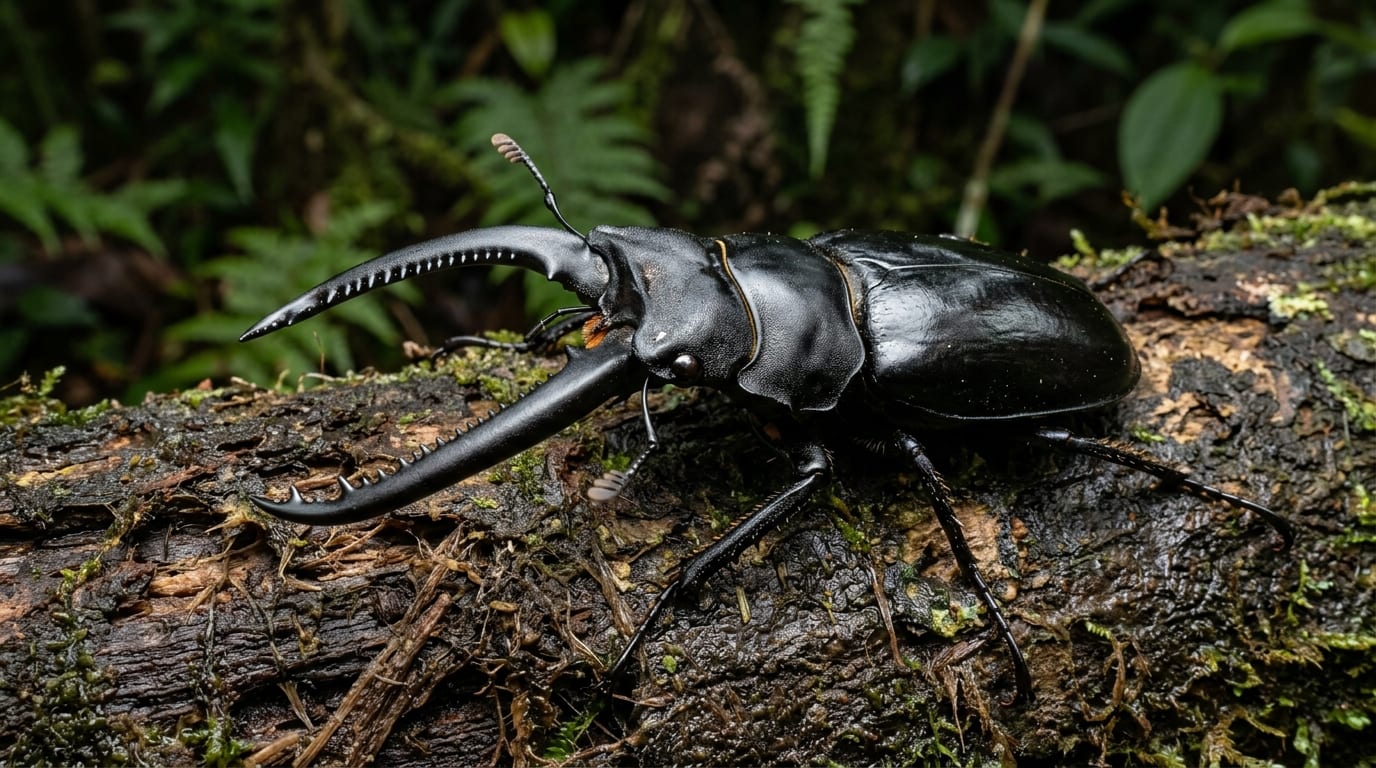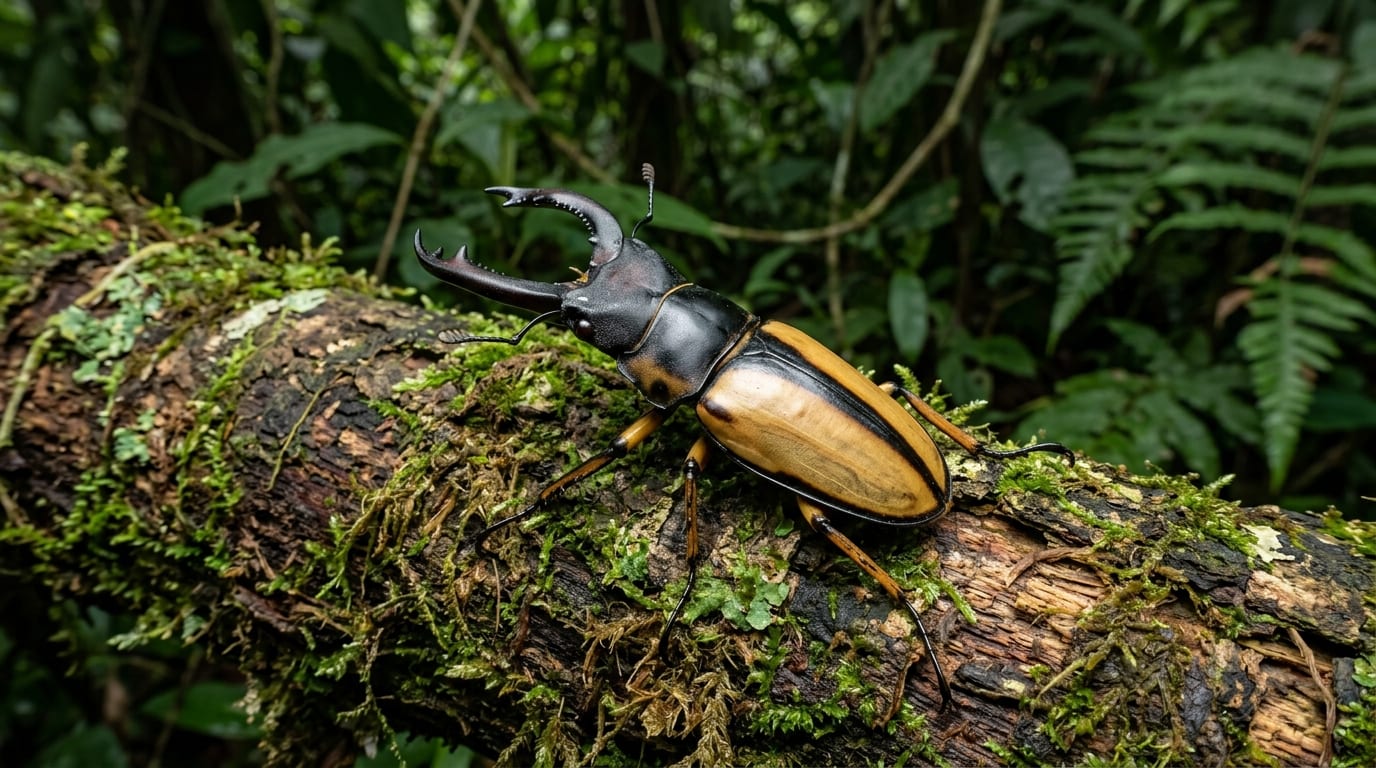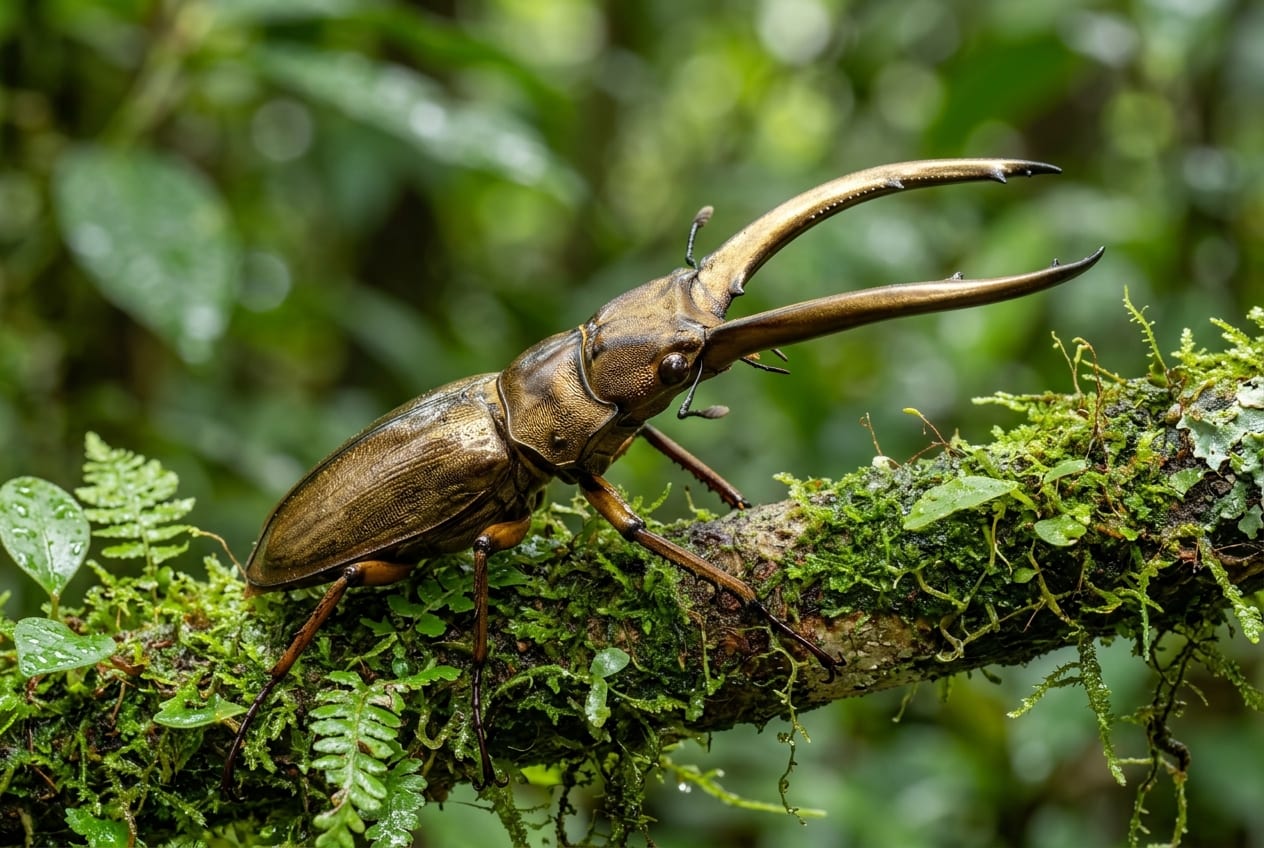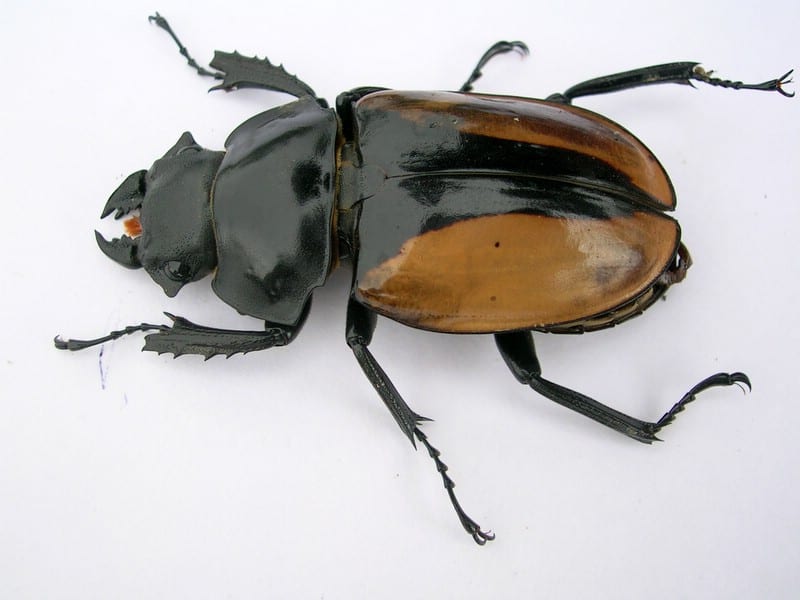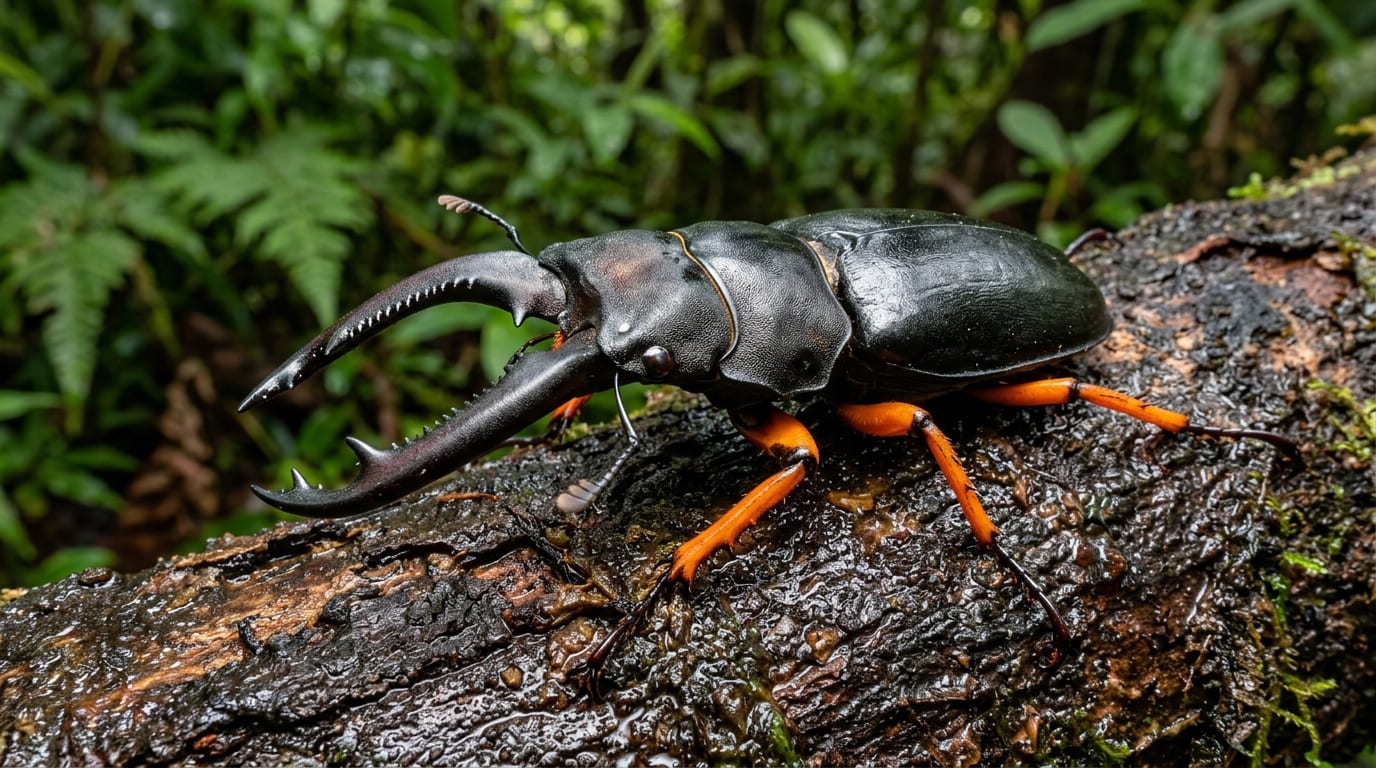
AI-generated image
Imperial Shining Stag Beetle
AdvancedOdontolabis imperialis
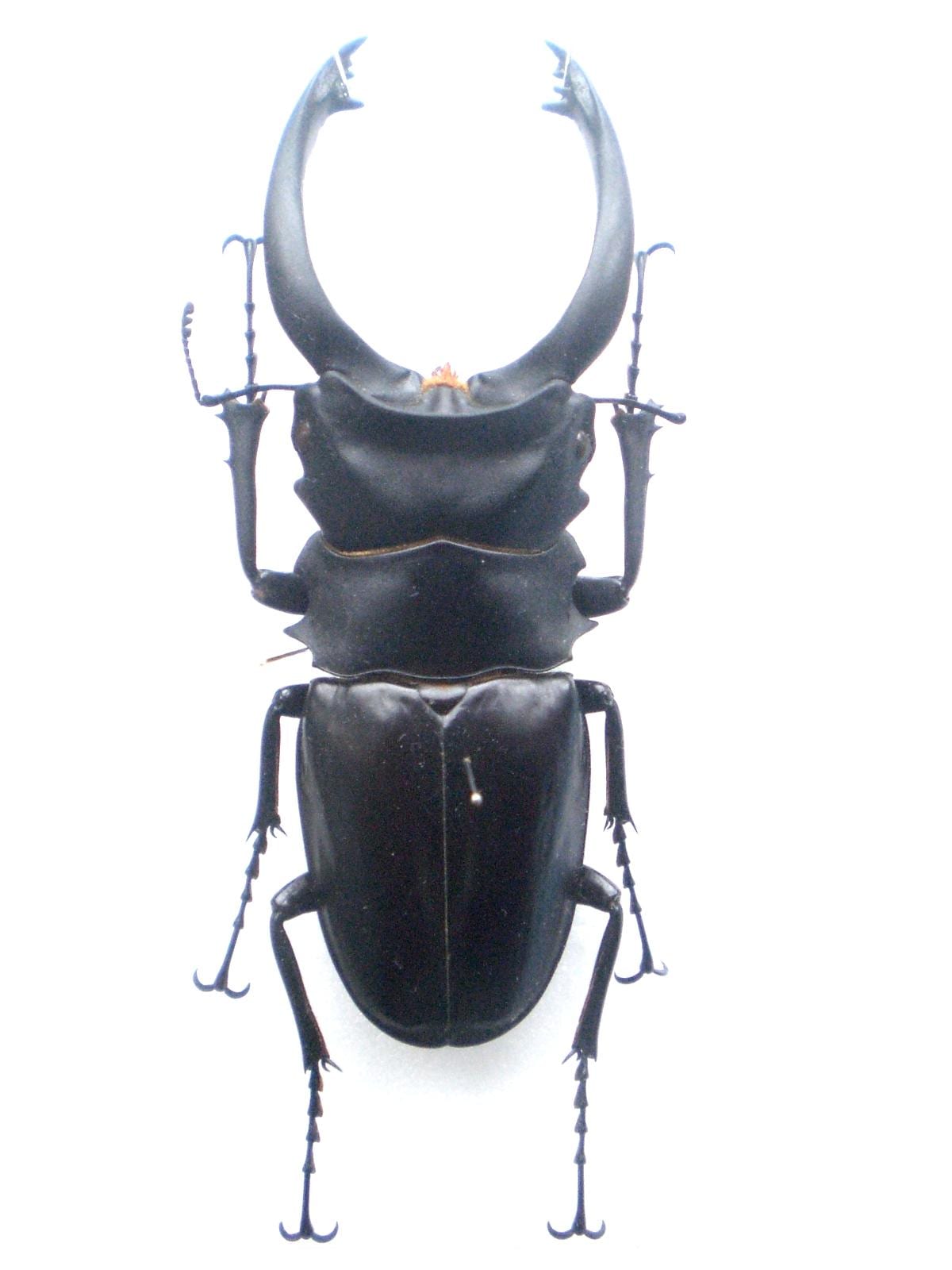
An Odontolabis marked by orange-tinged legs, with black elytra that throw a metallic sheen. The inner teeth run in a fine saw-like series, with a larger forked tooth near the tip. It occurs in northern Borneo and the Philippines.
Difficulty
Advanced
Temperature
20〜28℃
Lifespan
A few months as an adult
Size
Captive record 50.0mm for the nominate form; wild record 72.3mm
Humidity
60〜80%
Diet
Adults take fermented sap of broadleaf trees and beetle jelly; larvae eat humus close to soil
About
Odontolabis imperialis is marked by orange-tinged legs and black elytra that throw a metallic sheen. The inner teeth of the mandible run in a fine saw-like series, with a larger forked tooth near the tip. Its range is given as the Philippines together with Sarawak and Sabah in northern Borneo. The genus centres on island Southeast Asia and gathers at the fermented sap of various broadleaf trees. The larvae live in humus formed where broadleaf wood has rotted down close to soil, hollowing out a jar-shaped chamber that they hold as territory against insects of their own and other species. One to two years pass between hatching and pupation and the adults live a few months. The captive record of 50.0 mm falls well short of the wild record of 72.3 mm and further still from the 80 mm that BE-KUWA gives as the expected maximum, so the technique for finishing large individuals in captivity has yet to be worked out.
Source: Wikipedia (CC BY-SA 4.0)
Size of the Imperial Shining Stag Beetle
The Imperial Shining Stag Beetle grows to Captive record 50.0mm for the nominate form; wild record 72.3mm.
Basic Info
Origin
Northern Borneo (Sarawak and Sabah) and the Philippines
Lifespan
A few months as an adult
Size
Captive record 50.0mm for the nominate form; wild record 72.3mm
Temperature
20〜28℃
Humidity
60〜80%
Care Specifications
AggressiveSolitaryBreeding: Hard
Sources: Odontolabis - Wikipedia (JA; range, biology, the three mandible forms, humus-feeding larvae, per-species difficulty of egg-laying) / Odontolabis - Wikipedia (EN; genus description and per-species distributions) / GBIF species page for Odontolabis imperialis Mollenkamp, 1904 / BE-KUWA Certified Breeding Records (Mushi-sha, FY2025 edition PDF, JA)
Breeding Records & Localities
Captive record (♂)
50 mm
Wild record (♂)
72.3 mm
Record source: BE-KUWA 2025 edition, captive records for imported stag beetles (imperialis nominate: captive 50.0 mm, K. Aikawa, registered 2021; wild 72.3 mm; expected maximum 80 mm)
Notable localities
SarawakSabahPhilippines
The captive record falls well short of the wild record for this species, and further still from the 80 mm expected maximum given by BE-KUWA.
Generation codes
- WD
- Wild-caught
- WF1
- Offspring of a wild-caught female
- F1〜
- Captive generations (same locality)
- CBF1
- Cross-locality captive-bred (reset)
Sources: BE-KUWA Certified Breeding Records (Mushi-sha, FY2025 edition PDF, JA) / Odontolabis - Wikipedia (EN; genus description and per-species distributions)
References & Sources
Edited & verified by: BreederDirect editorial team
The taxonomic, regulatory, and husbandry data on this page are compiled and verified against the authoritative primary sources below.
Primary sources
- Wikipedia
- Ministry of the Environment, Invasive Species Act: "Guidance for Those Importing Live Insects in Scarabaeoidea"
- CITES Appendix (checklist.cites.org)
- Odontolabis - Wikipedia (JA; range, biology, the three mandible forms, humus-feeding larvae, per-species difficulty of egg-laying)
- GBIF species page for Odontolabis imperialis Mollenkamp, 1904
- BE-KUWA Certified Breeding Records (Mushi-sha, FY2025 edition PDF, JA)
Taxonomy & Authority
Accepted name: Odontolabis imperialis Möllenkamp, 1904
Authority databases: GBIF
Nomenclature follows global taxonomic authority databases.
Regulations & Conservation Status
Not CITES-listed
Plant Protection Act: When importing live specimens of Scarabaeoidea (including rhinoceros beetles, stag beetles, flower beetles, etc.), a species identification certificate issued by the exporting country government agency or equivalent must be attached in accordance with the Invasive Species Act (import ports are limited to Narita, Chubu, Kansai, Fukuoka, and Kagoshima airports). This species itself is not a designated invasive species, and import is possible upon submission of the certificate.
Sources: Ministry of the Environment, Invasive Species Act: "Guidance for Those Importing Live Insects in Scarabaeoidea" / CITES Appendix (checklist.cites.org)
Regulations may change. Always verify the latest information with the relevant authorities.
Imperial Shining Stag Beetle Listings
Loading latest listingsFind listings for this species