Source: Wikimedia Commons
Red-crested Cardinal
IntermediateParoaria coronata
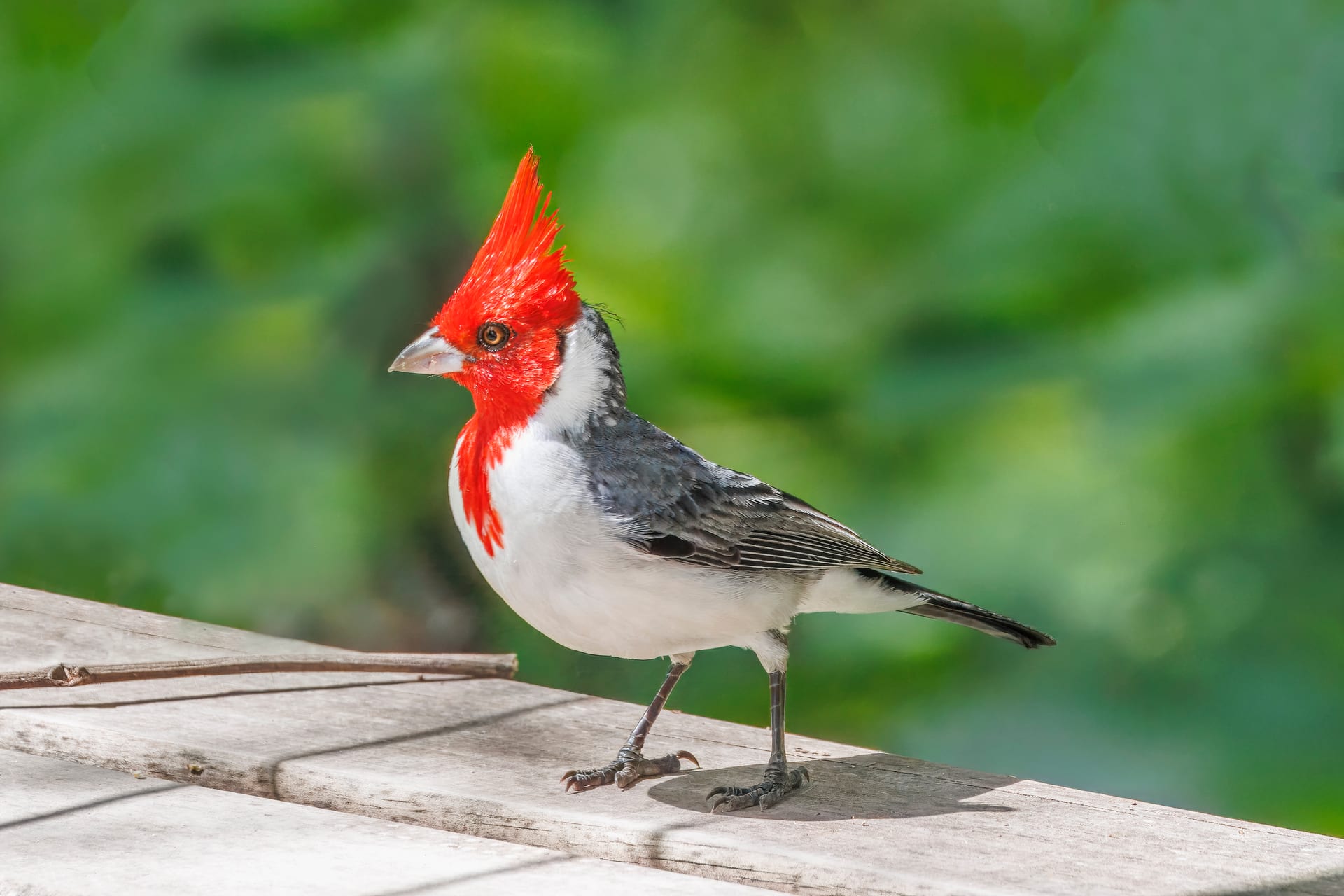
A bird 18 to 20 cm long with a red head and bib and a short red crest it raises when excited; the back, wings and tail are grey and the underparts white. Native to South America, it has long been kept as a cage bird for its song.
Difficulty
Intermediate
Temperature
15〜30℃
Lifespan
10-15 years
Size
18-20cm
Humidity
40〜60%
Diet
Mixed seed, fruit, insects and greens
About
The red-crested cardinal (Paroaria coronata) is a thraupid of south-central South America, 18 to 20 cm long, with a red head and bib and a short red crest that it raises when excited. The breast, belly and undertail are white while the back, wings and tail are grey, the primaries and rectrices a darker grey. Juveniles resemble adults but have a dull brownish-orange head and bib. The species is monotypic. Birds live in pairs or small groups and gather in larger flocks outside the breeding season, and both sexes feed the young. They eat seeds, fruit and insects, often foraging in wetlands, where large feet and long toes spread their weight over floating vegetation. John Frederick Miller described the species in 1776 as Loxia coronata. Trapping for the cage-bird trade, prompted by its fine song, has reduced numbers in some areas. It was introduced to Hawaii in 1928 and also to Puerto Rico and Chile.
Source: Wikipedia (CC BY-SA 4.0)
Lifespan of the Red-crested Cardinal
The Red-crested Cardinal lives 10-15 years.
Size of the Red-crested Cardinal
The Red-crested Cardinal grows to 18-20cm.
Basic Info
Origin
Southern Brazil (Rio Grande do Sul) and the southern Pantanal, eastern Bolivia, Paraguay, Uruguay and northern Argentina
Lifespan
10-15 years
Size
18-20cm
Temperature
Care Specifications
PeacefulPairBreeding: Moderate
Sources: Wikipedia - Red-crested cardinal (morphology, range, introductions, taxonomy, similar species) / Japanese Wikipedia - Kokancho (behaviour, diet, wetland foraging, trapping for the cage-bird trade, year of introduction to Hawaii) / German Wikipedia - Rotschopftangare (20 cm) / IOC World Bird List v15.2 (scientific name, authority, English name, range)
References & Sources
Edited & verified by: BreederDirect editorial team
The taxonomic, regulatory, and husbandry data on this page are compiled and verified against the authoritative primary sources below.
Primary sources
- Wikipedia
- CITES Appendices (Paroaria coronata listed in Appendix II)
- Annex to Council Regulation (EC) No 338/97 as amended by Commission Regulation (EU) 2026/1383 (post-CoP20)
- Ministry of the Environment, Japan - List of Invasive Alien Species designated under the IAS Act (birds)
- IUCN Red List
- Japanese Wikipedia - Kokancho (behaviour, diet, wetland foraging, trapping for the cage-bird trade, year of introduction to Hawaii)
- German Wikipedia - Rotschopftangare (20 cm)
- IOC World Bird List v15.2 (scientific name, authority, English name, range)
Taxonomy & Authority
Accepted name: Paroaria coronata (Miller, JF, 1776)
Synonyms: Loxia coronata
Authority databases: GBIF
Nomenclature follows global taxonomic authority databases.
Regulations & Conservation Status
CITES Appendix IIIUCN LC · Least Concern
Paroaria coronata is listed in CITES Appendix II, as is its congener Paroaria capitata. International trade in an Appendix II species requires an export permit from the exporting state; it is not among the Appendix I derived species that require registration under Japanese law, and it is not designated an Invasive Alien Species in Japan. The IUCN assesses it as Least Concern.
Sources: CITES Appendices (Paroaria coronata listed in Appendix II) / Annex to Council Regulation (EC) No 338/97 as amended by Commission Regulation (EU) 2026/1383 (post-CoP20) / Ministry of the Environment, Japan - List of Invasive Alien Species designated under the IAS Act (birds) / IUCN Red List
Regulations may change. Always verify the latest information with the relevant authorities.
Red-crested Cardinal Listings
Loading latest listingsFind listings for this species