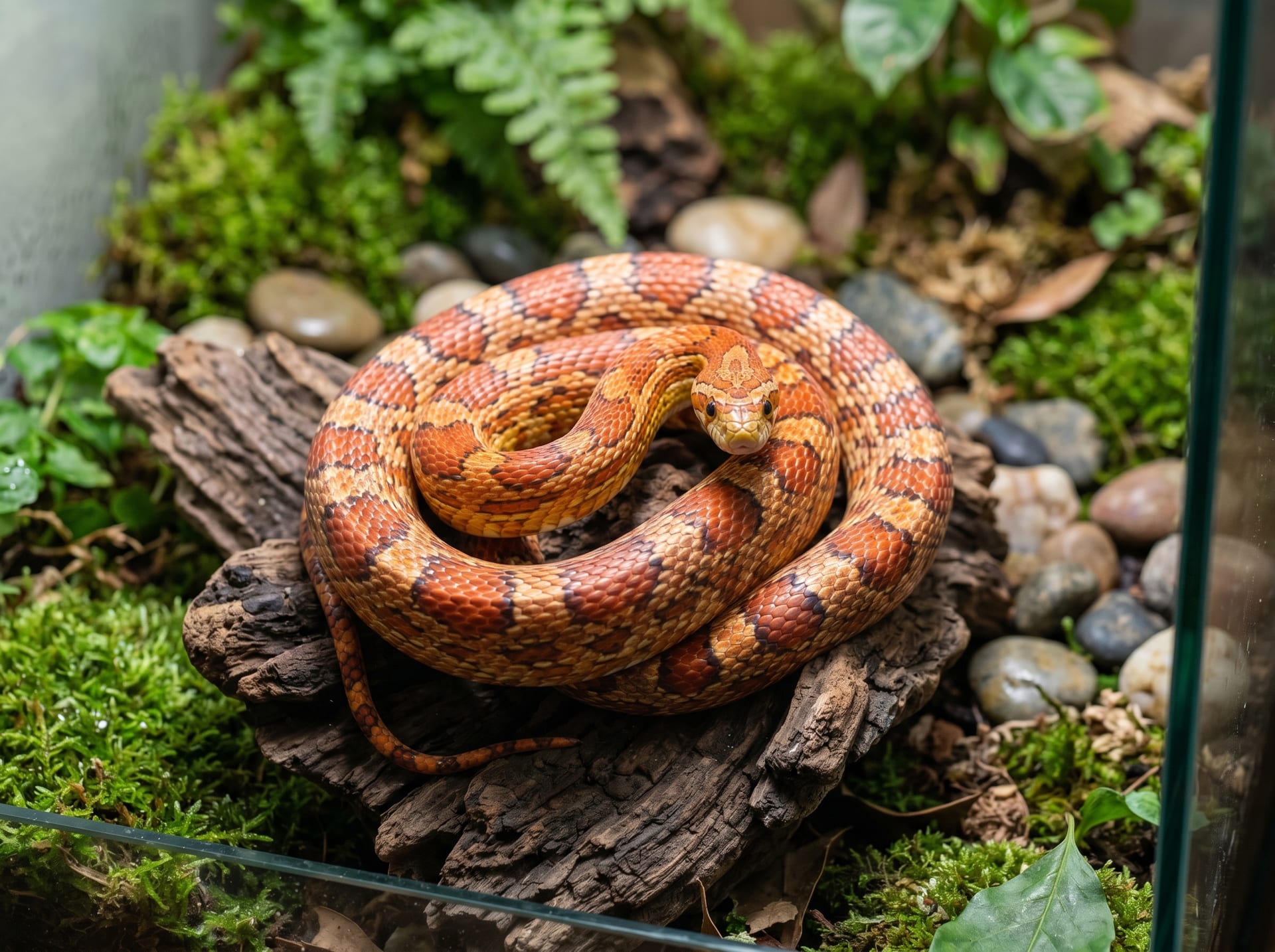
Complete Guide to Corn Snake Care | Enclosure, Feeding, Handling, and Shedding
A comprehensive guide to corn snake care for beginners, covering enclosure selection, temperature management, feeding mice, handling techniques, shedding care, and basic breeding fundamentals.

Key Takeaways
A comprehensive guide to corn snake care for beginners, covering enclosure selection, temperature management, feeding mice, handling techniques, shedding care, and basic breeding fundamentals.
Related Species
Corn snakes are among the easiest snakes to care for and are widely appreciated by reptile beginners. Their gentle temperament, hardy constitution, and abundant morphs (color variations) are their main attractions. If you're thinking about keeping a snake, we recommend starting with a corn snake.
Corn Snake Basics
- Origin: Southeastern North America (forests, farmland, grasslands)
- Length: 90–150 cm (adult size)
- Lifespan: 15–20 years
- Temperament: Docile, easily tamed, and easy to handle
- Activity: Nocturnal to crepuscular
Enclosure Selection and Setup
Recommended Enclosure Size
Adults require a minimum enclosure of 60 × 30 cm (width × depth). An enclosure of 90 cm or larger is ideal. Since snakes are escape artists, choose an enclosure with a securely locking lid.
- Dedicated reptile glass enclosures: Excellent airflow and visibility; the most popular choice
- Acrylic enclosures: Lightweight but prone to scratching
- Modified storage bins: Cost-effective but require ventilation modification
Substrate
- Aspen shavings: The most popular choice. Provides insulation and allows burrowing
- Coconut husk: Excellent humidity retention and creates a natural appearance
- Paper towels or newspaper: Easy to maintain. Suitable for hatchlings and recovering individuals
Hides and Water Bowls
Always provide 1–2 hides; one snug enough for the snake to fit comfortably provides a sense of security. The water bowl should be large enough for the snake to submerge completely. Before shedding, snakes naturally soak to soften their skin.
Temperature Management
Corn snakes can be kept at relatively cool temperatures, but maintaining proper temperature ranges is key to their health.
| Location | Recommended Temperature |
|---|---|
| Basking spot | 28–30°C |
| Enclosure overall | 22–26°C |
| Nighttime minimum | 18°C or above |
- Place a heat panel on 1/3 to 1/2 of the enclosure floor
- Use a thermostat for automatic temperature control
- UVB lighting is not essential but helps establish a natural circadian rhythm
Feeding: Types and Methods
Main Food Sources
The primary diet for corn snakes is frozen mice (from pinky mice to adult mice). Most keepers use frozen mice to avoid the risk of live mice injuring the snake.
- Pinky mice: Newborn to 1-week-old mice. Main diet for hatchling corn snakes
- Fuzzy mice: Around 2 weeks old. Begin to develop fur
- Hopper mice: 3–4 weeks old. Suitable for juvenile snakes
- Adult mice: For adult snakes
Feeding Size Guide
A mouse roughly the same width as the snake's head, or slightly larger, is appropriate. The ideal size produces a slight bulge in the snake's body after consumption.
Feeding Frequency
- Hatchlings to juveniles: Once every 5–7 days
- Adults: Once every 10–14 days
Feeding Notes
- Thaw frozen mice in 40°C water (do not use a microwave)
- Feed in the evening or night for better feeding response
- Avoid handling for 48 hours after feeding to prevent digestion issues and regurgitation
- Use feeding tongs or tweezers; do not feed by hand
Handling (Taming)
Corn snakes are relatively easy to handle, but a gradual approach to taming is necessary.
- Avoid handling for the first 2 weeks: Prioritize acclimation to the new environment
- Start with short sessions: About 5 minutes, three times per week
- Avoid sudden movements: Approach slowly from the side
- Gradually extend duration: Increase to 10–15 minutes as the snake becomes accustomed
Note: Avoid handling before and after shedding, as skin is sensitive and stress can be problematic
Shedding Care
Adults shed approximately every 3–4 weeks.
Pre-shedding Signs
- Overall color becomes dull
- Eyes become milky white (called "blue eye")
- Appetite decreases and the snake becomes more reclusive
Managing Incomplete Sheds
- Soak in warm water (30–35°C) for 15–30 minutes to soften the skin
- Gently remove shed with a wet towel
- Pay special attention to removing shed skin from the eyes and tail tip
Breeding Basics
Cooling (Brumation)
- Gradually reduce feeding from October to November
- Lower enclosure temperature to 15–18°C from December to February
- Return to normal temperature in March and resume feeding
Breeding to Egg-Laying
- Introduce males and females 2–3 weeks after cooling
- Females lay eggs 60–65 days after successful mating (8–20 eggs per clutch)
- Eggs incubate for 60–75 days at 27–28°C
Husbandry Precautions
- Escape prevention: Always lock the enclosure lid. Snakes can escape through tiny gaps
- Individual housing: Keep snakes separately (risk of cannibalism)
- Feeding refusal: Can occur due to stress, seasonal changes, or shedding. Observe for 2–3 weeks before intervening
On BreederDirect, many domestic corn snake breeders offer a wide range of individuals, including rare morphs, available for purchase as of 2026.