Multi-Cat Household Environmental Setup Guide | How to Prevent Fights and Help All Cats Live Comfortably
Explaining environmental setup and introduction procedures for multiple cats to coexist. Introduces territory management, food and litter box placement, steps for introducing new cats, and causes and solutions for fights.
Key Takeaways
Explaining environmental setup and introduction procedures for multiple cats to coexist. Introduces territory management, food and litter box placement, steps for introducing new cats, and causes and solutions for fights.
Multi-Cat Ownership Can Succeed With Proper Preparation
Cats are often said to be animals that prefer solitary behavior, but with the right steps, it is entirely possible to create an environment where multiple cats can coexist peacefully. The biggest cause of problems in multi-cat households is introducing them suddenly without preparation. Unlike dogs, cats prioritize the security of their territory over social hierarchy. A new cat's scent suddenly filling the space is nothing but an invasion of territory for the resident cat.
Conversely, if gradual introduction and proper spatial design are arranged, it is not rare for cats that were hissing at first meeting to be sleeping close together weeks later. This article explains practical steps from preparation before introduction to daily management.
Spatial Design Before Welcoming a New Cat
Prepare an Isolated Reception Room
Before welcoming a new cat, secure a dedicated space usable for at least 2 weeks. There are two reasons. One is to prevent direct contact with the resident cat, and the other is to create a "safe base" for the new cat to adjust to its new environment.
Prepare the following in the dedicated room.
- A dedicated litter box (if multiple new cats, one more than the number of cats)
- Dedicated food and water bowls
- A cat tower or high place like a cardboard box
- A dark place where they can hide (a carrier with a blanket works too)
The Golden Rule for Litter Box Placement
In multi-cat households, insufficient litter boxes are a serious source of stress. The guideline is "one more than the number of cats," and they should be distributed across multiple rooms. With 2 cats, place 3 boxes in separate locations. If you put them all in one place, the dominant cat will take them over, and the weaker cat may refrain from using the bathroom, leading to urinary tract disease. If the litter box size is at least 1.5 times the cat's body length, you can reduce refusal-to-use problems.
Gradual Scent Familiarization (1-2 Weeks Before Face-to-Face Meeting)
Cats process information through scent before sight. Letting them know about each other's existence through "scent" before showing their faces is the key to a smooth introduction.
Towel Exchange Method: Exchange towels that each the resident cat and new cat have used, and place them near each other's beds. When the resident cat can smell the towel without growling and go about its day normally, it's a sign to move to the next step.
Using Facial Pheromones: Using synthetic pheromone products like "Feliway" in each cat's space has an effect of relieving cat tension. Starting from the day of introduction and continuing for 2-4 weeks after face-to-face meeting is effective.
Face-to-Face Meeting Steps | Proceed Carefully in 3 Steps
Step 1: Communication Through the Door (3-7 Days)
Create a gap under the door that separates the rooms and let them sense each other's presence and scent. It's OK if both approach the door with their noses twitching or if they go about their day with indifference. If there is low growling or intense scratching, extend the period.
Step 2: Visual Contact (3-5 Days)
They see each other for the first time through a baby gate or mesh panel. If either has a severe panic attack at this stage, return to Step 1 once. Don't rush. If you give each cat their favorite treat during visual contact, a positive association forms where "the other's presence = good things happen."
Step 3: Short-Term Cohabitation in the Same Room (Gradually Extended)
Set 15-30 minutes as the limit on the first day. Always feed them in separate places, and isolate them after they finish eating. Feeding time is when territorial awareness peaks, so never put food bowls close together. Gradually increase the time they spend in the same room day by day, and once both can settle down, you can transition to full cohabitation.
Common Problems and Solutions
Hissing Continues for Several Weeks
It is likely that the face-to-face meeting steps progressed too quickly. Go back one step and take more time with scent familiarization. Hissing itself is a normal reaction, but if it becomes more intense each time, it's a sign that progress is too fast.
Resident Cat's Loss of Appetite and Hiding Behavior
These are typical symptoms when the resident cat is under serious stress. Temporarily isolate the new cat in a room and consciously increase one-on-one playtime and grooming with the resident cat. It's important to show through your actions that "your position hasn't changed."
One-Sided Chasing and Mounting
Consistently give the chasing cat a timeout (isolation in a separate room for 5-10 minutes). Punishing with yelling or hitting is counterproductive and further increases the cat's anxiety. If the chasing cat has excessive energy, providing two full play sessions per day (15-20 minutes with a feather toy) to release stress improves the situation in many cases.
Daily Environmental Setup for Multi-Cat Households
Spatial Design with Varying Heights
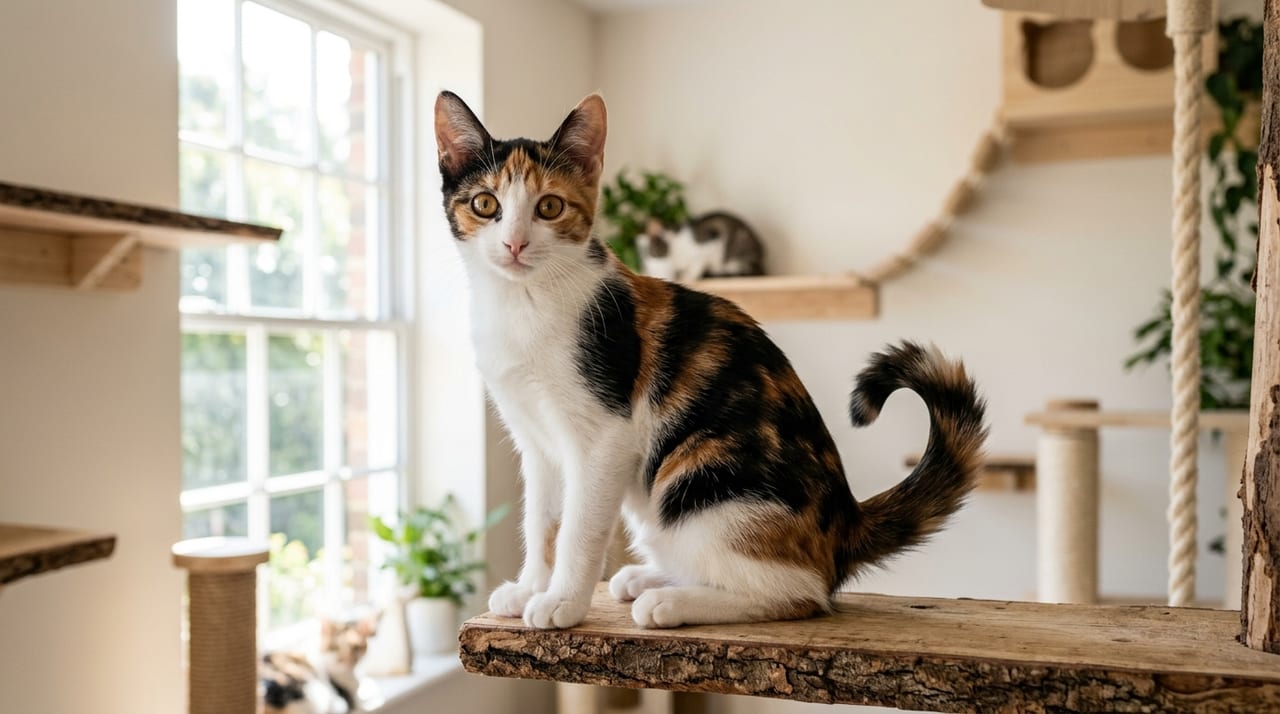
Cats use space in three dimensions. Install cat towers, shelves, wall shelves, and other heights to secure one "premium spot" per cat. High places provide security and become a refuge where stressed cats can escape. In particular, by creating an environment where a new cat can escape to high places, you can prevent panic encounters from being cornered.
Thorough Meal Management
The "food stealing problem," where a fast-eating cat eats another cat's share, is a standard multi-cat household trouble. As countermeasures, combine options like placing feeding locations physically apart, installing them out of sight, or having them eat in separate rooms in some cases. When choosing an automatic feeder, select one that allows individual management with a timer for convenience.
Regular Individual Care
In multi-cat households, there's a tendency to be in the state of "watching the whole but not the individual." Once a week, palpate each cat individually and check their weight, coat condition, eye discharge, and gum color. Multi-cat households also have a high risk of disease transmission, so managing vaccinations for viral rhinotracheitis, calicivirus, and panleukopenia across all cats is a prerequisite.
Finding Multi-Cat Compatible Cats on BreederDirect
The success of multi-cat households is greatly influenced by "individual personality compatibility." On BreederDirect, you can directly consult with breeders and say, "I'm thinking about multi-cat living with a resident cat. I'm looking for a kitten with high sociability and a calm temperament."
Experienced breeders understand each cat's individual personality, including how they were raised with siblings, their relationships with other cats, and their wariness levels. Being able to know in advance "what kind of cat this is," which you cannot obtain at pet shops, is the greatest advantage of direct breeding sales. Before welcoming a new family member, please consult with a breeder.