Guide to enriching indoor cats lives: vertical spaces, hunting-instinct play, scratching post placement, window perches, and solo play toys.
Key Takeaways
Guide to enriching indoor cats lives: vertical spaces, hunting-instinct play, scratching post placement, window perches, and solo play toys.
Complete indoor living is the best way to keep cats safe, but without the stimulation of going outside, you need to enrich the indoor environment to meet your cat's physical and mental needs. Insufficient enrichment (environmental enrichment) can cause cats to develop problem behaviors such as excessive grooming, furniture destruction, overeating, and aggression.
Cats evolved as solitary hunters. Indoor cats still retain the following instinctual needs.
Hunting drive: Cats conduct 10-20 short hunts per day, catching and eating small prey. In pet cats, this drive must be satisfied through play.
Territory patrol: Cats regularly patrol their territory to check for safety. Ideally, an indoor cat should be able to freely move between multiple rooms.
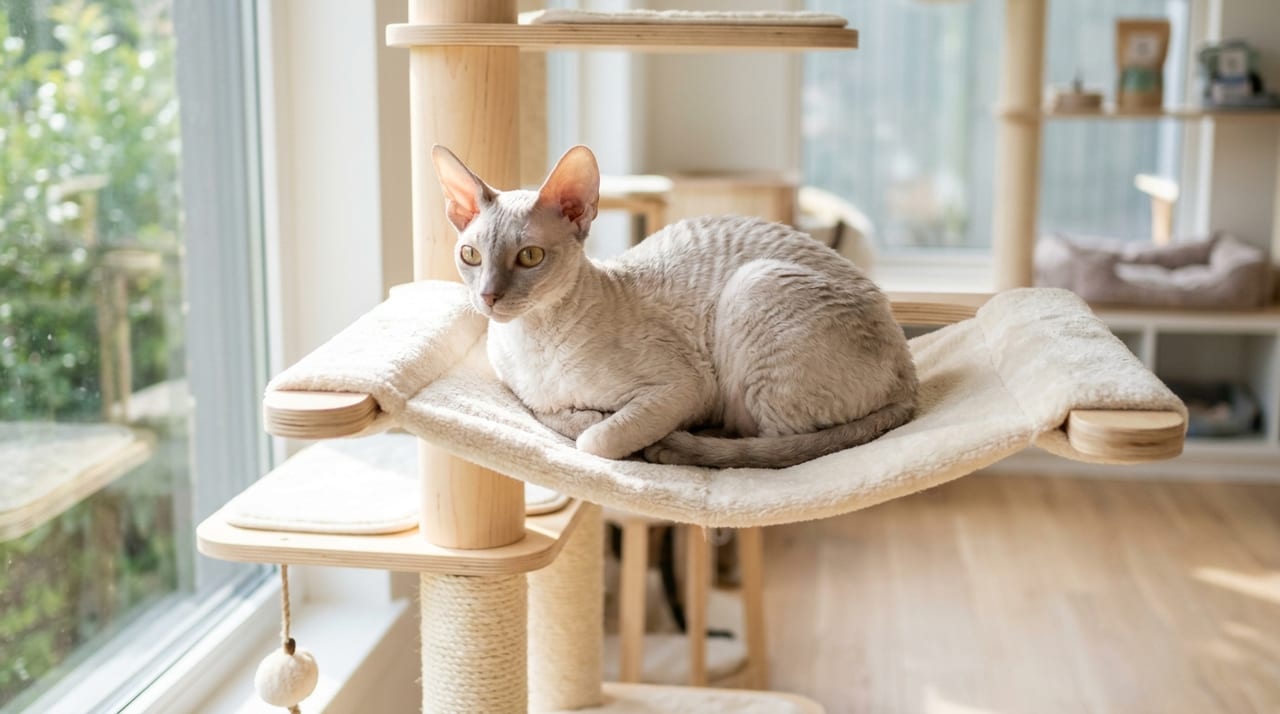
High-ground surveillance: Cats gain a sense of security by observing their surroundings from high places. High places serve as safe resting spots and positions of dominance.
Scratching: A natural behavior that serves both marking purposes (visual and olfactory) and nail maintenance. Without appropriate scratching posts, cats will use furniture instead.
Hiding: Cats feel safe hiding in enclosed, narrow spaces when stressed or resting.
For cats, vertical space is just as important as horizontal floor area.
Cat trees: Install at least one cat tree that's 150cm or taller. Ceiling-tension types are highly stable and safe even for large cats. Step spacing of around 30cm is ideal, as it's easier for senior cats to climb. A bed or hammock on the top tier allows cats to lounge for extended periods.
Cat walks: Installing shelves on walls to create cat walks turns the upper part of the room into a cat pathway. Designing routes that go through window areas or over bookshelves allows cats to enjoy patrolling while moving around. Applying carpet or cork to shelf surfaces provides traction.
Cat steps: Wall-mounted stair-step arrangements are another option. Combined with cat walks, this creates three-dimensional traffic patterns that maximize limited indoor space.
Using furniture: Simply placing cushions or blankets on top of bookshelves or dressers creates additional spots for your cat. Arrange furniture strategically to create routes from the floor up to tables, shelves, and curtain rods.
Playing with your cat is the most important enrichment activity.
Wand toys: These are the most effective toys for stimulating your cat's hunting instincts. Move feathered or mouse-shaped tips like real prey—drag them along the ground, give quick glimpses from hiding spots, or make them suddenly jump and flail to create the impression of "fleeing prey."
Play cycles: Each play session should last 10-15 minutes, following this cycle: First, let the cat discover the prey (discovery), chase it (pursuit), pounce on it (capture), and finally let the cat catch it for satisfaction (success). Always end play by letting your cat catch the prey, then give treats or food afterward—this completes the natural "hunt-to-meal" cycle.
Solo play toys: Provide solo toys so your cat isn't bored when you're away. Ball tracks (toys with balls rolling on rails), kick toys (stuffed toys for kicking), and spring-loaded toys are popular examples. Rotate toys regularly to prevent boredom.
Food puzzles: Interactive toys that require your cat to work to extract food. Options range from homemade puzzles (like drilling holes in a plastic bottle and filling it with food) to multi-level commercial puzzle feeders. Giving part of meals through food puzzles turns mealtime into an intellectually stimulating activity resembling hunting.
Scratching posts are essential items, but placement matters.
Material variety: Offering scratching posts in different materials—cardboard, sisal rope, carpet, and wood—helps your cat find ones that match their preference. Most cats prefer cardboard and sisal rope.
Shape options: Provide both vertical (pole) and horizontal (floor) scratchers. Cats perform both upright scratching while stretching and forward-leaning horizontal scratching.
Placement locations: Position scratchers where cats frequently pass, near bedding areas, and close to furniture like sofas. Doorways and room entrances are especially important, as these are frequent territory-marking points where cats use scratchers.
Window sills are the ultimate entertainment spot for indoor cats.
Cat window perches: Installing a cat shelf (perch) on the window allows your cat to sunbathe while enjoying the outdoor view. For suction-cup models, pay attention to weight limits and choose products with sufficient safety margin for your cat's weight.
Bird feeder installation: Setting up a bird feeder outside the window provides "cat TV"—your cat can spend hours observing bird movements. It's the ultimate visual stimulation.
Safe window opening: Installing cat escape-proof nets or window screens allows you to open windows and provide your cat with fresh air, sounds, and scents. The scents carried on the breeze stimulate your cat's sense of smell and provide valuable experience of the outside world while staying indoors.
When keeping multiple cats, ensuring sufficient resources is key to preventing stress.
Provide litter boxes, food bowls, water bowls, scratching posts, and resting areas following the guideline of "number of cats plus one." For three cats, four litter boxes are ideal. Secure multiple high-resting spots to prevent dominant cats from monopolizing them.
Depending on the relationships between cats, separate spaces where each cat can relax undisturbed may also be necessary. Creating traffic patterns that allow incompatible cats to avoid meeting reduces household stress.
Cats that fully enjoy enrichment are individuals raised with appropriate stimulation from early on with well-developed socialization. At Br-Choku, you can adopt well-socialized cats directly from breeders who have exposed them to various toys and environments. You can also ask breeders about the cat's personality and preferences, which helps you create an optimal enrichment plan.
Find Cats listings related to this article on BreederDirect. Buy directly from verified breeders.
Feeding Guide
Check feeding frequency, portion sizes & supplements by species and growth stage
Seasonal Care Calendar
Monthly care events and seasonal management tips at a glance
Symptom Checker
Select symptoms to diagnose possible diseases and remedies
Care Cost Simulator
Estimate initial, monthly & annual costs by category, care level and quantity