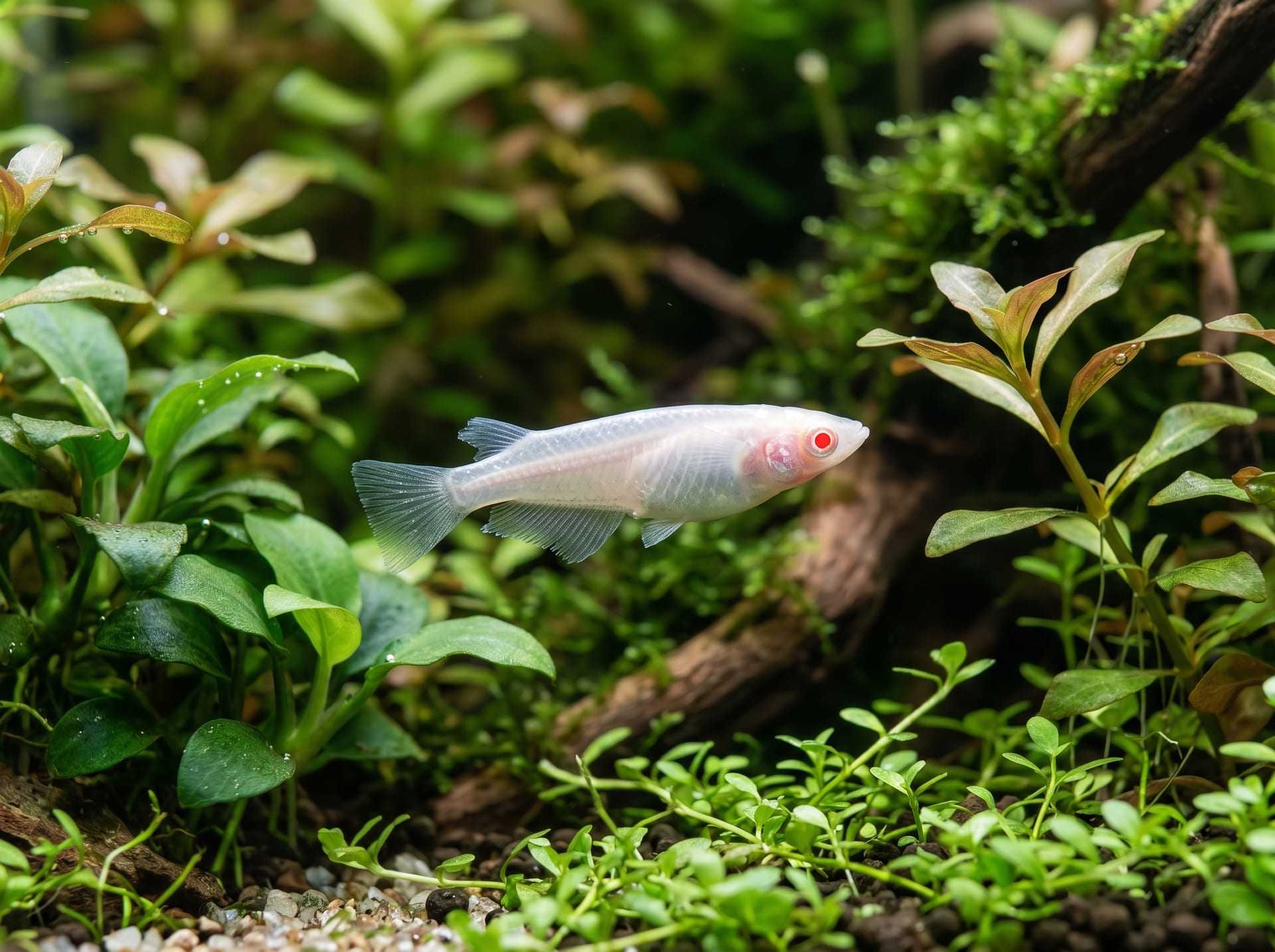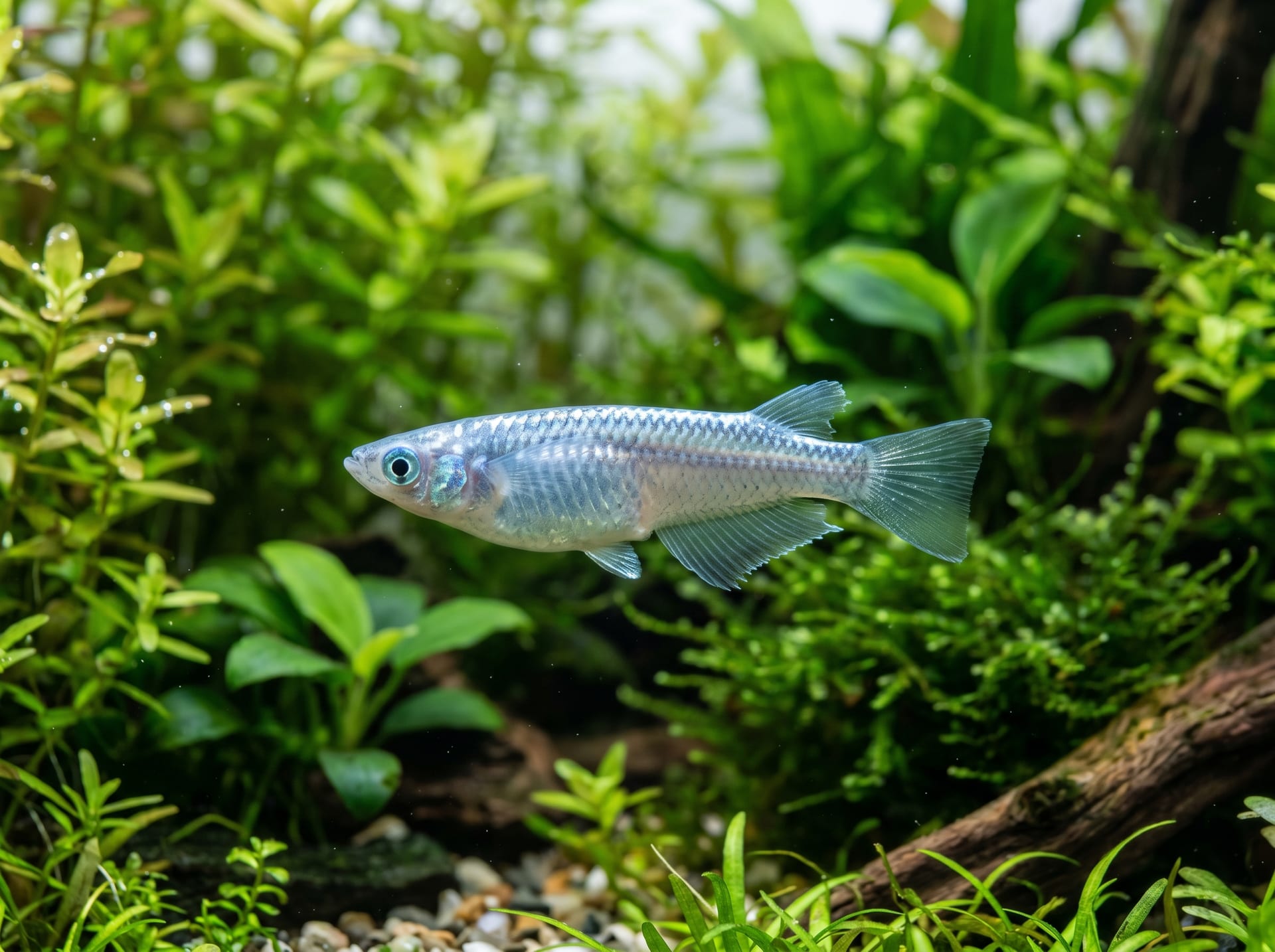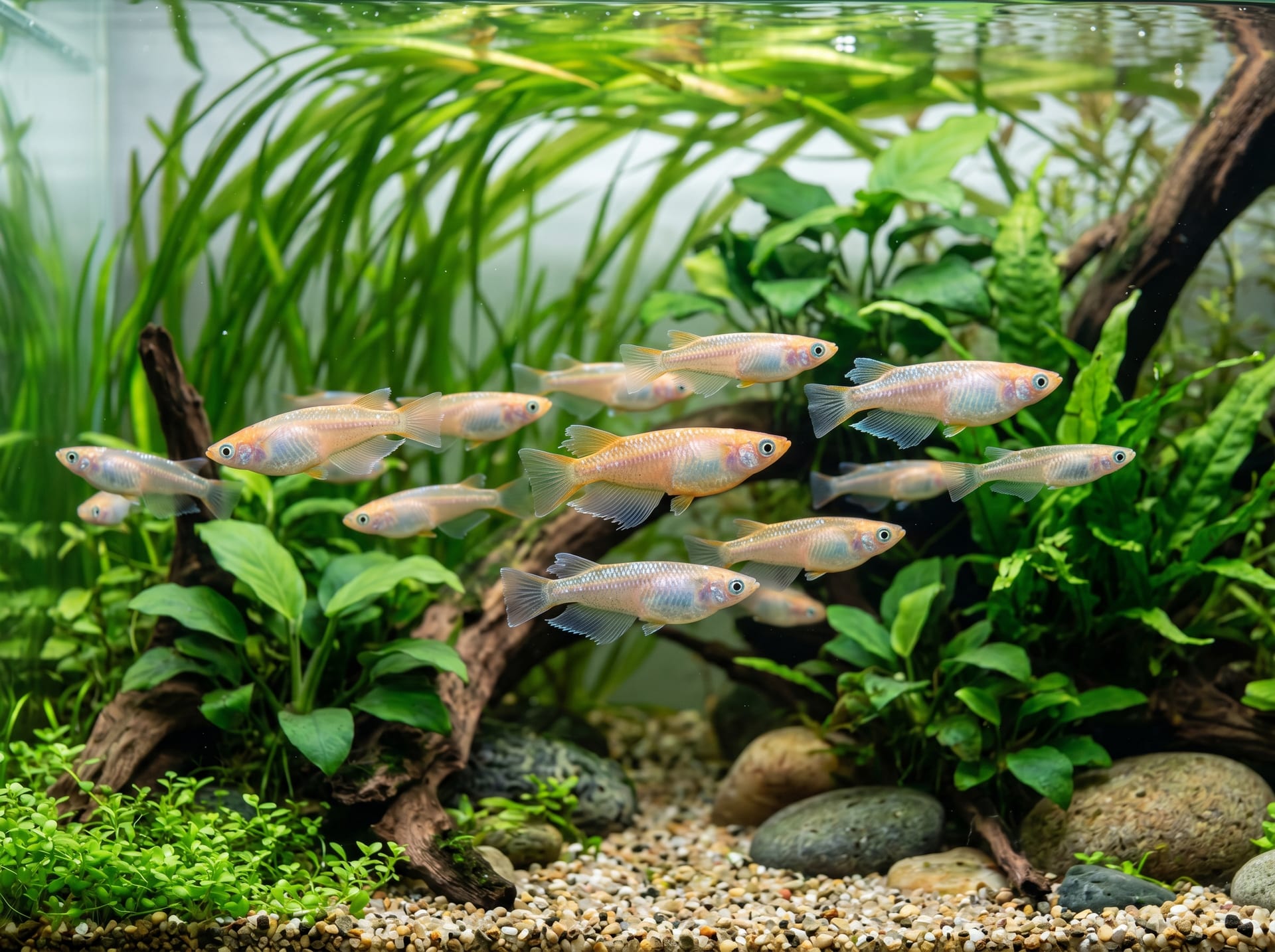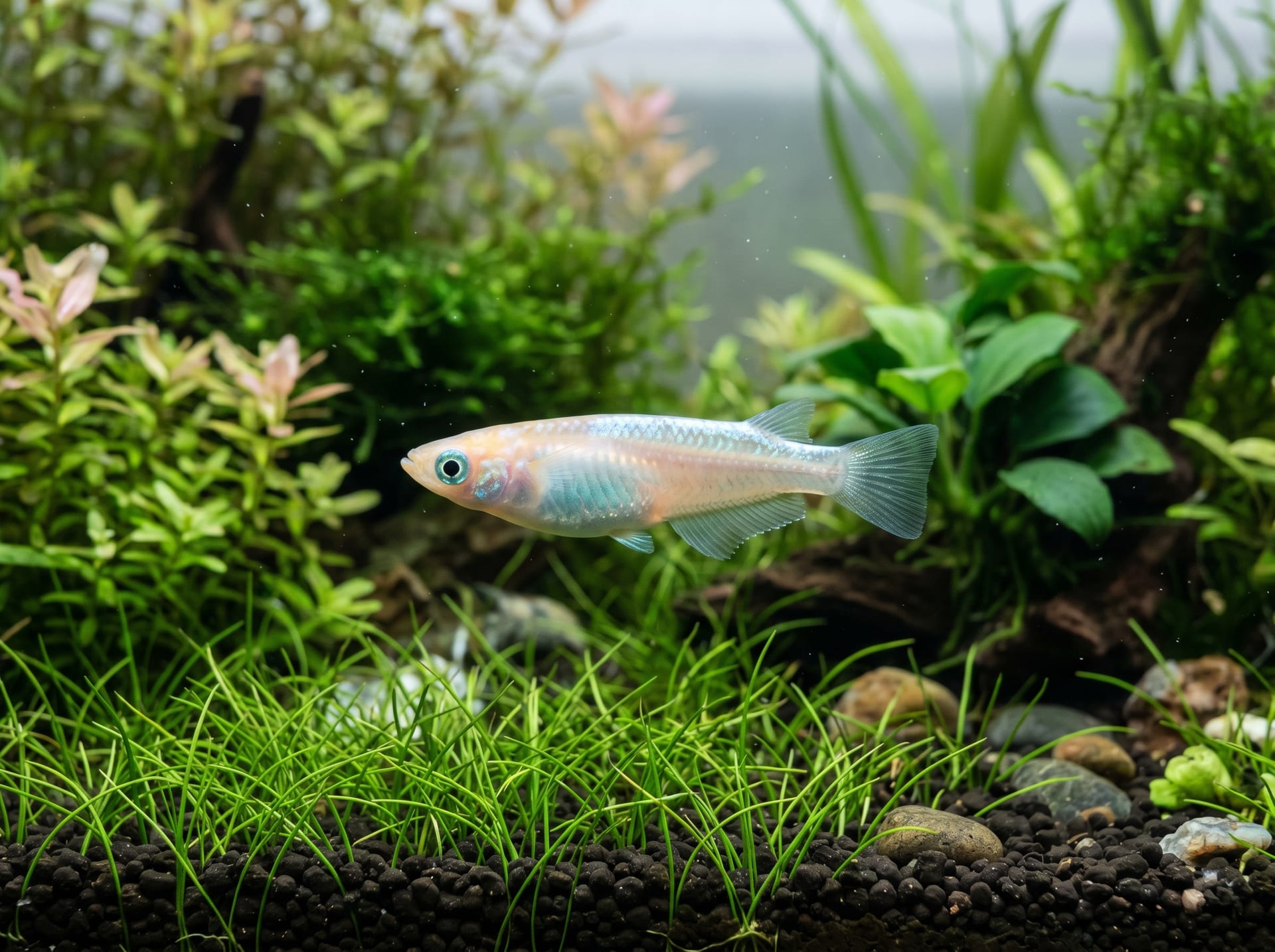
AI-generated image
Orochi Medaka
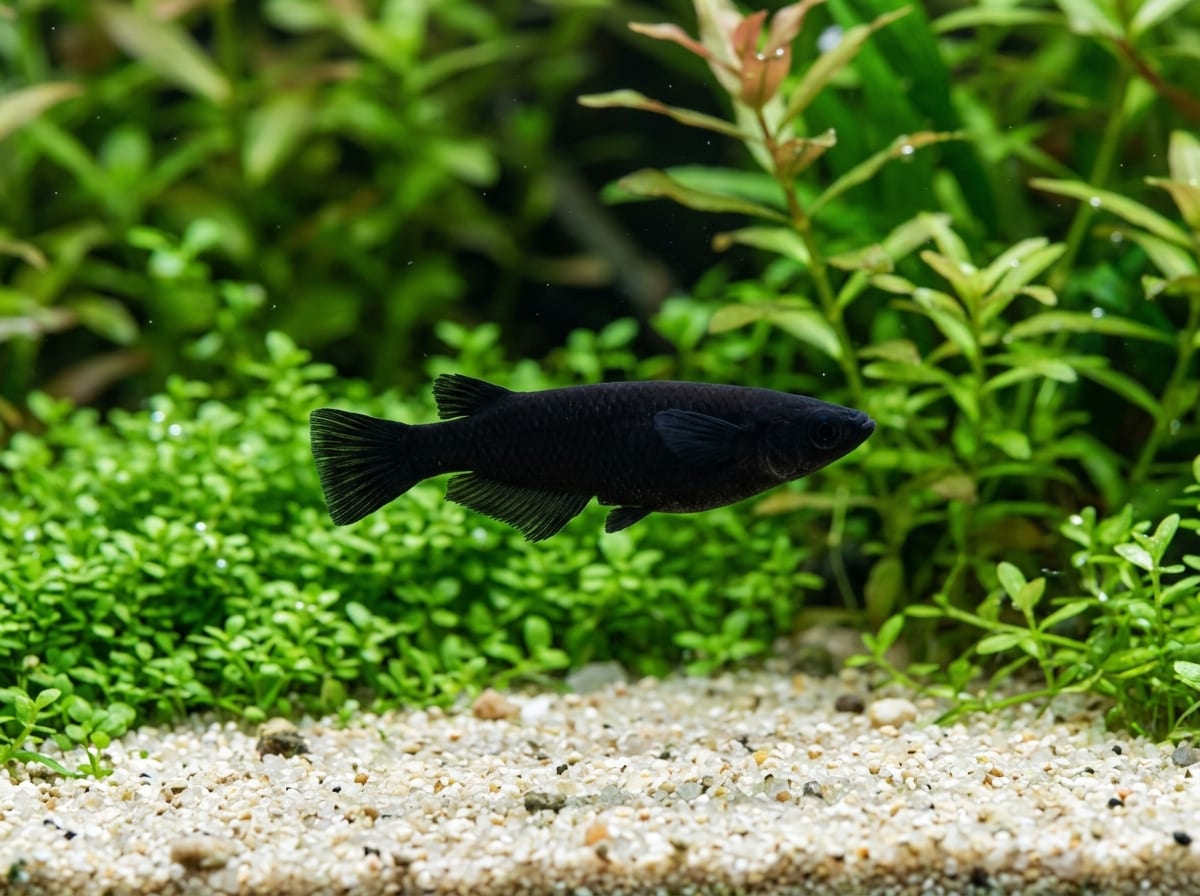
BeginnerJet-black medaka with no color fading from background adaptation. A fixed variety where depth of black determines value.
Difficulty
Beginner
Temperature
5〜30℃(適温20〜28℃)
Lifespan
2-3 years
Size
3-4cm
Diet
Medaka pellets
About
Orochi medaka is an improved variety with jet-black coloration covering the entire body — not just the scales but also the peritoneum, internal organs, and fins, all richly pigmented with melanophores. Unlike most medaka that pale in bright containers through adaptive coloration, Orochi maintains its black even in white containers, effectively having no background adaptation response. Named for its overwhelming black presence reminiscent of Yamata no Orochi (the eight-headed serpent of Japanese mythology). Widely used as a breeding parent for black-body varieties, forming the foundation for Black Diamond and Orochi lame strains.
Lifespan of the Orochi Medaka
The Orochi Medaka lives 2-3 years.
Size of the Orochi Medaka
The Orochi Medaka grows to 3-4cm.
Temperature & humidity for the Orochi Medaka
The ideal water temperature for the Orochi Medaka is 18〜24℃.
Hardy in 5–30°C.
Basic Info
Origin
Japan (selectively bred variety)
Lifespan
2-3 years
Size
3-4cm
Temperature
5〜30℃(適温20〜28℃)
Care Specifications
- pH
- 7–8
- Hardness (GH)
- 9–19 dGH
- Water Temp.
- 18–24℃
PeacefulGroupBreeding: Easy
Sources: FishBase: Oryzias latipes / Seriously Fish: Oryzias latipes
Captive Breeding
Egg-laying
- Clutch size
- 8〜48
- Incubation temp.
- 28℃
- Incubation days
- 7〜14 days
- Sexual maturity
- 2 mo
Breeding season: Mid-April to late September (wild, Japan); year-round indoors with >13 h photoperiod and water temperature of 20–28 °C
Breeding notes
Females spawn once each morning, briefly carrying the adhesive egg cluster near the vent (8–48 eggs per female per day). Photoperiods below 13 h/day markedly suppress spawning; water temperatures below approximately 15 °C also inhibit reproduction. Incubation takes roughly 7–14 days depending on water temperature; approximately 7 days near the optimum (~28 °C). Orochi Medaka is a fully-black ornamental colour line of Oryzias latipes; its reproductive biology is identical to the wild type.
Breeding requires planning, proper husbandry, and responsibility. These figures are general guidelines.
Sources: Leaf et al. (2011) Life-History Characteristics of Japanese Medaka Oryzias latipes — Copeia 2011(4):559-565 / Wangsongsak et al. (2013) Effects of Rearing Density, Salt Concentration, and Incubation Temperature on Japanese Medaka Embryo Development — PMC3698680
Morphs (Varieties)
Selectively bred killifish are trait combinations of body form × body color × pattern × luminescence (internal/external) × scale types (transparent scales) × sparkle × fin morphology and so forth. Published entries include only confirmed traits constituting the given variety, with genetic inheritance patterns provided only for confirmed traits (uncertain cases omitted). Genetic patterns are provided as reference for breeding.
Other
Black body (orochi)
Sources: JMA Japan Medaka Association — Improved Medaka Variety Classification Manual (JA) / Improved Medaka Web Encyclopedia (medakazukan, JA)
A curated selection of notable morphs. Inheritance modes are a breeding-planning guide; actual appearance varies with combos.
References & Sources
Edited & verified by: BreederDirect editorial team
The taxonomic, regulatory, and husbandry data on this page are compiled and verified against the authoritative primary sources below.
Primary sources
- FishBase: Oryzias latipes
- Seriously Fish: Oryzias latipes
- JMA Japan Medaka Association — Improved Medaka Variety Classification Manual (JA)
- Improved Medaka Web Encyclopedia (medakazukan, JA)
- Leaf et al. (2011) Life-History Characteristics of Japanese Medaka Oryzias latipes — Copeia 2011(4):559-565
- Wangsongsak et al. (2013) Effects of Rearing Density, Salt Concentration, and Incubation Temperature on Japanese Medaka Embryo Development — PMC3698680
- Koger et al. (1999) Variations of light and temperature regimes and resulting effects on reproductive parameters in medaka (Oryzias latipes) — PubMed 10529276
- Saito et al. (2025) Medaka initiate courtship and spawning late at night: Insights from field observations — PMC11819472
Taxonomy & Authority
Accepted name: (Temminck & Schlegel, 1846)
Synonyms: Aplocheilus latipes (Temminck & Schlegel, 1846), Poecilia latipes Temminck & Schlegel, 1846, Oryzias latipes latipes (Temminck & Schlegel, 1846)
Authority databases: FishBase · GBIF · Japan Medaka Association — Variety Classification Manual (JA)
Nomenclature follows global taxonomic authority databases.
Orochi Medaka Listings
Loading latest listingsFind listings for this species