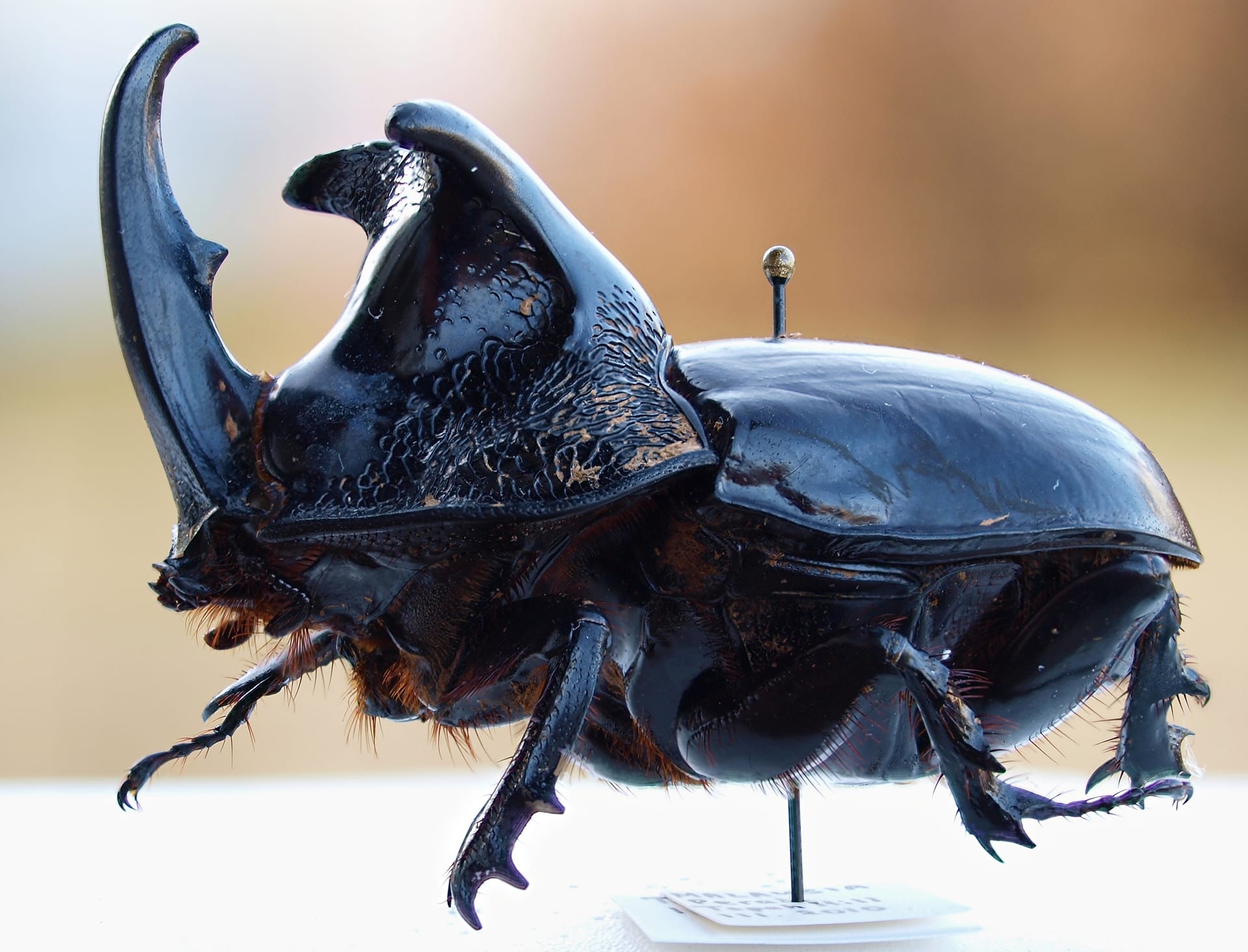
Source: Wikimedia Commons
Lunicollis rhinoceros beetle
IntermediateTrichogomphus lunicollis
A Trichogomphus rhinoceros beetle recorded from the Malay Peninsula and Borneo, in the same tribe as Oryctes. Described in 1847, it is little covered in Japanese-language sources.
Difficulty
Intermediate
Temperature
20〜28℃
Lifespan
Little data
Size
Little data
Humidity
60〜80%
Diet
Adults take beetle jelly; larvae eat fermented substrate
About
Trichogomphus lunicollis Burmeister, 1847 is a rhinoceros beetle of the genus Trichogomphus in the tribe Oryctini (Scarabaeidae: Dynastinae). The genus is Asian, with about sixteen species listed by BioLib. GBIF records are confined to Malaysia and Indonesia, from Sabah, Sarawak and Kalimantan on Borneo and from Pahang, Kelantan, Perak and Selangor on the Malay Peninsula. It shares a tribe with Oryctes, but little has been published on this species' size, diet or life history, so care follows general practice for exotic rhinoceros beetles. In Japan specialist shops sometimes offer it among the masked rhinoceros beetles, though not often. With no other member of the genus in this encyclopedia, checking the scientific name is the safest way to buy.
Source: Wikipedia (CC BY-SA 4.0)
Basic Info
Origin
Malay Peninsula and Borneo (Malaysia and Indonesia)
Lifespan
Little data
Size
Little data
Temperature
20〜28℃
Humidity
60〜80%
Diet
Adults take beetle jelly; larvae eat fermented substrate
Care Guide
Temperature & Humidity
There is little numeric temperature data. As a tropical Asian species, keep it out of winter cold and keep the substrate from drying out.
Breeding & Egg-laying
Little is published on breeding. Provide deep fermented substrate for laying and rear larvae in the same.
Cohabitation
Keep adults singly and together only for mating.
Lifespan & Rearing Period
Larval duration and adult lifespan are poorly documented.
Health & Notes
Importing foreign stag and rhinoceros beetles is regulated by the Plant Protection Act and the Invasive Alien Species Act (species-name certificate), with each species needing clearance from the Plant Protection Station, so domestically bred stock is the safe choice. Never release captive beetles.
TrichogomphusBorneoMalay PeninsulaExotic beetle
Lunicollis rhinoceros beetle FAQ
QHow difficult is it to keep Lunicollis rhinoceros beetle?
A
Intermediate. This is an intermediate-level species. Some prior experience and knowledge of environmental management are recommended.
QWhat should I feed Lunicollis rhinoceros beetle?
A
Lunicollis rhinoceros beetle feeds on: Adults take beetle jelly; larvae eat fermented substrate. Aim for a balanced diet with appropriate feeding frequency.
QWhat is the typical price for Lunicollis rhinoceros beetle?
A
The price of Lunicollis rhinoceros beetle varies significantly depending on bloodline, size, captive-bred generation, and sex. Check our market price page for the latest pricing information.
Last updated: September 23, 2026
References & Sources
Edited & verified by: BreederDirect editorial team
The taxonomic, regulatory, and husbandry data on this page are compiled and verified against the authoritative primary sources below.
Primary sources
- Wikipedia
- Plant Protection Station: Importing Scarabaeoidea (JA)
- Plant Protection Station: Importing live insects (JA)
- Ministry of the Environment: List of invasive alien species (JA)
- Species+ CITES query (no listing)
- GBIF: Trichogomphus lunicollis Burmeister, 1847 /地域別の記録
- Wikispecies - Trichogomphus lunicollis (classification)
Taxonomy & Authority
Regulations & Conservation Status
Not CITES-listed
Many live foreign Scarabaeoidea (stag beetles, rhinoceros beetles, flower chafers and relatives) are quarantine pests whose import is banned under Japan's Plant Protection Act, and even importable species require a species-name certificate from a foreign government body under the Invasive Alien Species Act (entry only via designated airports, never by international post). Whether a species may enter must be checked with the Plant Protection Station in advance, so choose domestically bred stock and never release captive beetles.
Sources: Plant Protection Station: Importing Scarabaeoidea (JA) / Plant Protection Station: Importing live insects (JA) / Ministry of the Environment: List of invasive alien species (JA) / Species+ CITES query (no listing)
Regulations may change. Always verify the latest information with the relevant authorities.
Related Species
Lunicollis rhinoceros beetle Listings
Loading latest listingsFind listings for this species
Related Articles
DIY Fermented Substrate Guide | How to Make Your Own Substrate for Rhinoceros Beetle and Stag Beetle Larvae
Learn how to make your own fermented substrate for breeding rhinoceros beetle and stag beetle larvae. We explain material selection, fermentation procedures, and breeder tips to avoid common mistakes in easy-to-understand language.
Electricity Costs and Energy-Saving Tips for Insect Breeding | Energy-Efficient Temperature Management and Annual Cost Guide
Explains electricity costs for temperature management of stag beetles and rhinoceros beetles, and provides concrete methods to save electricity costs through smart use of wine chillers, temperature-controlled cabinets, and air conditioning.
The Difference Between Wild-Caught (WF) and Captive-Bred (CB) Beetles | Essential Knowledge Before Purchasing Stag Beetles and Rhinoceros Beetles
Explaining the difference between "Wild-Caught (WF)" and "Captive-Bred (CB)" stag beetles and rhinoceros beetles. We break down how to choose when purchasing and important considerations from a breeder's perspective.