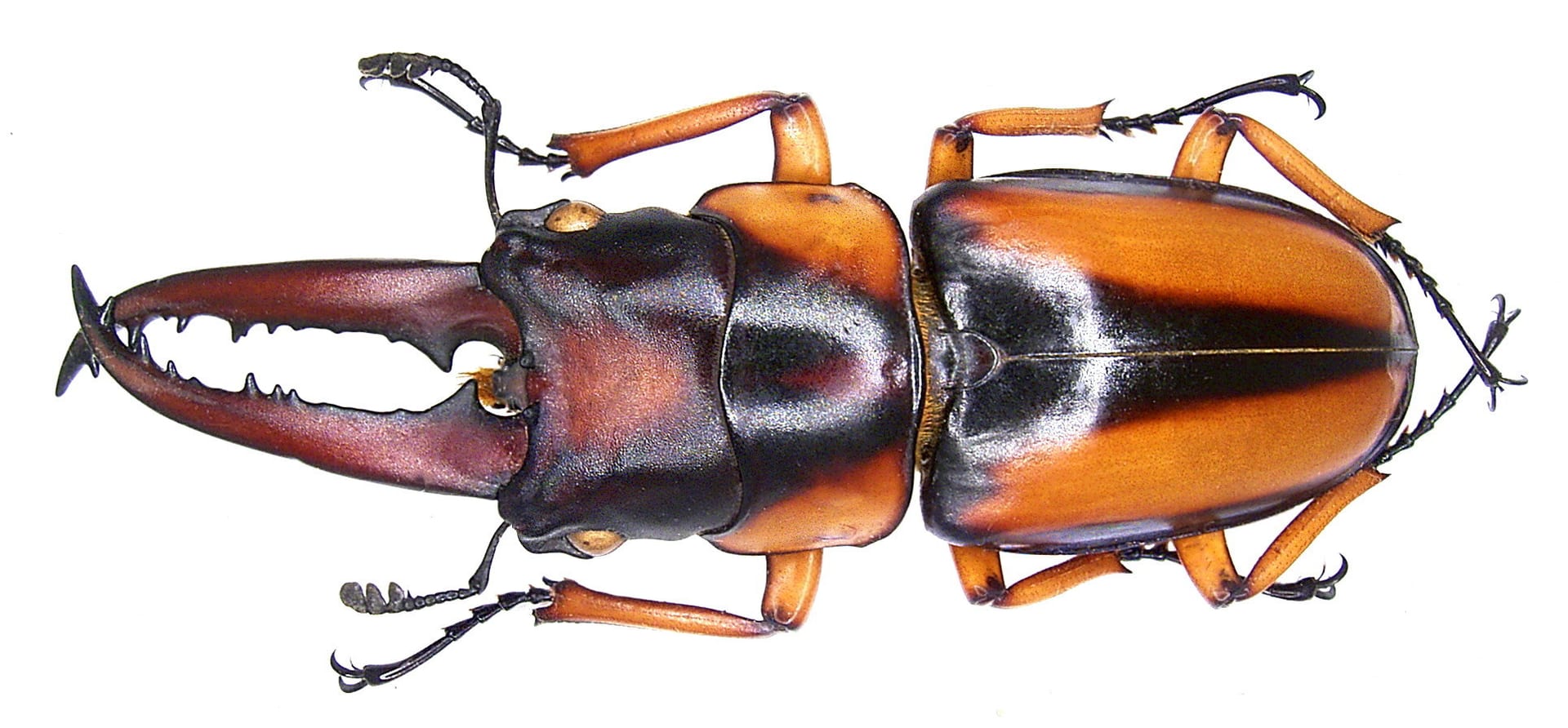
Source: Wikimedia Commons
Savage's Saw Stag Beetle
IntermediateProsopocoilus savagei
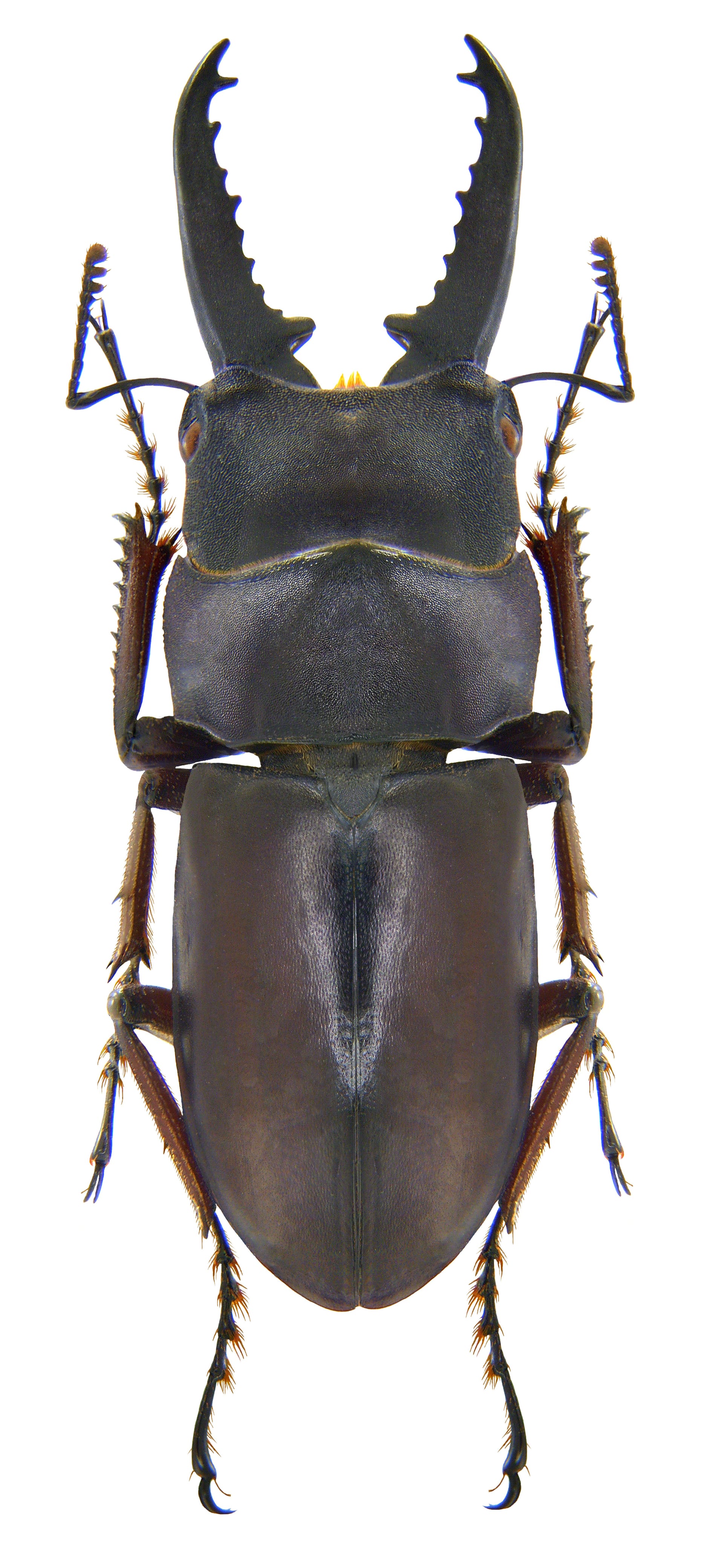
A reddish-brown African saw stag beetle. Males run 24-65mm and large individuals carry long, curved mandibles. It is seldom traded in Japan and husbandry information is limited.
Difficulty
Intermediate
Temperature
20〜24℃
Lifespan
About 8-10 months as adults, the general rule for foreign saw stag beetles
Size
Males 24-65mm (captive record 65.4mm), females 21-31mm
Humidity
60〜80%
Diet
Beetle jelly; larvae on fermented substrate or fungus bottles
About
Prosopocoilus savagei is an African saw stag beetle; males measure 24-65mm and females 21-31mm. Accounts of its range differ: some sources give Central and East Africa, while the specimen records aggregated in GBIF cluster in Ghana and Guinea, and one specimen is labelled as collected in the Kakamega forest of Kenya. The GBIF Backbone does not accept it as a full species, placing it instead as Prosopocoilus downesii savagei. The BE-KUWA 2025 edition gives a captive record of 65.4mm (Takayama Masaki, registered 2022) and a wild record of 65.0mm, with a predicted maximum of 70mm. It is not widely traded in Japan and little is known of its life in the wild. Care follows the standard routine for foreign saw stags at around 20-24C.
Source: Wikipedia (CC BY-SA 4.0)
Lifespan of the Savage's Saw Stag Beetle
The Savage's Saw Stag Beetle lives About 8-10 months as adults, the general rule for foreign saw stag beetles.
Size of the Savage's Saw Stag Beetle
The Savage's Saw Stag Beetle grows to Males 24-65mm (captive record 65.4mm), females 21-31mm.
Temperature & humidity for the Savage's Saw Stag Beetle
The ideal temperature for the Savage's Saw Stag Beetle is 20〜24℃.
Basic Info
Origin
Tropical Africa, with records from West Africa such as Ghana and Guinea through to East Africa including Kenya
Lifespan
About 8-10 months as adults, the general rule for foreign saw stag beetles
Size
Males 24-65mm (captive record 65.4mm), females 21-31mm
Temperature
20〜24℃
Humidity
60〜80%
Diet
Beetle jelly; larvae on fermented substrate or fungus bottles
Care Guide
Temperature & Humidity
Follow the standard routine for foreign saw stags and hold adults and larvae near 20-24C. Do not let winter temperatures fall below 18C or summer temperatures exceed 30C.
Breeding & Egg-laying
Set a log buried in fermented substrate at around 23-25C. Few Japanese breeders have run multiple generations, so start with the standard set and observe.
Cohabitation
House both sexes singly. The male's mandibles can crush a female during pairing, so keep them together only briefly and under supervision.
Lifespan & Rearing Period
As a general rule for foreign saw stags adults live about 8-10 months.
Health & Notes
Sources place it in West Africa or in Central and East Africa, so keep the locality exactly as supplied. Note also that GBIF treats it as a subspecies of P. downesii.
AfricanForeign stag beetleRarely tradedProsopocoilus
Savage's Saw Stag Beetle FAQ
QHow difficult is it to keep Savage's Saw Stag Beetle?
A
Intermediate. This is an intermediate-level species. Some prior experience and knowledge of environmental management are recommended.
QWhat is the ideal temperature for Savage's Saw Stag Beetle?
A
The ideal temperature for Savage's Saw Stag Beetle is 20〜24℃. Avoid sudden temperature changes and maintain a stable environment.
QWhat is the lifespan of Savage's Saw Stag Beetle?
A
The average lifespan of Savage's Saw Stag Beetle is About 8-10 months as adults, the general rule for foreign saw stag beetles. With proper care and nutrition, they can live a long and healthy life.
QHow large does Savage's Saw Stag Beetle get?
A
Savage's Saw Stag Beetle typically reaches Males 24-65mm (captive record 65.4mm), females 21-31mm as an adult. Size may vary depending on care conditions and individual genetics.
QWhat should I feed Savage's Saw Stag Beetle?
A
Savage's Saw Stag Beetle feeds on: Beetle jelly; larvae on fermented substrate or fungus bottles. Aim for a balanced diet with appropriate feeding frequency.
QWhat is the typical price for Savage's Saw Stag Beetle?
A
The price of Savage's Saw Stag Beetle varies significantly depending on bloodline, size, captive-bred generation, and sex. Check our market price page for the latest pricing information.
Last updated: September 16, 2026
Care Specifications
AggressiveSolitaryBreeding: Moderate
Sources: Wikipedia (en) / Tsukiyono Kinokoen: Prosopocoilus giraffa rearing manual (general care for foreign saw stags) / BE-KUWA rearing records (2025 edition, Mushi-sha) / GBIF Backbone Taxonomy
Breeding Records & Localities
Captive record (♂)
65.4 mm
Wild record (♂)
65 mm
Record source: BE-KUWA 2025 edition (Savage's saw stag: captive 65.4 mm, Takayama Masaki, registered 2022; wild 65.0 mm; predicted maximum 70 mm)
Notable localities
GhanaGuineaKenya
Generation codes
- WD
- Wild-caught
- WF1
- Offspring of a wild-caught female
- F1〜
- Captive generations (same locality)
- CBF1
- Cross-locality captive-bred (reset)
Sources: BE-KUWA rearing records (2025 edition, Mushi-sha) / Wikipedia (en) / GBIF Backbone Taxonomy
References & Sources
Edited & verified by: BreederDirect editorial team
The taxonomic, regulatory, and husbandry data on this page are compiled and verified against the authoritative primary sources below.
Primary sources
- Wikipedia
- Ministry of the Environment, Invasive Species Act: "Guidance for Those Importing Live Insects in Scarabaeoidea"
- CITES Appendix (checklist.cites.org)
- Tsukiyono Kinokoen: Prosopocoilus giraffa rearing manual (general care for foreign saw stags)
- BE-KUWA rearing records (2025 edition, Mushi-sha)
- GBIF Backbone Taxonomy
Taxonomy & Authority
Accepted name: Prosopocoilus savagei (Hope, 1842)
Synonyms: Prosopocoilus downesii savagei (GBIF Backbone の受容名), Metopodontus savagei, Lucanus savagei Hope, 1842
Authority databases: GBIF
Nomenclature follows global taxonomic authority databases.
Regulations & Conservation Status
Not CITES-listed
Plant Protection Act: When importing live specimens of Scarabaeoidea (including rhinoceros beetles, stag beetles, flower beetles, etc.), a species identification certificate issued by the exporting country government agency or equivalent must be attached in accordance with the Invasive Species Act (import ports are limited to Narita, Chubu, Kansai, Fukuoka, and Kagoshima airports). This species itself is not a designated invasive species, and import is possible upon submission of the certificate.
Sources: Ministry of the Environment, Invasive Species Act: "Guidance for Those Importing Live Insects in Scarabaeoidea" / CITES Appendix (checklist.cites.org)
Regulations may change. Always verify the latest information with the relevant authorities.
Related Species
Savage's Saw Stag Beetle Listings
Loading latest listingsFind listings for this species
Related Articles
How Many Years Do Stag Beetles Live? Average Lifespan by Species Ranking and Tips for Longevity
How many years do stag beetles live? Compare average lifespans of different species including Japanese rhinoceros beetle, Miyama stag beetle, Japanese saw stag beetle, and small stag beetle in list and ranking format. Explains tips for extending their lives through temperature management and nutritional supplementation.
Complete Guide to Stag Beetle Species | Domestic Species, Popular Imported Species: Characteristics and Breeding Difficulty
From domestic species such as the Japanese giant stag beetle, flat-horned stag beetle, and saw-toothed stag beetle, to popular imported species like the Giraf, Palawan, and Caucasus beetles—we provide a thorough explanation of characteristics, breeding difficulty, and how to obtain them.
Stag Beetle Overwintering Care and Spring Awakening
Overwintering management for stag beetles: ideal temperature, humidity, substrate depth, resuming feeding after hibernation, and post-winter recovery care.
Stag Beetle and Rhinoceros Beetle Stage Management | Complete Guide to Larvae, Pupae, and Post-Emergence Care
Detailed explanation of the different breeding environments, temperatures, humidity levels, and feeding methods required for each stage from stag beetle and rhinoceros beetle larvae through pupae to adult management after emergence. Also covers the timing of stage transitions and important precautions.