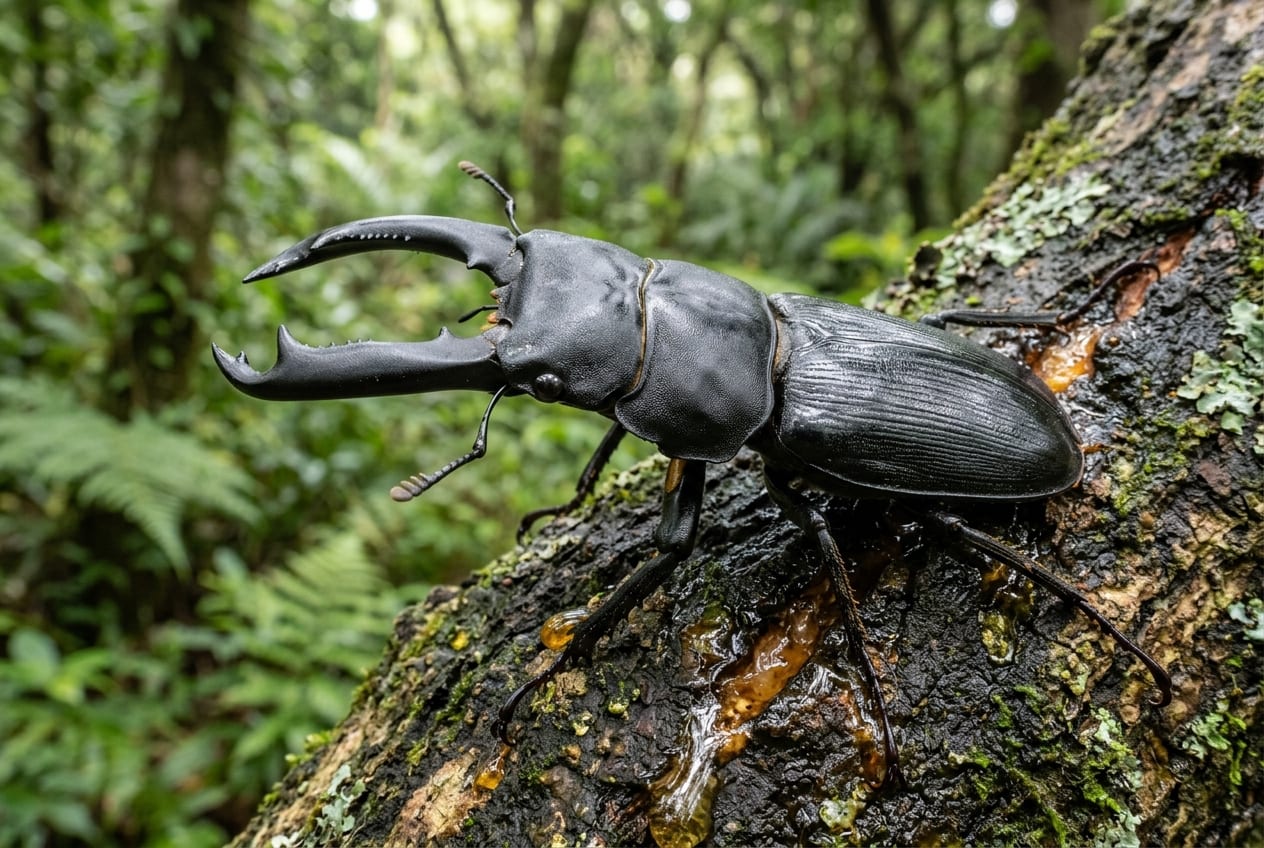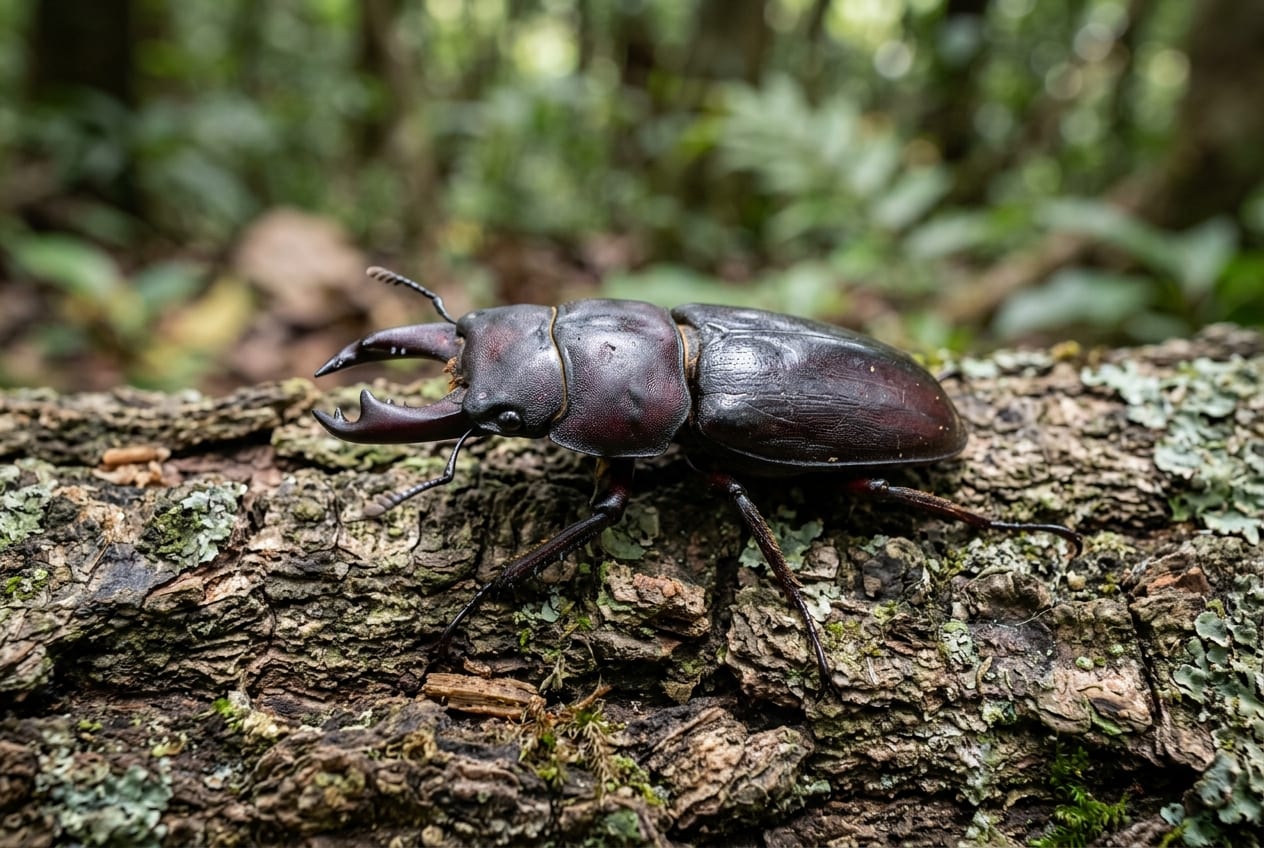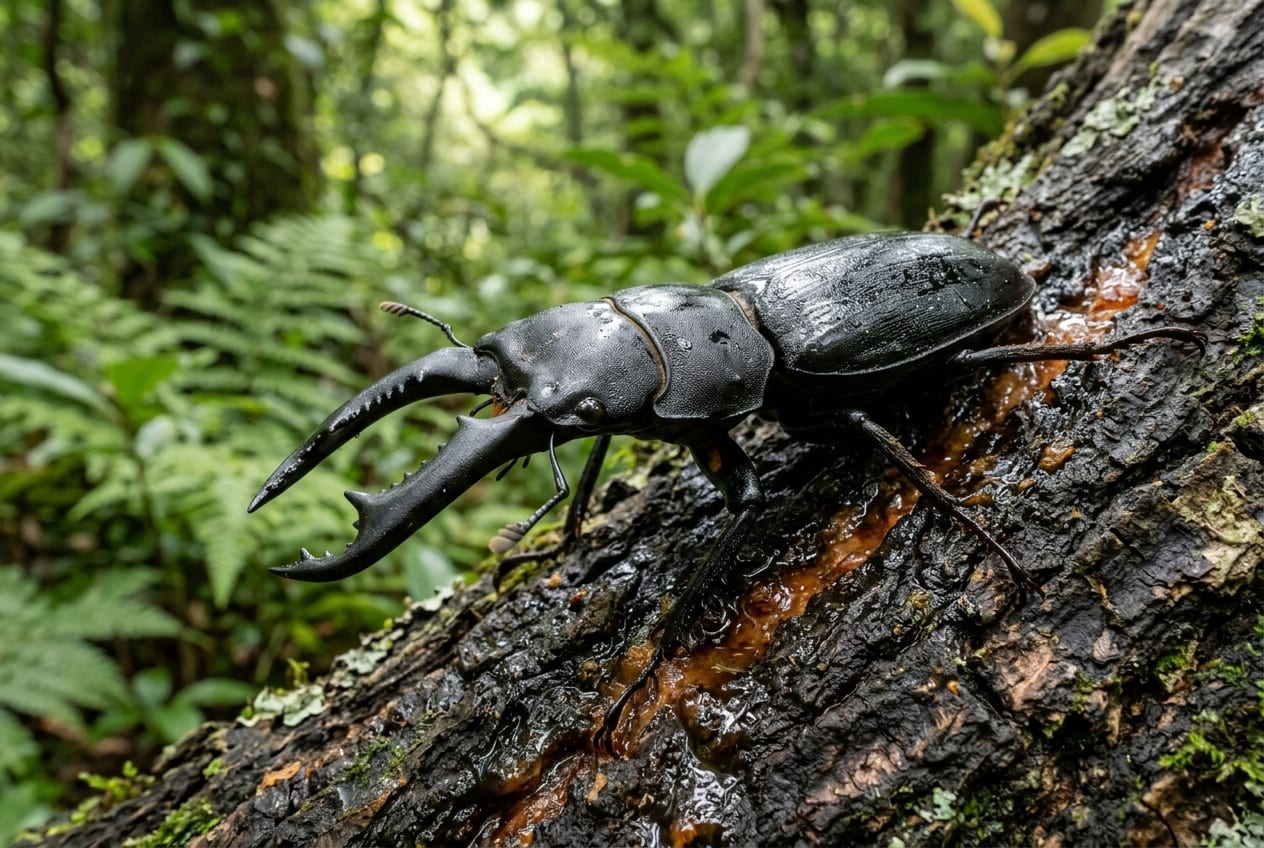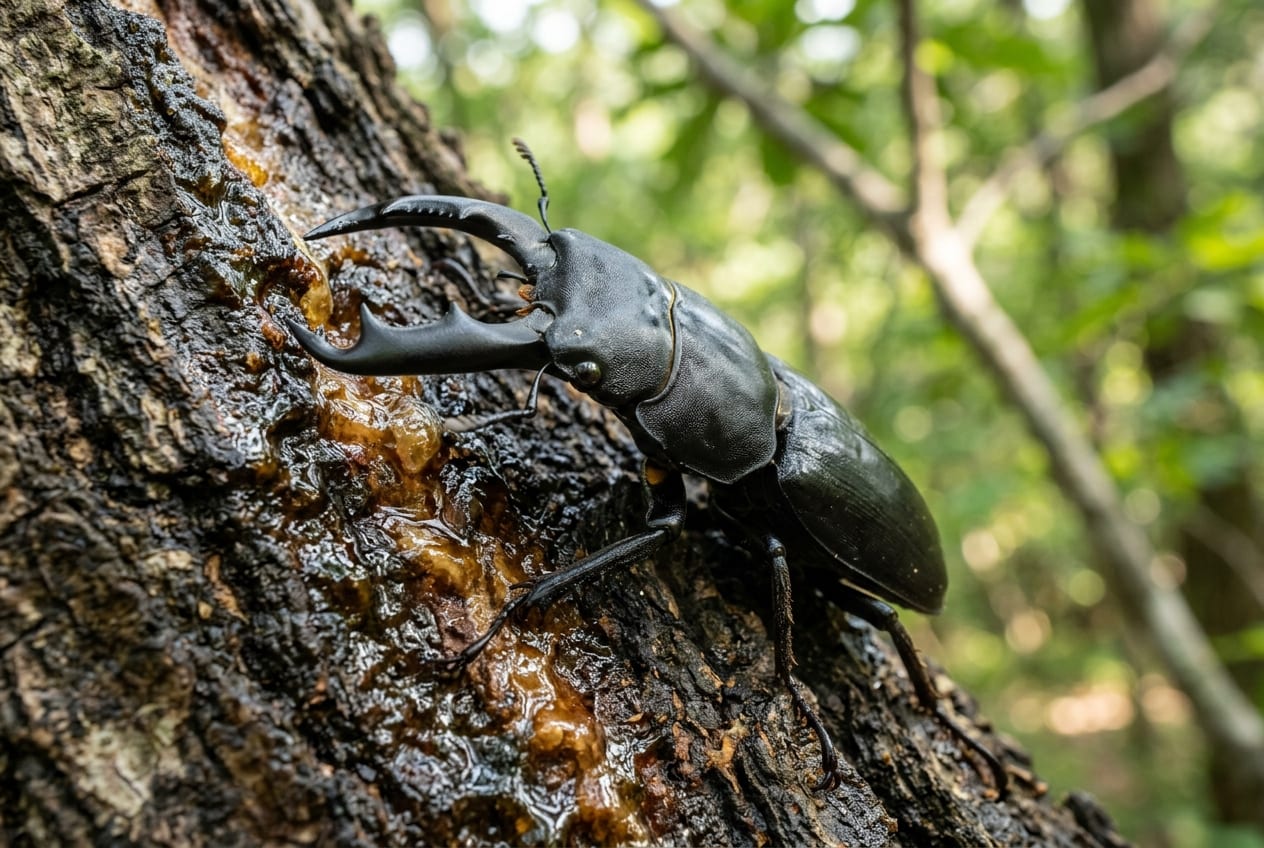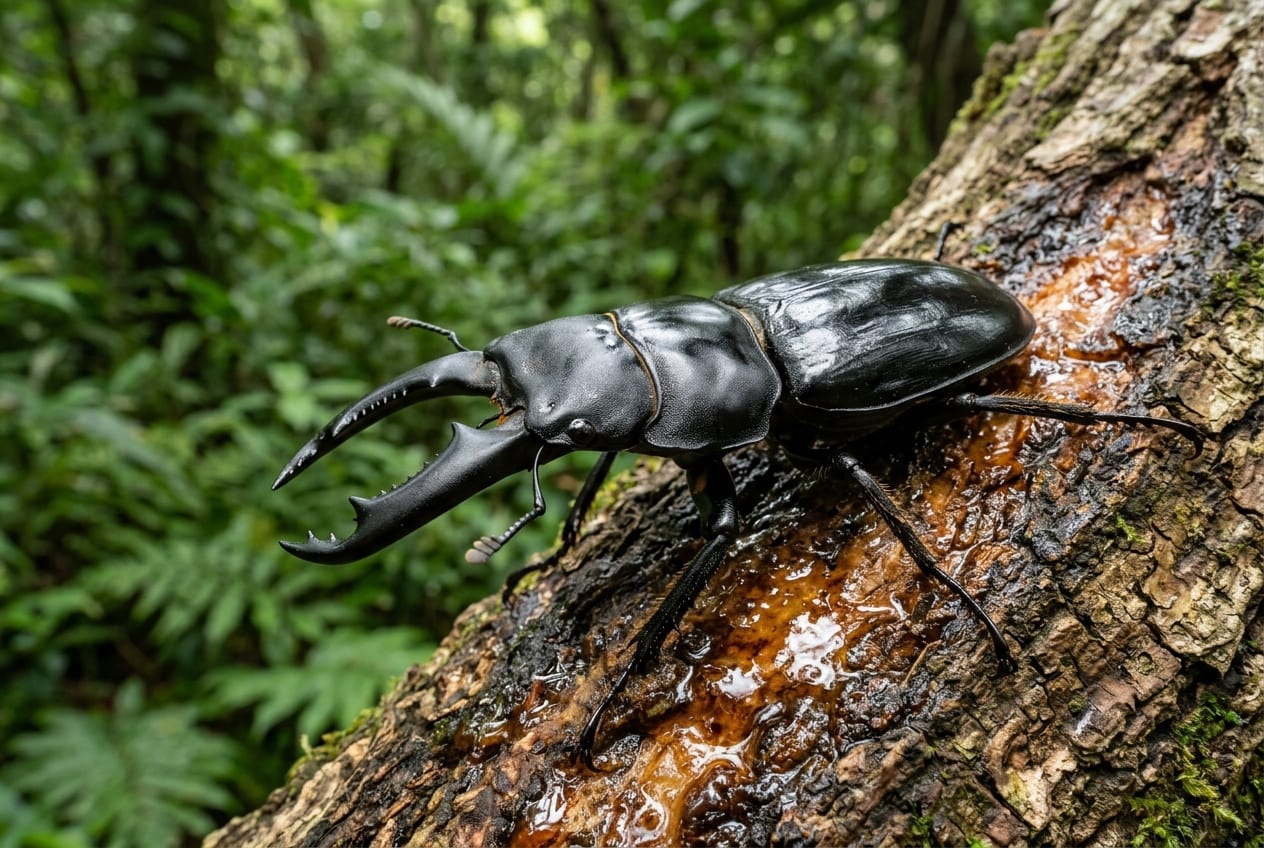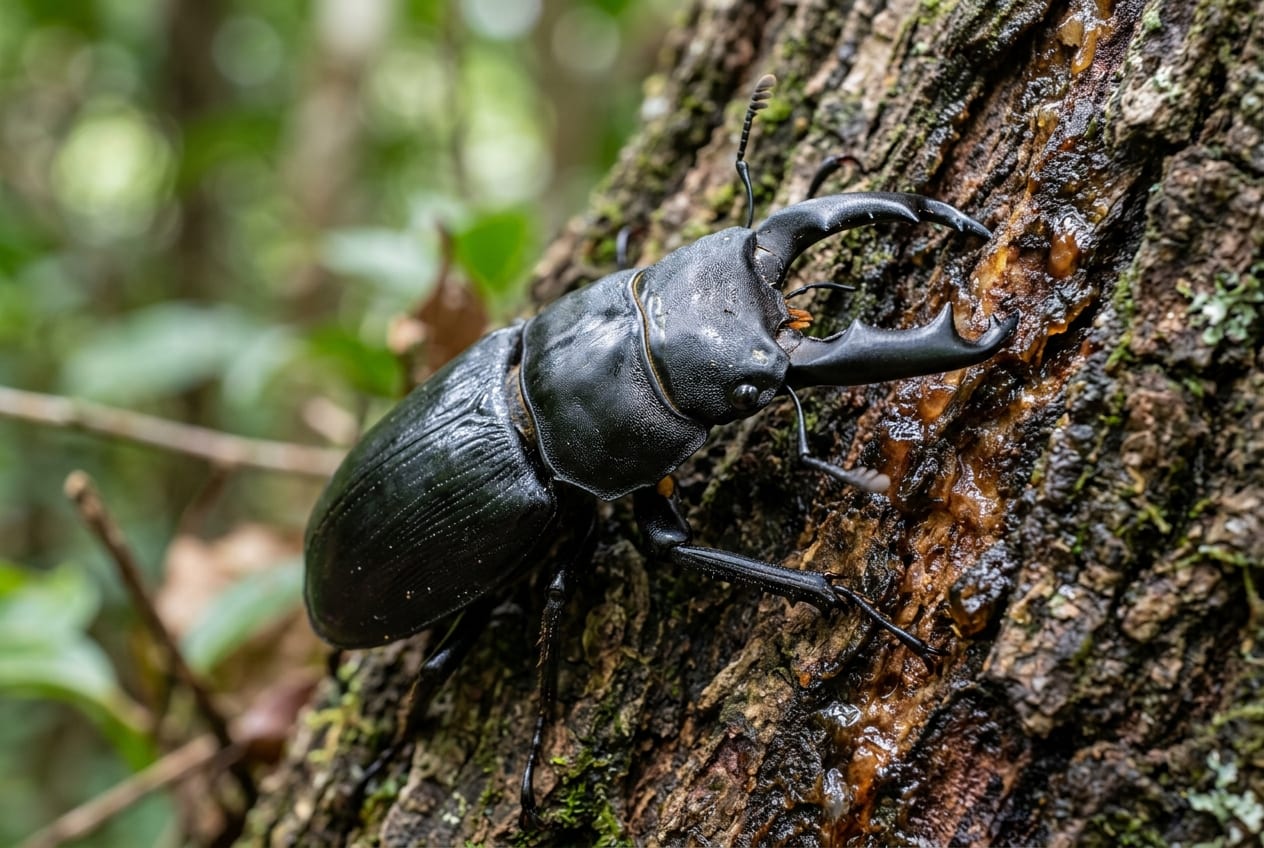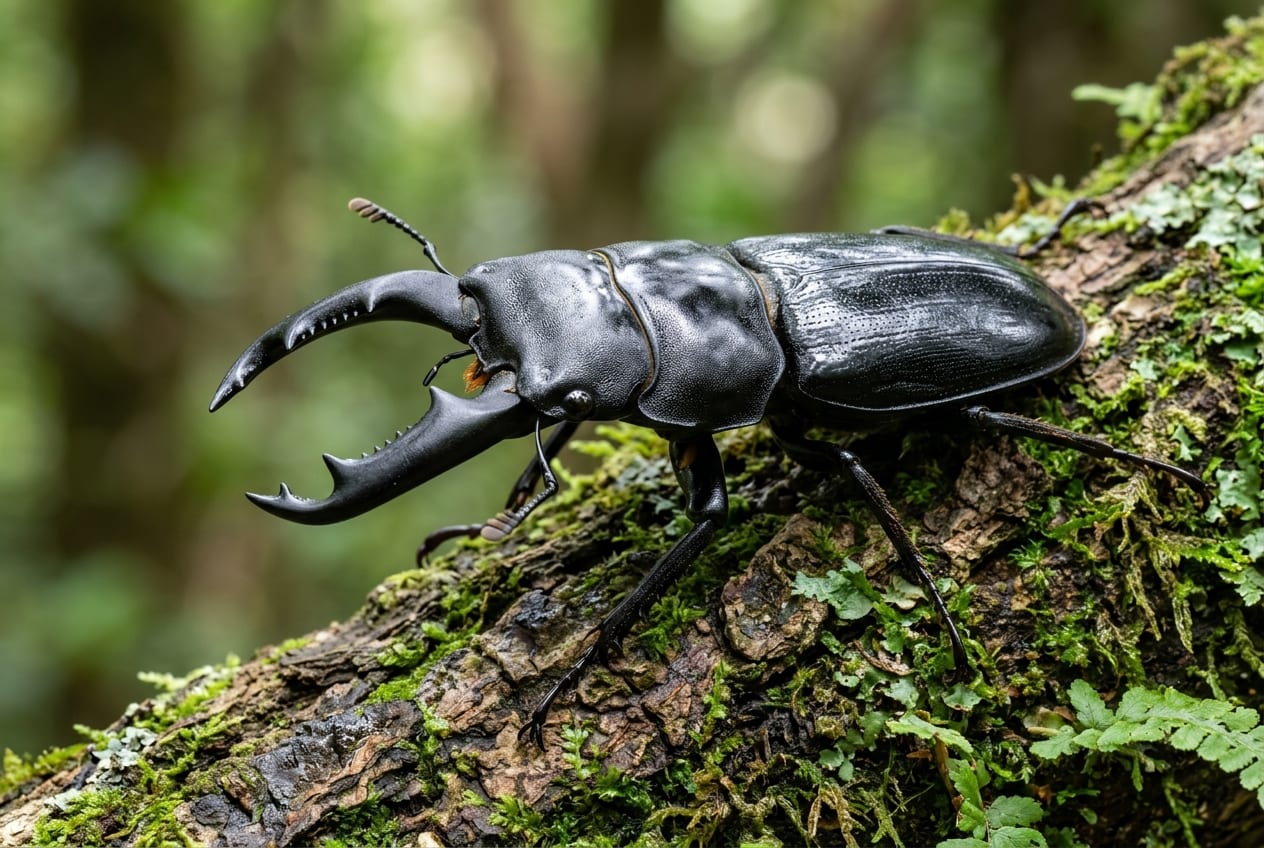
AI-generated image
Hachijo Flat Stag Beetle
IntermediateDorcus titanus hachijoensis
An endemic subspecies of Hachijojima in the Izu Islands. Close to the mainland form but distinguished by males whose first inner tooth sits toward the mandible tip; habitat loss has put it on the Ministry of the Environment Red List as Vulnerable.
Difficulty
Intermediate
Temperature
20〜26℃
Lifespan
Adults 1-3 years
Size
Males 45-73 mm (including captive; wild up to 60.3 mm) / females 22-33 mm
Humidity
60〜80%
Diet
Tree sap, beetle jelly
About
The Hachijo flat stag (Dorcus titanus hachijoensis) is a subspecies of Dorcus titanus found only on Hachijojima in the Izu Islands, described in 1989. Flat stags on the other Izu islands (Oshima, Miyakejima and others) are assigned to the mainland subspecies, but the Hachijojima population was separated because some males have the first inner tooth close to the mandible tip. Males measure 45-73 mm and females 22-33 mm; the BE-KUWA captive record is 73.0 mm (2015) and the wild record 60.3 mm, medium-sized among Japanese subspecies. In mitochondrial DNA phylogenies the mainland flat stag descends from the lineage of the Taiwan, Sakishima and Hachijo forms, giving this subspecies a key place in the origin of the mainland population. Ecology matches other flat stags: it gathers at sap in broadleaf forest and is nocturnal. Keep at 20-26 C and breed with logs and fermented substrate. The Ministry of the Environment Red List 2020 lists it as Vulnerable, and the island population is limited. Use captive-bred stock rather than adding collecting pressure, and never release beetles to avoid genetic contamination.
Source: Wikipedia (CC BY-SA 4.0)
Lifespan of the Hachijo Flat Stag Beetle
The Hachijo Flat Stag Beetle lives Adults 1-3 years.
Size of the Hachijo Flat Stag Beetle
The Hachijo Flat Stag Beetle grows to Males 45-73 mm (including captive; wild up to 60.3 mm) / females 22-33 mm.
Temperature & humidity for the Hachijo Flat Stag Beetle
The ideal temperature for the Hachijo Flat Stag Beetle is 20〜26℃.
Basic Info
Origin
Care Specifications
AggressiveSolitaryBreeding: Easy
Sources: beetlebreeding.ch - The Breeding/Rearing of Dorcus titanus palawanicus by Kay (species-level guidance for D. titanus) / Dorcus titanus - Wikipedia (JA) / Dorcus titanus pilifer - Wikipedia (JA)
Breeding Records & Localities
Captive record (♂)
73 mm
Wild record (♂)
60.3 mm
Record source: BE-KUWA 2025 edition (Hachijo flat stag, captive 73.0 mm, T. A 2015 / wild 60.3 mm, 菊池淳; projected maximum 76 mm)
Notable localities
Hachijojima (Tokyo)
Regional subspecies
- Dorcus titanus hachijoensis — Hachijojima
Vulnerable on the Ministry of the Environment Red List 2020. The 73.0 mm captive record far exceeds the 60.3 mm wild maximum.
Generation codes
- WD
- Wild-caught
- WF1
- Offspring of a wild-caught female
- F1〜
- Captive generations (same locality)
- CBF1
- Cross-locality captive-bred (reset)
Sources: BE-KUWA Certified Breeding Records (Mushi-sha, FY2025 edition PDF, JA) / Dorcus titanus - Wikipedia (JA)
References & Sources
Edited & verified by: BreederDirect editorial team
The taxonomic, regulatory, and husbandry data on this page are compiled and verified against the authoritative primary sources below.
Primary sources
- Wikipedia
- CITES Appendix (checklist.cites.org)
- Ministry of the Environment Red List 2020 (Insects, JA)
- beetlebreeding.ch - The Breeding/Rearing of Dorcus titanus palawanicus by Kay (species-level guidance for D. titanus)
- Dorcus titanus pilifer - Wikipedia (JA)
- BE-KUWA Certified Breeding Records (Mushi-sha, FY2025 edition PDF, JA)
- GBIF
Taxonomy & Authority
Accepted name: Dorcus titanus hachijoensis Fujita & Okuda, 1989
Synonyms: Serrognathus titanus hachijoensis
Authority databases: GBIF
Nomenclature follows global taxonomic authority databases.
Regulations & Conservation Status
Not CITES-listed
Sources: CITES Appendix (checklist.cites.org) / Ministry of the Environment Red List 2020 (Insects, JA)
Regulations may change. Always verify the latest information with the relevant authorities.
Hachijo Flat Stag Beetle Listings
Loading latest listingsFind listings for this species