Source: Wikimedia Commons
Oriental Goliath Beetle
AdvancedGoliathus orientalis
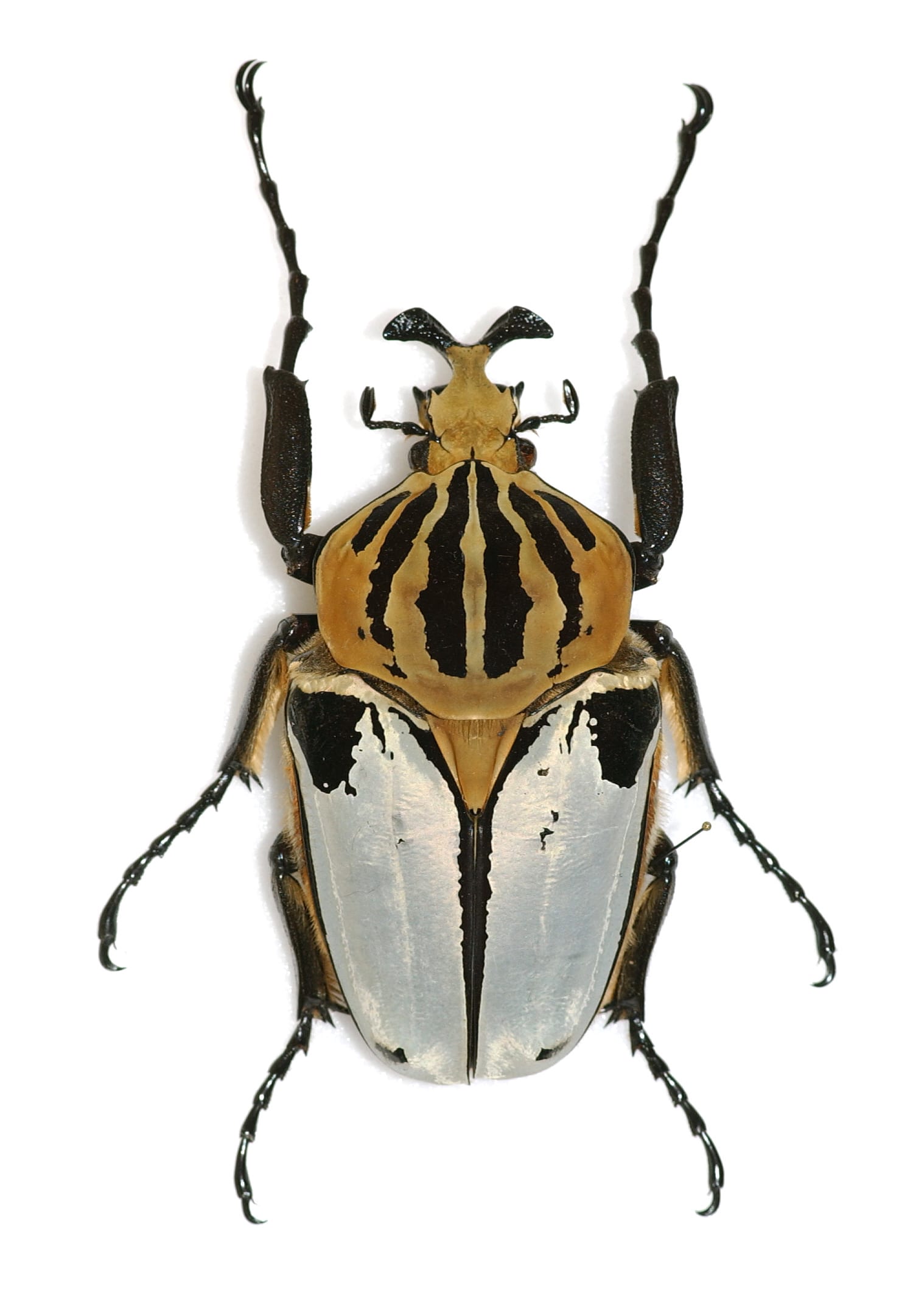
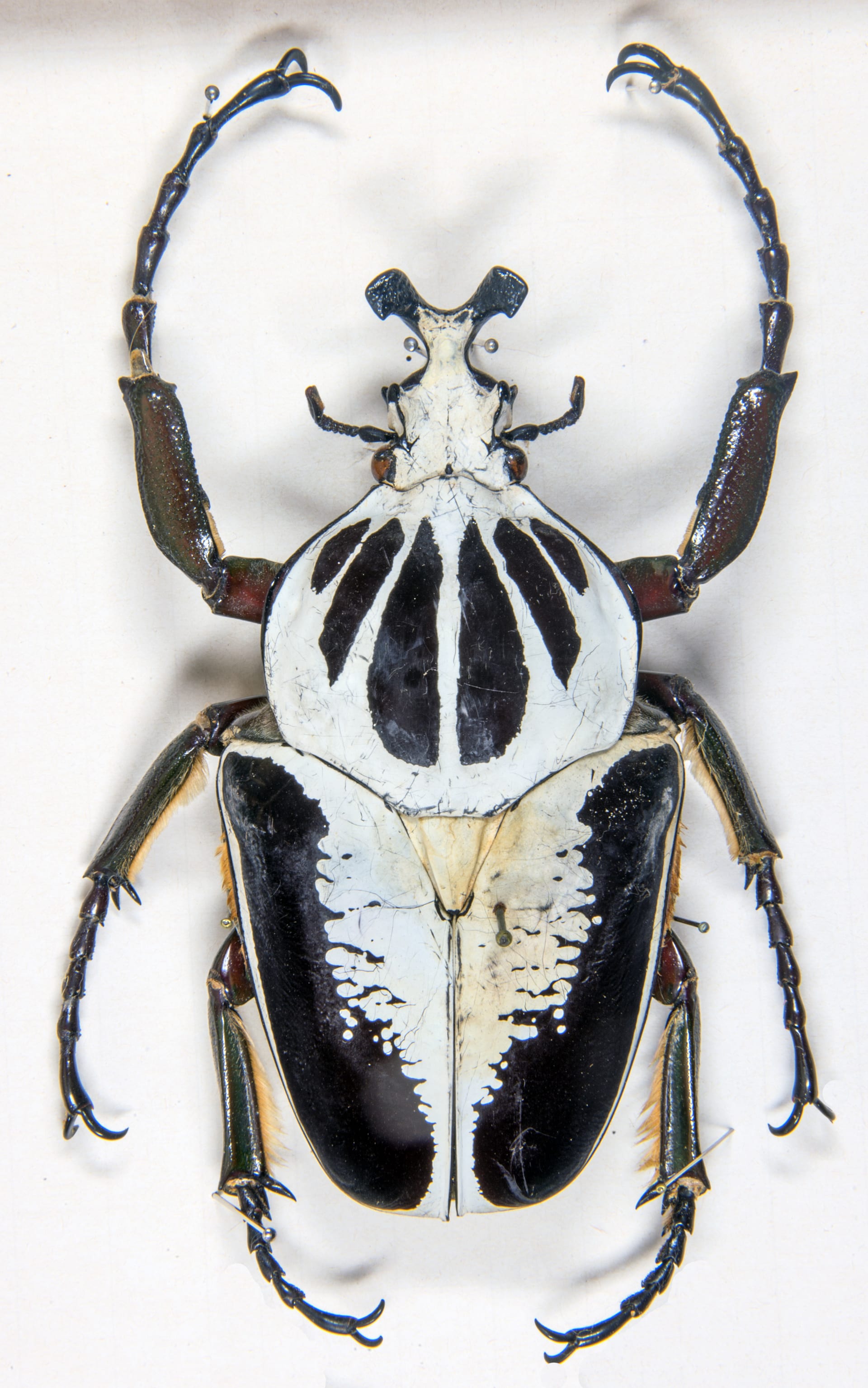
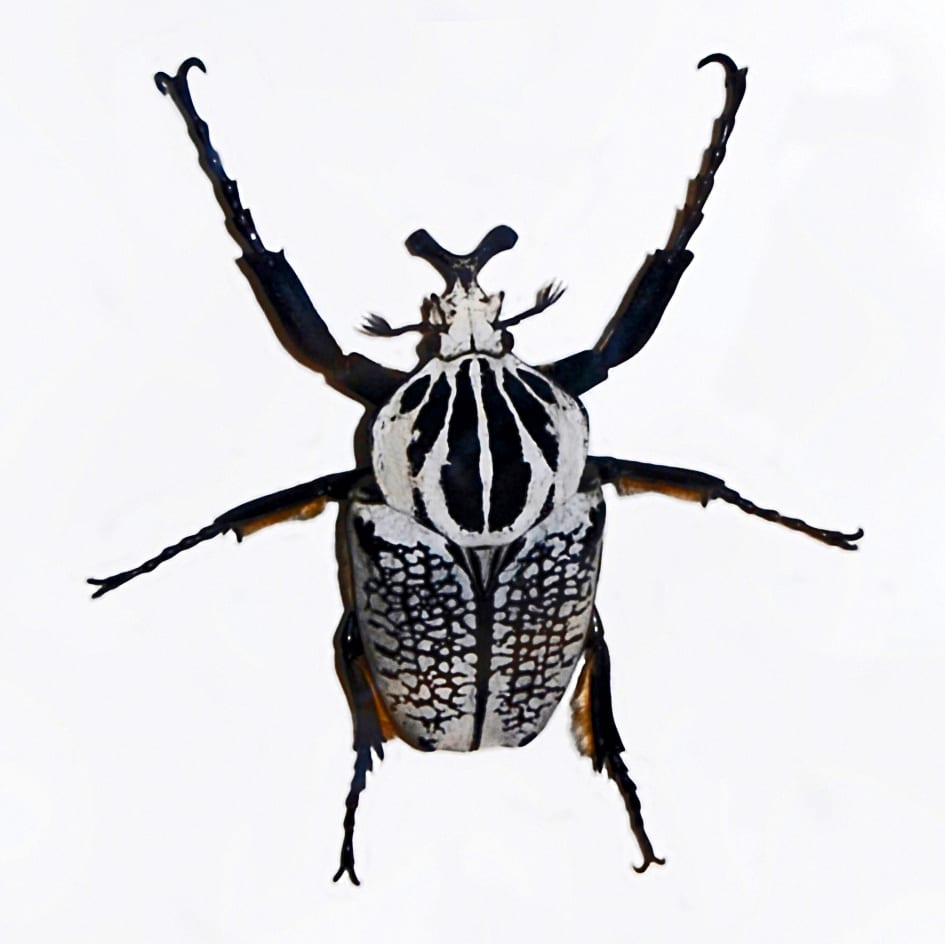
One of Africa's largest flower beetles, with whitish elytra ringed in black. Males carry a black Y-shaped horn on the head and use it in fights. The larvae are cannibalistic, so rearing it is regarded as work for experienced keepers.
Difficulty
Advanced
Temperature
20〜28℃
Lifespan
Adults 6 months to 1 year
Size
Males 50-100 mm / females 50-65 mm
Humidity
60〜80%
Diet
Adults take tree sap, fruit and beetle jelly; larvae need protein-rich food such as dried dog or cat food, dried silkworms and the larvae of other species
About
Goliathus orientalis was described by Moser in 1909 and is among the largest of the goliath beetles, with males of 50-100 mm and females of 50-65 mm. The body is broad and flat; the elytra are whitish with an intricate pattern of black markings, usually rings, and the pronotum carries black longitudinal stripes or a large black area. Males have a black Y-shaped horn on the head which they use in fights with other males. The legs are long and powerful, and despite their bulk these beetles fly well. Adults feed mainly on tree sap and fruit. GBIF records cluster in the DR Congo and Tanzania, and the subspecies usambarensis is recognised. In captivity the key discovery was that Goliathus larvae are cannibalistic: they grow when fed protein such as dried dog or cat food, dried silkworms or the larvae of other beetles. Losses at pupation are nonetheless heavy, which is why the genus is left to experienced breeders.
Source: Wikipedia (CC BY-SA 4.0)
Lifespan of the Oriental Goliath Beetle
The Oriental Goliath Beetle lives Adults 6 months to 1 year.
Size of the Oriental Goliath Beetle
The Oriental Goliath Beetle grows to Males 50-100 mm / females 50-65 mm.
Basic Info
Origin
Central and East Africa (DR Congo, Tanzania and the Republic of the Congo)
Lifespan
Adults 6 months to 1 year
Size
Males 50-100 mm / females 50-65 mm
Care Specifications
AggressiveSolitaryBreeding: Very hard
Sources: Goliathus orientalis - Wikipedia (EN; males 50-100 mm and females 50-65 mm, whitish elytra with black markings, the male's Y-shaped horn, two subspecies, sap and fruit) / Goliathus - Wikipedia (EN; genus size range, sap and fruit diet, rearing to adult on protein-rich foods such as commercial cat and dog food, not evaluated by the IUCN) / Goliathus - Wikipedia (JA; genus size of 65-110 mm for males and 50-75 mm for females, the Japanese name for this species and its central African range) / Ben's Beetle Breeding Pages - Goliathus orientalis (Congo; cannibalistic larvae and protein feeding, heavy losses at pupation, rated for experienced breeders) / Ben's Beetle Breeding Pages - Report about my trials breeding Goliathus (observations of larvae preying on other larvae, and how protein feeding was arrived at) / GBIF species page for Goliathus orientalis (distribution and occurrence records by country)
Breeding Records & Localities
Notable localities
DR CongoTanzaniaRepublic of the Congo
Regional subspecies
- Goliathus orientalis orientalis — DR Congo
- Goliathus orientalis usambarensis — Usambara, Tanzania
The BE-KUWA certified records do not cover the Cetoniinae, so no record figure exists. The subspecies usambarensis was described by Preiss in 1933.
Generation codes
- WD
- Wild-caught
- WF1
- Offspring of a wild-caught female
- F1〜
- Captive generations (same locality)
- CBF1
- Cross-locality captive-bred (reset)
Sources: Goliathus orientalis - Wikipedia (EN; males 50-100 mm and females 50-65 mm, whitish elytra with black markings, the male's Y-shaped horn, two subspecies, sap and fruit) / Ben's Beetle Breeding Pages - Goliathus orientalis (Congo; cannibalistic larvae and protein feeding, heavy losses at pupation, rated for experienced breeders)
References & Sources
Edited & verified by: BreederDirect editorial team
The taxonomic, regulatory, and husbandry data on this page are compiled and verified against the authoritative primary sources below.
Primary sources
- Wikipedia
- Ministry of the Environment, Invasive Species Act: "Guidance for Those Importing Live Insects in Scarabaeoidea"
- CITES Appendix (checklist.cites.org)
- Goliathus - Wikipedia (EN; genus size range, sap and fruit diet, rearing to adult on protein-rich foods such as commercial cat and dog food, not evaluated by the IUCN)
- Goliathus - Wikipedia (JA; genus size of 65-110 mm for males and 50-75 mm for females, the Japanese name for this species and its central African range)
- Ben's Beetle Breeding Pages - Goliathus orientalis (Congo; cannibalistic larvae and protein feeding, heavy losses at pupation, rated for experienced breeders)
- Ben's Beetle Breeding Pages - Report about my trials breeding Goliathus (observations of larvae preying on other larvae, and how protein feeding was arrived at)
Taxonomy & Authority
Accepted name: Goliathus orientalis Moser, 1909
Synonyms: Goliathus giganteus orientalis Moser, 1909, Goliathus goliathus preissi Endrodi, 1951
Authority databases: GBIF
Nomenclature follows global taxonomic authority databases.
Regulations & Conservation Status
Not CITES-listed
Plant Protection Act: When importing live specimens of Scarabaeoidea (including rhinoceros beetles, stag beetles, flower beetles, etc.), a species identification certificate issued by the exporting country government agency or equivalent must be attached in accordance with the Invasive Species Act (import ports are limited to Narita, Chubu, Kansai, Fukuoka, and Kagoshima airports). This species itself is not a designated invasive species, and import is possible upon submission of the certificate.
Sources: Ministry of the Environment, Invasive Species Act: "Guidance for Those Importing Live Insects in Scarabaeoidea" / CITES Appendix (checklist.cites.org)
Regulations may change. Always verify the latest information with the relevant authorities.
Oriental Goliath Beetle Listings
Loading latest listingsFind listings for this species