Source: Wikimedia Commons
Chinese Hourglass Trapdoor Spider
AdvancedCyclocosmia ricketti
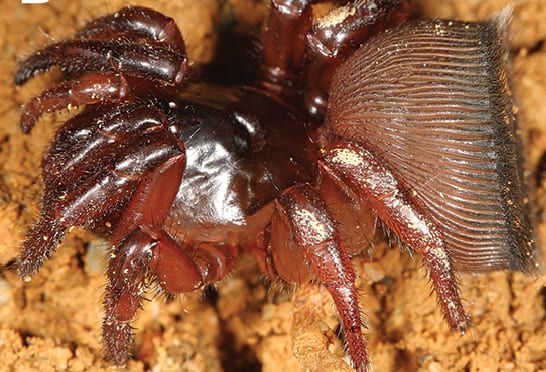
A Chinese trapdoor spider whose abdomen ends in a flat, hardened disc patterned like an old coin. It digs a deep vertical burrow and plugs the entrance with the disc when threatened. Field records are scarce.
Difficulty
Advanced
Lifespan
10+ years
Size
About 2.8cm body length; large specimens exceed 3cm
Diet
Live insects such as crickets
About
Cyclocosmia ricketti is a trapdoor spider from China, described in 1901 as Halonoproctus ricketti. Its abdomen ends abruptly in a hardened disc reinforced by radial ribs and grooves that resembles an old coin or a seal. When threatened it retreats down the burrow and plugs the entrance with this disc. Females are about 2.8 cm long with a disc some 1.6 cm across, and dig vertical burrows 7-15 cm deep that are silk-lined only at the bottom. They are poor silk spinners and build no web, ambushing prey that passes the burrow entrance instead. In China the species is known by names such as the money trapdoor spider and the severed-abdomen spider, and a Tang-dynasty pharmacopoeia records a burrowing spider of this kind. The venom is weak but bites are painful. Field records are scarce: only six individuals were reported in China between 2000 and 2016. Stock in the pet trade is said to come mainly from breeding in Thailand. There is no established figure for captive temperature or humidity.
Source: Wikipedia (CC BY-SA 4.0)
Lifespan of the Chinese Hourglass Trapdoor Spider
The Chinese Hourglass Trapdoor Spider lives 10+ years.
Size of the Chinese Hourglass Trapdoor Spider
The Chinese Hourglass Trapdoor Spider grows to About 2.8cm body length; large specimens exceed 3cm.
Basic Info
Origin
China
Lifespan
10+ years
Size
About 2.8cm body length; large specimens exceed 3cm
Care Specifications
PeacefulSolitary
Sources: Wikipedia / Wikipedia: Cyclocosmia (genus) / GBIF / World Spider Catalog
References & Sources
Edited & verified by: BreederDirect editorial team
The taxonomic, regulatory, and husbandry data on this page are compiled and verified against the authoritative primary sources below.
Taxonomy & Authority
Accepted name: Cyclocosmia ricketti (Pocock, 1901)
Synonyms: Halonoproctus ricketti Pocock, 1901
Authority databases: GBIF
Nomenclature follows global taxonomic authority databases.
Regulations & Conservation Status
Not CITES-listed
Sources: CITES Appendices (species not listed)
Regulations may change. Always verify the latest information with the relevant authorities.
Chinese Hourglass Trapdoor Spider Listings
Loading latest listingsFind listings for this species