Source: Wikimedia Commons
Yellow-collared Macaw
AdvancedPrimolius auricollis
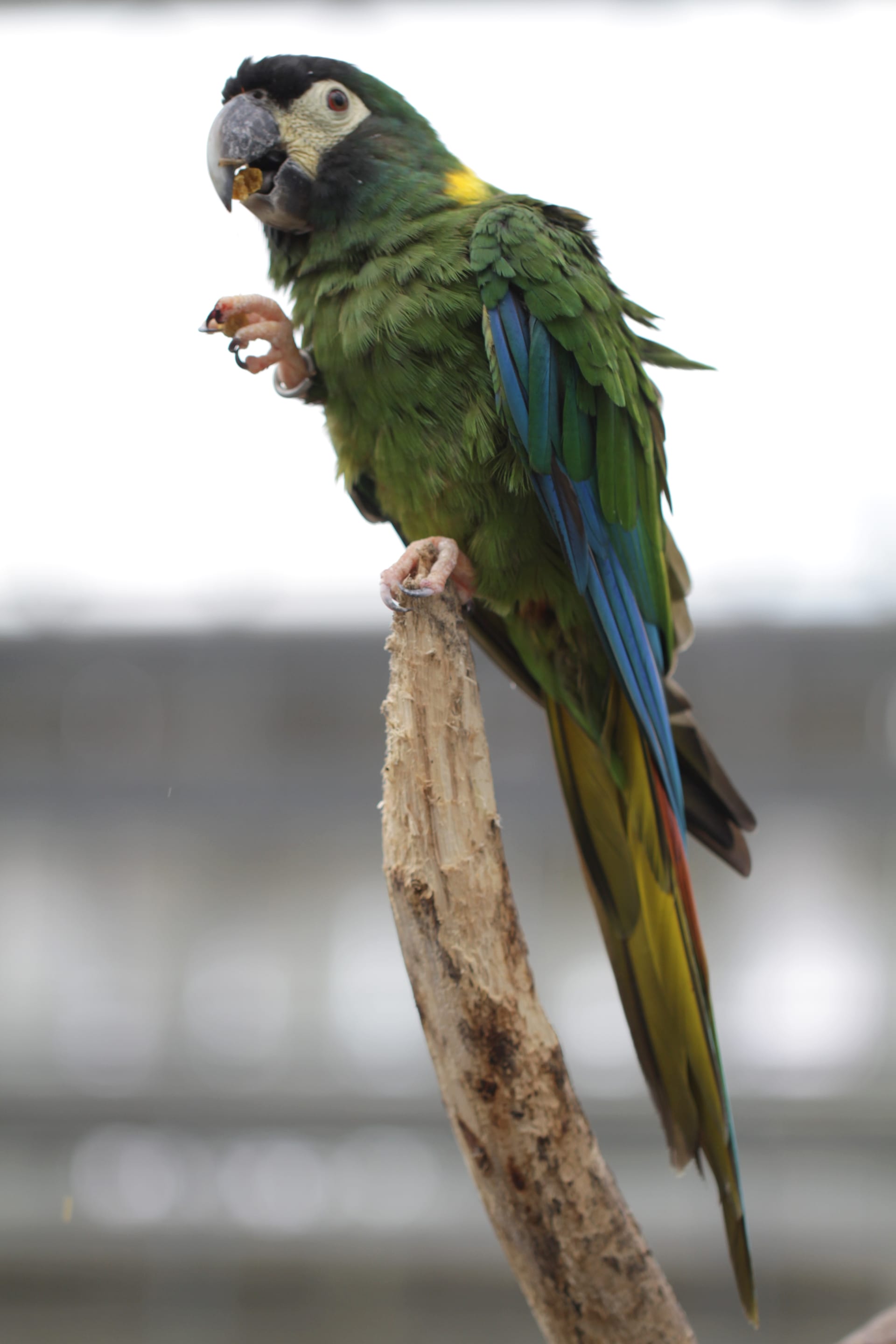
A small macaw about 38 cm long and up to 250 g, green with a vivid yellow collar across the nape that deepens with age. The face is bare white skin, the bill black, and the tail has a red base and a blue tip.
Difficulty
Advanced
Temperature
15〜30℃
Lifespan
25-30 years
Size
About 38cm
Humidity
40〜60%
Diet
Medium parrot pellets, nuts, fruit and vegetables
About
The yellow-collared or golden-collared macaw (Primolius auricollis) is a small macaw of central South America, one of the group known in aviculture as mini-macaws. The plumage is green with a bright yellow collar broadest on the back of the neck, a collar that deepens in colour as the bird matures. The forehead and crown are brownish black, the remiges and primary coverts blue, and the long pointed tail has a red base, a narrow green centre and a blue tip; the underside of the tail and flight feathers is greenish-yellow. The legs are dull pink and the iris ranges from reddish to dull yellow. Bare white facial skin is extensive and the heavy black bill is often tipped pale grey. The main population occupies the Pantanal of Brazil, northern Argentina, far northern Paraguay and much of northern and eastern Bolivia. It avoids Amazon rainforest, living instead in forest, woodland, savanna and grassland with scattered trees.
Source: Wikipedia (CC BY-SA 4.0)
Lifespan of the Yellow-collared Macaw
The Yellow-collared Macaw lives 25-30 years.
Size of the Yellow-collared Macaw
The Yellow-collared Macaw grows to About 38cm.
It is about 38 cm long, nearly half of that tail, and weighs up to about 250 g.
Basic Info
Origin
The Pantanal of Brazil, northern and eastern Bolivia, far northern Paraguay and northern Argentina
Lifespan
25-30 years
Size
Care Specifications
References & Sources
Edited & verified by: BreederDirect editorial team
The taxonomic, regulatory, and husbandry data on this page are compiled and verified against the authoritative primary sources below.
Primary sources
- Wikipedia
- CITES Appendices (Psittaciformes spp. listed in Appendix II)
- Annex to Council Regulation (EC) No 338/97 as amended by Commission Regulation (EU) 2026/1383 (post-CoP20)
- IUCN Red List
- French Wikipedia - Ara a collier jaune (38 cm, up to 250 g, morphology)
- IOC World Bird List v15.2 (scientific name, authority, English name, range)
- GBIF
Taxonomy & Authority
Accepted name: Primolius auricollis (Cassin, 1853)
Synonyms: Ara auricollis, Propyrrhura auricollis
Authority databases: GBIF
Nomenclature follows global taxonomic authority databases.
Regulations & Conservation Status
CITES Appendix IIIUCN LC · Least Concern
Primolius auricollis. CITES lists Psittaciformes spp. as a whole in Appendix II, excluding only Agapornis roseicollis, Melopsittacus undulatus, Nymphicus hollandicus and Psittacula krameri, so this species is covered. International trade in an Appendix II species requires an export permit from the exporting state; it is not among the Appendix I derived species that require registration under Japanese law. The IUCN assesses it as Least Concern. Two congeners, Primolius couloni and Primolius maracana, are in Appendix I, so the scientific name should be checked to avoid confusion.
Sources: CITES Appendices (Psittaciformes spp. listed in Appendix II) / Annex to Council Regulation (EC) No 338/97 as amended by Commission Regulation (EU) 2026/1383 (post-CoP20) / IUCN Red List
Regulations may change. Always verify the latest information with the relevant authorities.
Yellow-collared Macaw Listings
Loading latest listingsFind listings for this species