Source: Wikimedia Commons
Pale-headed Rosella
IntermediatePlatycercus adscitus
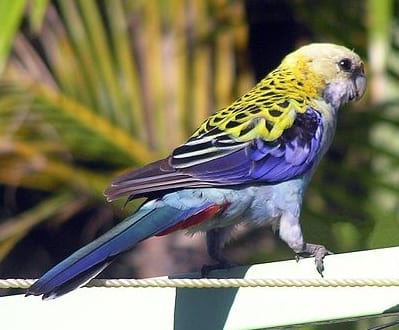
A medium parrot 30-33 cm long with a pale creamy head and strongly blue body. It lives in the open woodland of northeastern Australia, eating seeds and fruit, and it chews hard and calls loudly.
Difficulty
Intermediate
Temperature
15〜30℃
Lifespan
15 years or more
Size
30-33cm (tail 15cm; 95-120g)
Humidity
40〜60%
Diet
Mixed seed, seeding grasses, greens, fruit and vegetables, and pellets
About
The pale-headed rosella (Platycercus adscitus) is a broad-tailed parrot of northeastern Australia. The sexes look similar, though the female is slightly smaller and duller. A pale creamy head over a strongly blue body is its hallmark. Hybrids with its close relative are recorded where ranges meet in northeastern New South Wales and southeastern Queensland. It occurs up to 700 m in open woodland, scrub, riverine woodland, grassland, wet sclerophyll forest, lantana thickets, farmland, orchards and Banksia-dominated coastal heath. In captivity a walk-in flight 4.5 m long is recommended, and the advice is not to house the species next to other rosellas. Because it scratches about in soil it needs regular worming. Clutches are of four to five eggs with fledging at five weeks.
Source: Wikipedia (CC BY-SA 4.0)
Lifespan of the Pale-headed Rosella
The Pale-headed Rosella lives 15 years or more.
Size of the Pale-headed Rosella
The Pale-headed Rosella grows to 30-33cm (tail 15cm; 95-120g).
It is 33 cm long including a 15 cm tail and weighs 95-120 g.
Basic Info
Origin
Northeastern Australia, centred on Queensland
Lifespan
15 years or more
Size
30-33cm (tail 15cm; 95-120g)
Temperature
Care Specifications
Semi-aggressivePair
Sources: World Parrot Trust Parrot Encyclopedia / Wikipedia - Pale-headed rosella
References & Sources
Edited & verified by: BreederDirect editorial team
The taxonomic, regulatory, and husbandry data on this page are compiled and verified against the authoritative primary sources below.
Taxonomy & Authority
Accepted name: Platycercus adscitus (Latham, 1790)
Synonyms: Psittacus adscitus
Authority databases: GBIF
Nomenclature follows global taxonomic authority databases.
Regulations & Conservation Status
CITES Appendix IIIUCN LC · Least Concern
Platycercus adscitus. The order Psittaciformes is listed in CITES Appendix II except for species placed in Appendix I, so this species is Appendix II and international trade requires an export permit.
Sources: CITES Appendices (Appendix II) / IUCN Red List
Regulations may change. Always verify the latest information with the relevant authorities.
Pale-headed Rosella Listings
Loading latest listingsFind listings for this species