What is Turbinaria (Cup Coral)?
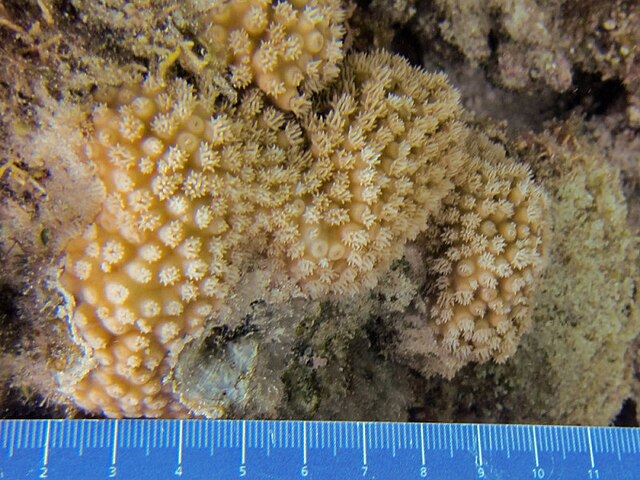
Turbinaria (genus Turbinaria) is a type of hard coral (stony coral) widely distributed throughout the Indian and Pacific Oceans. In Japan, it's commonly traded under names like cup coral, plate coral, or scroll coral. Its appearance varies from thin plate-like to cup-shaped or spiral forms, with muted yet elegant coloration ranging from brown and cream to yellowish-green.
While Turbinaria is sometimes classified as SPS (Small Polyp Stony Coral), it has wider tolerance for water quality and light intensity compared to Acropora (Branching Coral) and Montipora. It's considered one of the ideal corals for your first SPS challenge.
Biology and Basic Characteristics
Turbinaria's key traits are summarized below:
- High photosynthetic capacity: Contains abundant zooxanthellae (symbiotic algae) and can thrive with slightly elevated nutrient levels if lighting is adequate
- Relatively slow growth: Unlike Acropora, it won't grow explosively, but expands several centimeters annually in proper conditions
- Morphological diversity: Changes from plate-like (flat), cup-shaped (bowl), or scroll-like (spiral) forms depending on water flow and light intensity
- Small polyps: Features 2–3mm polyps on the surface, relatively large for an SPS coral
- Nocturnal feeder: Extends polyps at night and has the ability to capture plankton
Required Water Parameters
Target water parameters for long-term Turbinaria maintenance are as follows:
| Parameter | Target Range | Notes |
|---|
| Temperature | 24–26°C | Be cautious of summer heat (≥28°C) |
| Specific Gravity | 1.025–1.026 | Stability is essential |
| pH | 8.1–8.3 | Watch for nighttime drops (below 7.8) |
| KH (Alkalinity) | 8–11 dKH | Avoid sudden changes (≤0.5 dKH/day fluctuation) |
| Calcium (Ca) | 400–450 mg/L | Maintain balance with KH |
| Magnesium (Mg) | 1250–1350 mg/L | Essential for Ca and KH stability |
| Nitrate (NO₃) | 5–20 mg/L | Zero management can paradoxically cause browning |
| Phosphate (PO₄) | 0.05–0.10 mg/L | No need to maintain zero |
Critical Point: Don't Zero Out Nutrients
Most corals, including Turbinaria, maintain stable coloration by sustaining moderate nitrate and phosphate levels. In ultra-low nutrient (ULNS) environments, they tend to fade (become whitish-brown). There's no need to intentionally target zero levels.
Lighting Selection
Turbinaria, as an SPS coral, can be maintained under moderate light intensity. Unlike Acropora, it doesn't require a high-PAR environment.
Recommended PAR Values
| Turbinaria Position | Recommended PAR (µmol/m²/s) |
|---|
| Near tank bottom | 50–100 |
| Middle layer | 100–200 |
| Upper area (intense light) | 200–300 |
Warning: High-light environments increase bleaching risk. When first introducing a specimen, place it in a dim lower area and gradually increase light over several weeks through "light acclimation."
Optimal LED Spectrum
To bring out Turbinaria's color, use a blended spectrum with blue (420–470nm) as the primary component plus white (approximately 6000–7000K). Adding ultraviolet (UV: 360–400nm) can enhance fluorescence on the coral's surface.
Water Flow (Current) Setup
Turbinaria prefers gentle to moderate turbulent flow. Strong unidirectional currents like those for Acropora are unsuitable; a diffuse, non-stagnant flow is ideal.
Flow Guidelines
- Whole tank turnover: 10–20× per hour (relative to total volume)
- Surface flow at Turbinaria: Gentle swaying motion (approximately 10–30 cm/s)
- Direct strong currents are forbidden: They damage polyps and cause tissue damage
Layout and Flow Design
Plate-form Turbinaria placed on the bottom easily accumulates detritus (organic particles) on its surface. Angle it or lean it against live rock on its side so debris naturally falls away.
Placement Considerations
Key points when positioning Turbinaria in your tank:
Site Selection
- Light: Low to moderate light zones (bottom to middle layer) are standard. Upper areas with intense light risk bleaching
- Water flow: A location not subject to direct strong currents. Receiving the indirect turbulent flow from a wavemaker is ideal
- Growth space: Consider the growth direction (expanding outward) and maintain at least 10cm distance from neighboring corals
Compatibility with Other Corals
Turbinaria rarely extends sweeper tentacles. However, it can be affected by chemical warfare (allelopathy) from other corals, so avoid close proximity to LPS corals like hammer coral or Favia.
Feeding
While Turbinaria supplements most of its energy through photosynthesis, weekly to bi-weekly active feeding noticeably improves growth and coloration.
Recommended Food Types
- Reef-Roids: The most convenient and effective dry plankton food
- Phytoplankton (liquid): Supports photosynthesis and directly adds nutrients
- Copepods (live or frozen): Promotes tissue fullness and growth
- Rotifers: Activates juvenile polyps
Feeding Procedure
- Reduce or pause flow pumps 30 minutes before feeding
- Dissolve food with a dropper or measuring spoon and introduce it upstream toward the Turbinaria
- Resume pumps after 30–60 minutes
- Pair with 10–15% water changes 2–3 times weekly to prevent nitrate and phosphate spikes
Introduction Tips
Acclimatization
For stone corals like Turbinaria, use the drip acclimation method:
- Float the Turbinaria in its bag (or a small bucket) in the tank for 30 minutes to match water temperature
- Add tank water drop by drop (1–2 drops per second) for 30–60 minutes to gradually adjust water chemistry
- Place it initially in a dimly-lit, low-flow area and observe for 1–2 weeks
- Once polyps consistently open, move it to its permanent location
Bleaching and Color Loss Signs
| Symptom | Possible Cause |
|---|
| Sudden overall whitening | Rapid temperature rise, chemical contamination, light stress |
| Whitening from edges | Contact with other corals, allelopathy |
| Fading brown (cream color) | Insufficient light or ultra-low nutrients (ULNS) |
| Retracted, closed polyps | Excessive flow, salinity fluctuation, chemical exposure |
Long-Term Maintenance Tips
Key points for maintaining beautiful Turbinaria for 3+ years:
Regular Maintenance
- Weekly: Test nitrate, phosphate, and KH. Perform 10–15% water change
- Monthly: Test calcium, magnesium, and pH. Clean protein skimmer cup
- Quarterly: Consider ICP-OES (trace element) testing for early detection of heavy metal contamination
Enjoy Form Changes
Turbinaria changes shape with water flow and light variations. Under strong light and flow it tends toward plate form; under weak conditions it grows more cup- or scroll-shaped. Watching your coral develop a unique form suited to your tank is one of Turbinaria's greatest joys.
Fragmentation and Clone Propagation
Large specimens can be propagated through fragmentation:
- Use a disposable blade or coral nippers to cut 2–3cm fragments from the plate edge
- Attach to a frag plug (ceramic or plastic) using coral adhesive (cyanoacrylate-based)
- Move to an isolation area (frag tank) with gentle flow and low light for 1–2 months until attached
- After establishment, transfer to the main tank or use for trading and propagation
Summary: Turbinaria is Ideal for SPS Beginners
Turbinaria (cup coral) is an excellent stepping stone into SPS corals for these reasons:
- Wide water quality tolerance: Can handle nitrate levels up to 5–20 mg/L
- Modest light requirements: Thrives and colors beautifully under PAR 100–200
- Stable growth: Doesn't experience explosive growth that overruns tanks
- Enjoyable form changes: Develops unique shapes suited to your environment
- Easy fragmentation: Simple to propagate with just a nipper
Try Turbinaria as a stepping stone before Acropora, or as an accent in a mixed reef tank.