Annual Fish (Killifish) Care Guide | Egg Management and Breeding Methods for Nothobranchius and Others
This guide explains how to care for killifish called "annual fish." We introduce the characteristics of annual fish, represented by Nothobranchius, methods for managing dormant eggs, and the entire process from hatching to breeding, all designed for beginners.
Key Takeaways
This guide explains how to care for killifish called "annual fish." We introduce the characteristics of annual fish, represented by Nothobranchius, methods for managing dormant eggs, and the entire process from hatching to breeding, all designed for beginners.
What Are Annual Fish (Killifish)?
"Annual fish" or "annual killifish" are a special group of tropical fish that inhabit temporary pools and ephemeral water bodies in Africa and South America where the rainy and dry seasons are clearly defined. When these pools dry up during the dry season, all adult fish die, but the eggs laid in the substrate survive in a dormant state within the dry soil, hatching again when the next rainy season arrives—an extraordinary life cycle.
They are called "annual fish" from this cycle of completing an entire lifespan within one year. Representative species include Nothobranchius (African), Fundulopanchax, and Austrolebias (South American). Many species have extremely vibrant coloration; Nothobranchius rachovii and Nothobranchius furzeri, in particular, display jewel-like beauty with intricate combinations of red, blue, and orange. In recent years, their high collectibility has been re-evaluated among aquarium enthusiasts, and they have devoted fans worldwide.
The Appeal and Challenge of Keeping Annual Fish
Appeal:
- Although their lifespan is short (6–18 months), their growth is rapid, allowing you to experience the entire cycle from hatching to spawning in 3–4 months
- You can enjoy a unique breeding process—dormant egg hatching—that other tropical fish do not offer
- Depending on the species, they have strikingly beautiful coloration with high ornamental value
- They are relatively small (5–10 cm) and can be kept in compact tanks
- Since eggs can be mailed and obtained in egg form, acquisition is easier with lower live transport risks
Challenges:
- Their short lifespan means that without continued breeding and egg management, the lineage cannot be passed to the next generation
- Managing dormant eggs (temperature, humidity, storage duration) requires a certain level of knowledge
- Many species are sensitive to water quality changes, requiring regular water changes and water quality checks
- Determining the precise hatching timing is difficult; hatching too early results in low hatch rates
Keeping annual fish offers the profound experience of recreating the life cycle of living creatures in your own hands. Because they are short-lived, your observational skills for each individual improve naturally, and your tank management abilities advance as well.
Creating the Right Rearing Environment
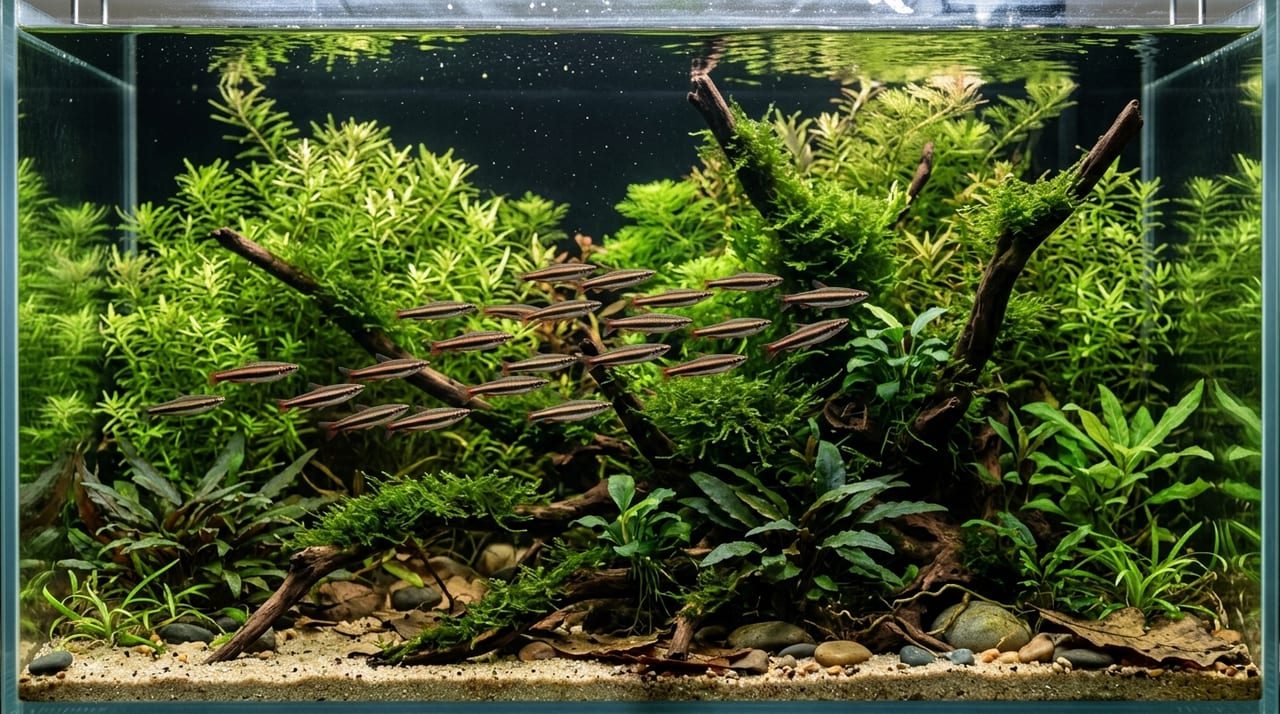
A 20–30 L small tank is sufficient for keeping annual fish. The ideal water conditions are slightly acidic to neutral (pH 6.5–7.5), and water temperature should be 24–26°C. For the substrate, you can use peat moss for spawning, or you can skip substrate and set up a separate spawning box.
Basic Setup:
- Small tank (20–30 L)
- Sponge filter (gentle water flow)
- Heater (set to 25°C)
- Aquatic plants (hornwort, waterweed, etc.)
The key is to keep water flow as gentle as possible. Since annual fish inhabit shallow, still pools in their natural environment, strong water flow causes stress. Sponge filters have high biological filtration capacity and gentle flow, making them ideal for annual fish keeping.
Co-habitation with the same species is possible, but since males engage in fierce territorial disputes, a 45 cm tank with one male and 2–3 females is recommended. Avoid mixing different species of annual fish, as there is a risk of hybridization.
Perform a water change once per week, changing about one-third of the water volume. When using dechlorinated tap water, always match the water temperature before adding it. Annual fish are particularly sensitive to sudden temperature changes; even a 2–3°C difference can cause stress.
Spawning and Dormant Egg Management Are the Heart of Annual Fish Keeping
The greatest appeal of breeding annual fish is managing dormant eggs and inducing hatching. The care you put into this process significantly affects hatch rates and fry survival rates.
Spawning: Lay 3–5 cm of moistened peat moss as a spawning substrate on the tank bottom. When male and female are together, you can observe spawning behavior—the male pushing the female into the sand. Spawning typically occurs daily, with healthy individuals producing 10–30 eggs per day.
Egg Removal and Dry Storage:
- Once or twice per month, remove the spawning peat moss
- Gently absorb excess water with a paper towel (do not completely dry; maintaining appropriate humidity is crucial)
- Place in a zip-lock bag or container, and always record the species name, collection date, and recommended storage period
- Store in a dark place at 25–28°C
Using a magnifying glass or simple microscope to check egg condition is effective. Normally developing eggs show eyes and body segments visible inside, and the fry shape becomes clearer each day. Remove any moldy eggs promptly to prevent infection of healthy eggs.
Dormant Period: This varies by species, but for Nothobranchius, 2–4 months is a guideline. For Austrolebias, setting a longer 3–6 month period can increase hatch rates in some cases. During storage, open the peat moss once a month to check humidity; if it is dry, lightly mist with water to replenish moisture.
Inducing Hatching: After the dormant period ends, immerse the peat moss in slightly cooler soft water (RO water or tap water that has been boiled and cooled). Hatching water temperature should be 25–26°C. If successful, fry will hatch within 24–48 hours. If hatching does not occur on the first attempt, dry the peat moss again and retry after 2–3 weeks—this "two-stage hatching" method is also effective.
Raising Fry and Important Precautions
Newly hatched fry are extremely small (2–3 mm), and the initial feeding directly affects survival rates. Begin feeding immediately after hatching; successfully raising them during the first week is the key.
Fry Food:
- Brine shrimp nauplii: highest nutritional value and recommended
- Infusoria (Paramecium): suitable for early fry with small mouths
- Commercial powdered fry food: convenient but sometimes shows lower feeding response than live food
In the fry tank, replace the sponge filter with a finer one or cover the outlet with stocking material to prevent fry from being sucked in. Maintain about 12 hours of consistent lighting to promote healthy growth.
Growth speed is remarkable: fry reach 1–2 cm in one month and 3–5 cm in two months. By around three months of age, the males' coloration begins to intensify, and beautiful patterns emerge. At this point, you can begin setting up spawning substrate to start collecting the next generation.
Obtain Annual Fish Eggs and Adults from BreederDirect
Annual fish are rarely seen in pet shops, as they are a specialized genre. Direct purchase from specialist breeders is the standard approach. BreederDirect features breeders specializing in annual fish, offering both parent fish and dormant eggs, allowing you to check storage conditions, dormant periods, and hatching advice before purchasing.
The greatest advantage of purchasing directly from a breeder is gaining access to detailed information such as egg collection dates and storage environments. This allows you to pinpoint hatching timing accurately, making high hatch rates achievable even for beginners. Many breeders accommodate those who want to "try starting with eggs first," allowing you to enter the world of annual fish keeping without the difficulty of transporting live fish. Experience the unique life cycle of annual fish through BreederDirect.