How to Create a Biotope-Style Pair Breeding Tank for Apistos | Recreating South America with Soft Water, Dried Leaves, and Coconut Shells
A guide to creating a biotope-style pair breeding tank for Apistogramma, a South American dwarf cichlid. Covers setup including blackwater conditions, substrate, coconut shells, driftwood, and dried leaves, as well as pairing, spawning, and fry rearing. Also introduces characteristics of Cockatoo, Agassiz's, and Banded Apistos.
Key Takeaways
A guide to creating a biotope-style pair breeding tank for Apistogramma, a South American dwarf cichlid. Covers setup including blackwater conditions, substrate, coconut shells, driftwood, and dried leaves, as well as pairing, spawning, and fry rearing. Also introduces characteristics of Cockatoo, Agassiz's, and Banded Apistos.
Related Species
Apistogramma and Biotope Breeding Tanks
Apistogramma (Apistogramma sp.) are small cichlids native to South American Amazon basin waters and represent the iconic "dwarf cichlid" among aquarium hobbyists. Despite their modest size of 5–8 cm in most species, they captivate aquarists with their vibrant male coloration, pairing behavior, and division of parental duties between sexes—particularly those seeking to breed them.
Creating a biotope-style tank (one that mimics the fish's natural habitat) encourages natural behavior in Apistogramma and significantly improves breeding success rates.
Apistogramma Biology and Water Chemistry
Natural Habitat
Most Apistogramma inhabit tributaries, shallow streams, and seasonally flooded forest floors (igapó) throughout the Amazon basin. Their native waters range from blackwater to clearwater, rich in humic substances, with these key characteristics:
| Parameter | Ideal Range |
|---|---|
| pH | 4.5–6.5 (varies by species) |
| Hardness (GH) | 0–5°dH (ultra-soft) |
| KH | 0–2 |
| Temperature | 26–29°C |
| Lighting | Low to moderate (natural-level) |
Water chemistry requirements vary by species. For example, Apistogramma cacatuoides (Cockatoo) tolerates a broader pH range, while Apistogramma agassizii (Agassiz's) requires weakly acidic soft water to develop full coloration.
Biotope Breeding Tank Design
Tank Size Selection
Pair breeding works best in a 45–60 cm tank. Tanks smaller than 30 cm tend to trigger territorial disputes, while 60 cm or larger allows "harem" setups (one male with two to three females).
| Breeding Style | Recommended Tank |
|---|---|
| Pair (1♂1♀) + other species | 45–60 cm |
| Harem (1♂2–3♀) | 60–75 cm |
| Species preservation / breeding operation | 90 cm+ |
Substrate Selection
Layer natural sand or fine river sand 2–3 cm deep to mimic silt. Females spawn in depressions they dig in sand or beneath dried leaves, making substrate selection crucial for biotope authenticity.
Recommended substrates:
- Fine-grain silica sand, pH-adjusted with weak acid
- Aquatic plant soils like ADA Amazonia (readily forms blackwater)
- Natural river sand
Shelter Placement
Biotope success hinges on abundant hiding spots.
- Coconut shell halves (pit caves): Apistos' preferred spawning sites; place 2–3 large enough for females to enter
- Driftwood (fine branches): Recreates Amazon root systems with complex structure
- Dried leaves (almond leaves, magic leaves): Provide tannins and spawning substrate
- Plants (Java fern, Bucephalandra, and other shade-loving species): Low-light-tolerant plants are ideal
Blackwater Creation and Water Management
- Use RO water or commercial soft water (GH 0–3) as base
- Add 3–5 almond leaves per 10L and 1–2 magic leaves
- Allow pH to stabilize at 5.5–6.5 over 1–2 weeks before introducing fish
- Perform 10–15% weekly water changes to prevent excess humic buildup
Pairing and Spawning
Pairing Methods
Apistogramma show strong sexual dimorphism—males are colorful and larger, females dull and smaller. Successful breeding relies on confirmed pairs or allowing pairs to form naturally from a group.
- Raise 4–6 juveniles together in a spacious tank and wait for natural pairing
- Purchase individually confirmed male and female from a retailer
Spawning and Hatching Cycle
- Pre-spawning behavior: Male establishes territory and performs courtship displays (color intensifies significantly)
- Spawning: Female deposits 40–150 eggs in coconut shells, driftwood crevices, or cave-like spots
- Care: Female guards eggs while male defends the surrounding territory; eggs hatch in 2–3 days
- Free-swimming: Fry begin swimming 3–5 days post-hatch
Fry Feeding
Newly hatched fry absorb their yolk sacs initially, but once free-swimming begins, feed infusoria (paramecia) or ultra-fine powdered foods immediately (in this order):
- Initial stage (first 3–5 days of free-swimming): Infusoria, green water
- One week onward: Newly hatched brine shrimp (baby brine)
- Three weeks onward: Microworms, finely crushed pellets
Species Guide: Beginner-Friendly Varieties
Apistogramma cacatuoides (Cockatoo Apisto)
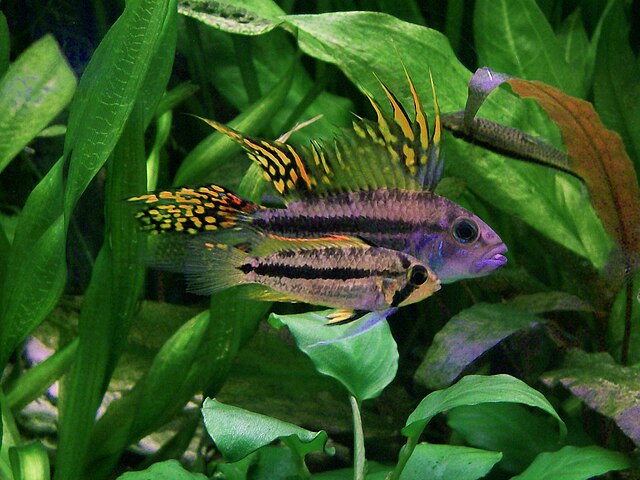
The most popular entry-level species. Males of "Super Red Cockatoo" morphs feature dramatically extended dorsal spines, and their tolerance of pH 6.0–7.0 makes them ideal for first-time Apisto keepers.
Apistogramma agassizii (Agassiz's Apisto)
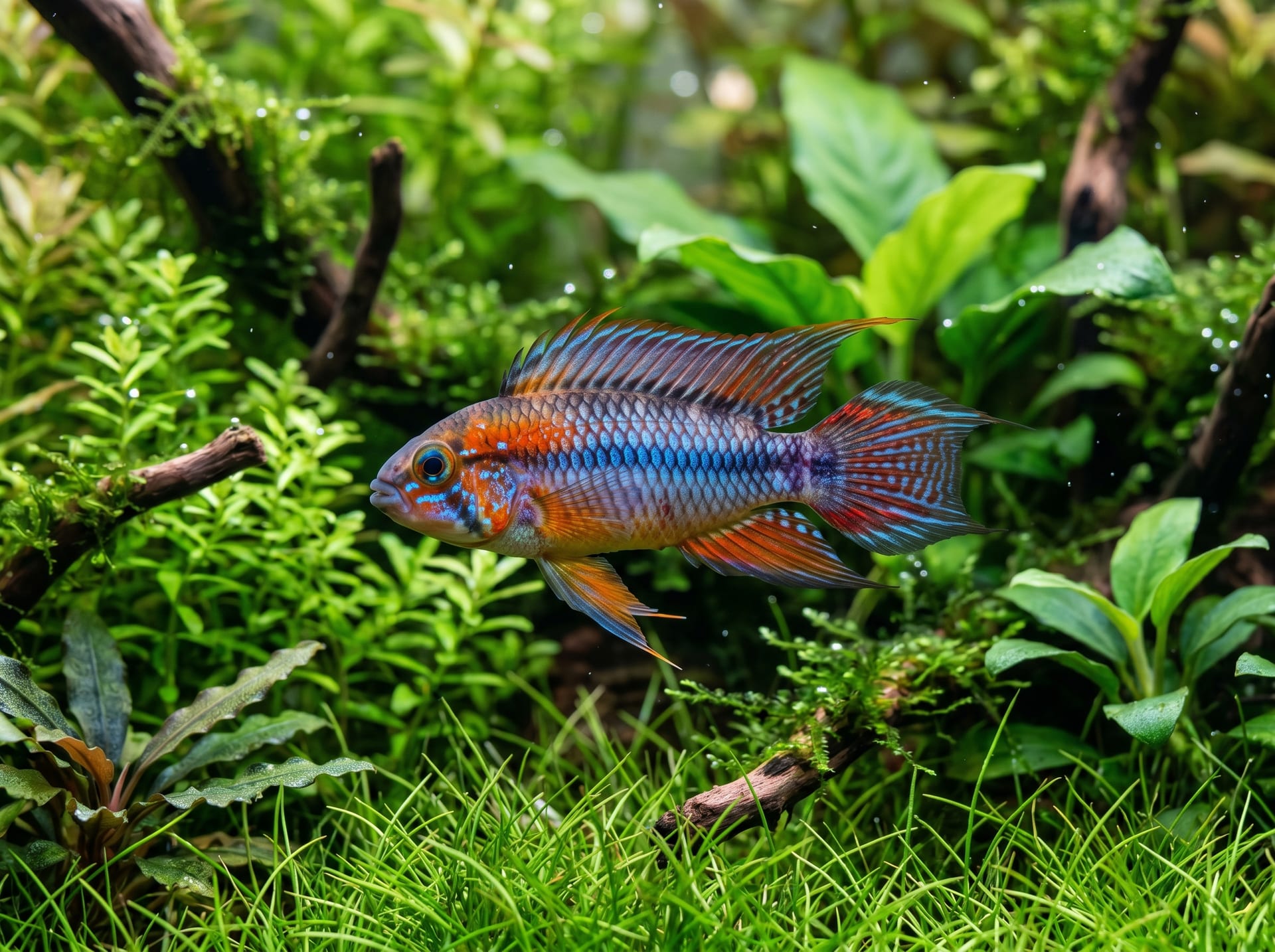
A stunning species with spade-shaped tail fins. Vibrant morphs like "Fire Red" and "Double Red" are widely available. Weakly acidic soft water (pH 5.5–6.5) maximizes coloration.
Apistogramma vittata (Banded Apisto)
An advanced-level species with striking lateral bands. Requires natural, weakly acidic blackwater conditions; hardwater easily causes color loss. Breeding difficulty is moderately high.
Conclusion
A biotope-style Apistogramma breeding tank recreates their South American habitat—ultra-soft water, weak acidity, and humic substances—bringing out their best coloration, health, and breeding behaviors. The combination of coconut shells, driftwood, dried leaves, and blackwater is both beautiful and ideal for naturalistic aquascaping enthusiasts. Despite their small size, Apistos display the intelligent behavior characteristic of cichlids. Experience their full charm through biotope-style keeping.