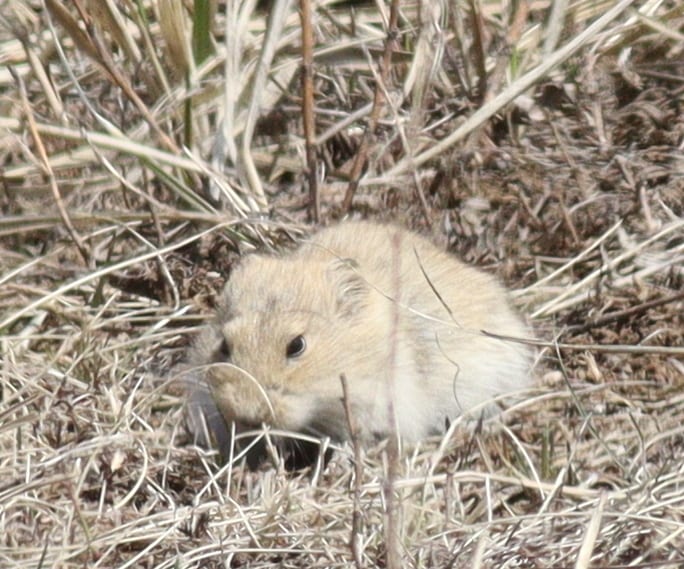
Source: Wikimedia Commons
Brandt's Vole
IntermediateLasiopodomys brandtii
A steppe vole from Mongolia and north-eastern China with small ears, short sandy-brown fur and a short tail. It lives in family burrow networks, is active day and night, and stores food for winter.
Difficulty
Intermediate
Temperature
18〜26℃
Lifespan
up to about 4 years (captive record)
Size
About 15cm long; tail up to 3.5cm
Humidity
40〜60%
Diet
Herbivore: above-ground and underground parts of plants
About
Brandt's vole (Lasiopodomys brandtii), also called the steppe vole, is a small rodent of the family Cricetidae, subfamily Arvicolinae. It lives in Inner Mongolia, Jilin and Hebei in China, in Mongolia and in southern Transbaikalia in Russia, on dry steppes, pastures and lakeside meadows. It is about 15cm long with a tail of up to 3.5cm and small ears; the short fur is uniform sandy brown, paler below, with dense hair on the back of the hind feet. Each family builds a burrow network with several entrances, passages, storerooms and nest chambers, and the voles are active both day and night. They eat both the above-ground and underground parts of plants and lay in large food stores before winter. They have four or five litters a year of about seven young, and in good years mass outbreaks strip Mongolian pastures. They adapt to cold by boosting heat production in brown fat. In Japan, captive-bred animals are handled by exotic-pet specialists.
Source: Wikipedia (CC BY-SA 4.0)
Lifespan of the Brandt's Vole
The Brandt's Vole lives up to about 4 years (captive record).
Little has been published on lifespan.
Size of the Brandt's Vole
The Brandt's Vole grows to About 15cm long; tail up to 3.5cm.
Basic Info
Origin
Steppes of north-eastern China (Inner Mongolia, Jilin, Hebei), Mongolia and southern Transbaikalia, Russia
Lifespan
up to about 4 years (captive record)
Size
About 15cm long; tail up to 3.5cm
Temperature
18〜26℃
Humidity
40〜60%
Diet
Herbivore: above-ground and underground parts of plants
Care Guide
Cage
Wild voles dig burrow networks with several entrances, storerooms and nest chambers. Provide deep bedding, nesting material and hides.
Diet
Wild voles eat both leaves and roots and store large amounts before winter. Feed mainly plant matter such as hay and vegetables; expect hoarding.
Temperament
A colonial species living in family burrow systems and active both day and night.
Breeding
Prolific, with four or five litters of about seven young a year. Keep sexes apart unless you plan to breed.
Regulations
Imports fall under the animal import notification system; animals bred in Japan need no notification.
Notes
In its native range it can erupt in huge numbers and strip pastures. Never release captive animals into the wild.
VoleSteppeColonialMongolia
Brandt's Vole FAQ
QHow difficult is it to keep Brandt's Vole?
A
Intermediate. This is an intermediate-level species. Some prior experience and knowledge of environmental management are recommended.
QWhat is the lifespan of Brandt's Vole?
A
The average lifespan of Brandt's Vole is up to about 4 years (captive record). With proper care and nutrition, they can live a long and healthy life.
QHow large does Brandt's Vole get?
A
Brandt's Vole typically reaches About 15cm long; tail up to 3.5cm as an adult. Size may vary depending on care conditions and individual genetics.
QWhat should I feed Brandt's Vole?
A
Brandt's Vole feeds on: Herbivore: above-ground and underground parts of plants. Aim for a balanced diet with appropriate feeding frequency.
QWhat is the typical price for Brandt's Vole?
A
The price of Brandt's Vole varies significantly depending on variety, age, sex, and the individual animal's condition. Check our market price page for the latest pricing information.
Last updated: September 30, 2026
References & Sources
Edited & verified by: BreederDirect editorial team
The taxonomic, regulatory, and husbandry data on this page are compiled and verified against the authoritative primary sources below.
Primary sources
Taxonomy & Authority
Accepted name: Lasiopodomys brandtii (Radde, 1861)
Synonyms: Microtus brandtii
Authority databases: GBIF · GBIF: Lasiopodomys brandtii
Nomenclature follows global taxonomic authority databases.
Regulations & Conservation Status
Not CITES-listedIUCN LC · Least Concern
Not covered by CITES, the Invasive Alien Species Act or the specified-animal rules. Imports fall under Japan's animal import notification system (Infectious Diseases Control Law, MHLW): a health certificate from the exporting country's government must be filed with the quarantine station, and rodents must come from a holding facility designated by that government. Animals bred in Japan can be sold and kept without notification. Never release captive animals into the wild.
Sources: MHLW: Animal import notification system (JA) / Species+ CITES query (not listed) / Ministry of the Environment: Invasive Alien Species list, incl. species requiring a species-name certificate (JA)
Regulations may change. Always verify the latest information with the relevant authorities.
Related Species
Brandt's Vole Listings
Loading latest listingsFind listings for this species
Related Articles
Hamster Genetics and Selective Breeding: From Coat Color Gene Basics to Understanding Diverse Color Variations
Explaining the mechanisms of coat color genes in Djungarian Hamsters and Golden Hamsters, along with basic breeding strategies for selective breeding.
The Complete Rabbit Hay Guide: Comprehensive Comparison of Timothy, Alfalfa, and Orchard Grass
This guide explains the types of hay that serve as a rabbit's staple diet, their nutritional characteristics, and the key points for selecting and feeding the right amount based on age and health status.
Beginner's Guide to 5 Recommended Small Animals | Comparing Hamsters, Rabbits, Guinea Pigs, Chinchillas, and Degus
A comprehensive comparison of 5 popular species (hamsters, rabbits, guinea pigs, chinchillas, and degus) for first-time small animal owners, covering care difficulty, cost, lifespan, tameness, and temperature management. We help you choose the species that best fits your lifestyle.
Hamster Exercise and Running Wheel Complete Guide | Optimal Size, Material, and Exercise Volume Management Methods
An explanation of how to choose and properly use running wheels for hamsters. We introduce in detail the appropriate size by species, noise level and compatibility with bedding materials, how to distinguish between signs of stress and exercise deficiency, and methods for managing appropriate daily exercise volume.
🩺 Common diseases
Psittacine Beak and Feather DiseaseCrop Infection (Ingluvitis)Egg BindingAvian Gastric Yeast (Macrorhabdosis)Feather PluckingPsittacosis (Chlamydiosis)Aspergillosis (Fungal Respiratory Infection)Scaly Face Mite (Knemidocoptes pilae)Gastrointestinal Stasis (GI Stasis)Snuffles (Pasteurellosis)Malocclusion (Dental Overgrowth)Wet Tail (Proliferative Ileitis)