Source: Wikimedia Commons
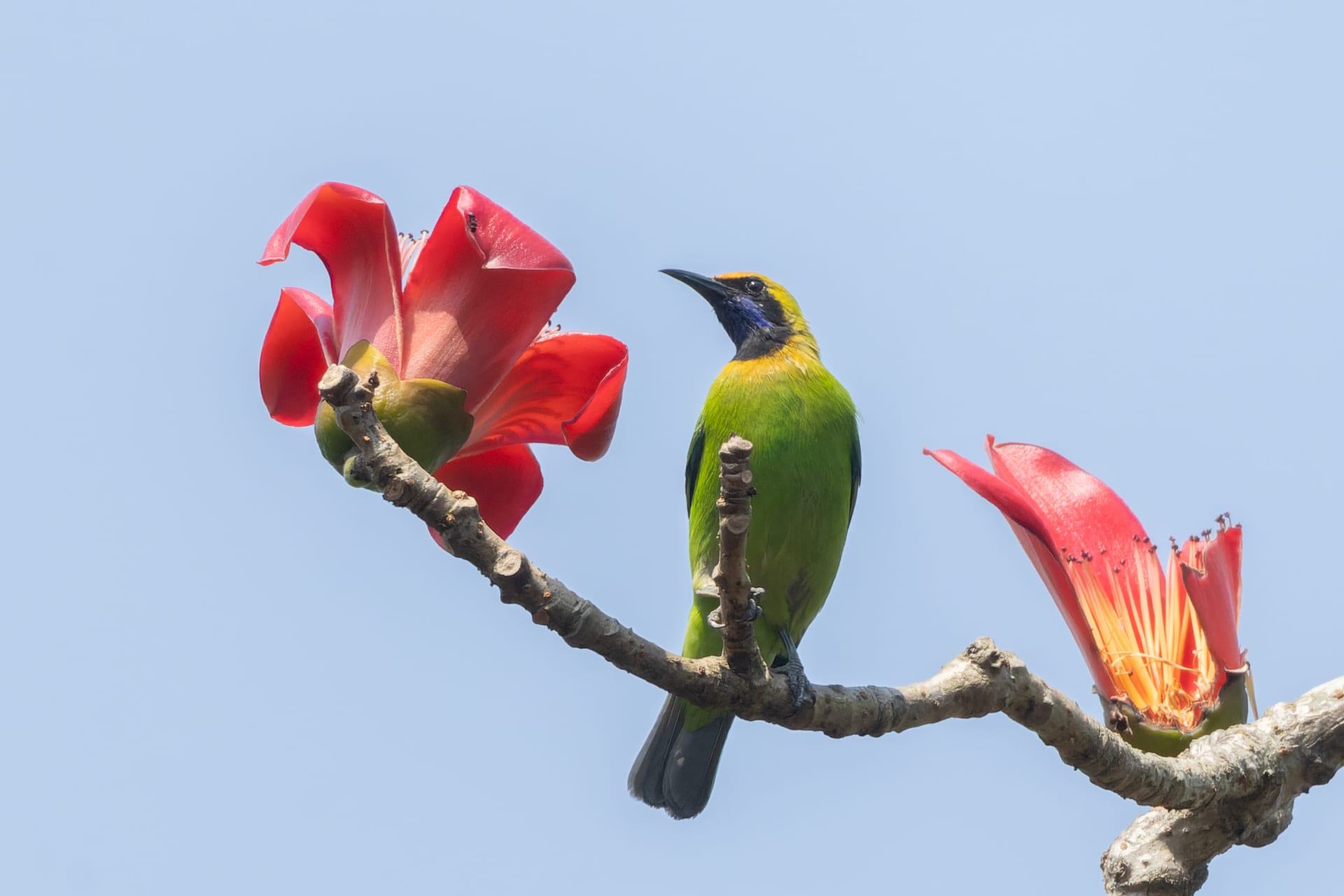
Golden-fronted Leafbird
AdvancedChloropsis aurifrons
A leafbird of South and Southeast Asia with a leaf-green body, a black face and throat bordered with yellow, a yellowish-orange forehead and a blue moustache. It mimics other birds skilfully and eats nectar, fruit and insects.
Difficulty
Advanced
Temperature
15〜30℃
Lifespan
Little data
Size
About 20 cm
Humidity
40〜60%
Diet
Softbill pellets or mash, fruit, nectar and insects such as mealworms
About
The golden-fronted leafbird (Chloropsis aurifrons) ranges from the Indian subcontinent and south-western China to Southeast Asia. It is about 20 cm long. Adults are green with a black face and throat bordered in yellow, a yellowish-orange forehead and a blue moustachial line, with blackish bill and feet and dark brown irises. It resembles the blue-winged leafbird but lacks blue in the flight feathers and tail sides. Young birds have a plain green head without the black face and throat, and females show slightly duller black. The southern Indian race frontalis has a narrower yellow border to the face, and the smaller insularis occurs further south, including Sri Lanka. The Sumatran leafbird was formerly included as a subspecies but differs extensively and is now a separate species. It is a common resident of forest canopy, deciduous forest, woodland and scrub in India, Bangladesh, Sri Lanka and Southeast Asia, and visits wooded gardens and plantations. Highly acrobatic, it often hangs upside down from twigs to glean insects and spiders, also feeding on nectar and berries and pollinating flowers as it feeds. Its song is a high, liquid, whistling warble, and it skilfully imitates other birds such as the tailorbird, black drongo and common iora. It moves in pairs or small groups of up to eight. As a nectar- and fruit-eating softbill it takes effort to keep, and in Japan imported birds occasionally appear at specialist shops.
Source: Wikipedia (CC BY-SA 4.0)
Size of the Golden-fronted Leafbird
The Golden-fronted Leafbird grows to About 20 cm.
Basic Info
Origin
Forest canopy, woodland, gardens and plantations from the Indian subcontinent and south-west China to Southeast Asia
Lifespan
Little data
Size
References & Sources
Edited & verified by: BreederDirect editorial team
The taxonomic, regulatory, and husbandry data on this page are compiled and verified against the authoritative primary sources below.
Taxonomy & Authority
Regulations & Conservation Status
Not CITES-listedIUCN LC · Least Concern
Chloropsis aurifrons. This leafbird is not listed in the CITES Appendices. It does not occur naturally in Japan; imports are subject to animal import notification under the Infectious Diseases Control Law, but no notification is needed to keep or transfer it within Japan. The IUCN assesses it as Least Concern.
Sources: Species+ search (Chloropsis aurifrons not listed) / IUCN Red List
Regulations may change. Always verify the latest information with the relevant authorities.
Golden-fronted Leafbird Listings
Loading latest listingsFind listings for this species