Source: Wikimedia Commons
Chukar Partridge
IntermediateAlectoris chukar
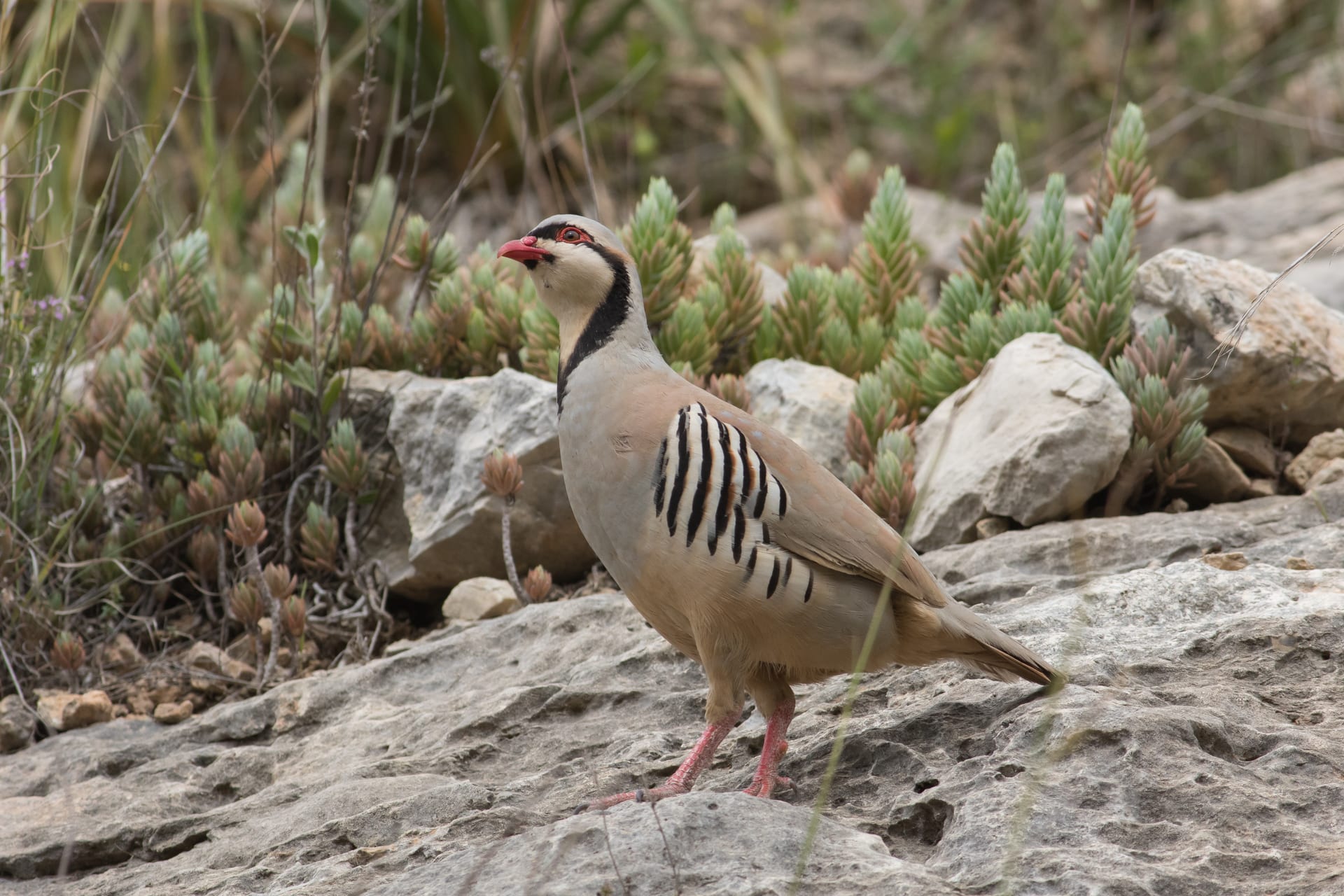
A rotund partridge whose white face and throat are ringed by a black band running from the forehead through the eye into a necklace, with bold black and white flank bars. It has red legs and a coral-red bill, and its loud 'chukar' call gives it its name.
Difficulty
Intermediate
Temperature
15〜30℃
Lifespan
Little data
Size
32-35 cm
Humidity
40〜60%
Diet
Gamebird or poultry rations, grain, seeds, greens and insects
About
The chukar partridge (Alectoris chukar) is a gamebird of dry Asian uplands from Israel and Turkey through Iran, Afghanistan, Pakistan, India and the western Himalayas to Nepal, and of parts of south-eastern Europe such as Bulgaria and Greece. It is a rotund partridge 32-35 cm long, light brown on the back, grey on the breast and buff on the belly. A black band running from the forehead through the eye and down the neck forms a necklace around the white face and throat, and the flanks carry black and white bars mixed with rufous. The legs are red and the bill coral-red. The sexes are alike, the female slightly smaller and without spurs. It is browner on the back with a yellowish foreneck compared with the rock partridge, once treated as the same species, and differs from the red-legged partridge in its sharply defined gorget that does not break into streaks. It prefers rocky hillsides with grass or scattered scrub and avoids humid, rainy regions. Outside the breeding season it lives in coveys of 10 to 50, and in summer pairs form and cocks call and fight fiercely. It has been introduced as a gamebird and established in North America, New Zealand, Hawaii and elsewhere, while releasing hybrids with the red-legged partridge is banned in countries such as the UK. In Japan it is available from ornamental gamebird dealers and fanciers.
Source: Wikipedia (CC BY-SA 4.0)
Size of the Chukar Partridge
The Chukar Partridge grows to 32-35 cm.
Basic Info
Origin
Rocky, dry hillsides from western and central Asia to the western Himalayas and parts of south-eastern Europe
Lifespan
Little data
Size
32-35 cm
References & Sources
Edited & verified by: BreederDirect editorial team
The taxonomic, regulatory, and husbandry data on this page are compiled and verified against the authoritative primary sources below.
Taxonomy & Authority
Regulations & Conservation Status
Not CITES-listedIUCN LC · Least Concern
Alectoris chukar. Not listed in the CITES Appendices, and a foreign gamebird not native to Japan. Imports are subject to animal import notification under the Infectious Diseases Control Law, but no notification is needed for transfers within Japan. Captive birds must never be released. The IUCN assesses it as Least Concern.
Sources: Species+ search (Alectoris chukar not listed) / IUCN Red List
Regulations may change. Always verify the latest information with the relevant authorities.
Chukar Partridge Listings
Loading latest listingsFind listings for this species