Source: Wikimedia Commons
Golden Pheasant
IntermediateChrysolophus pictus
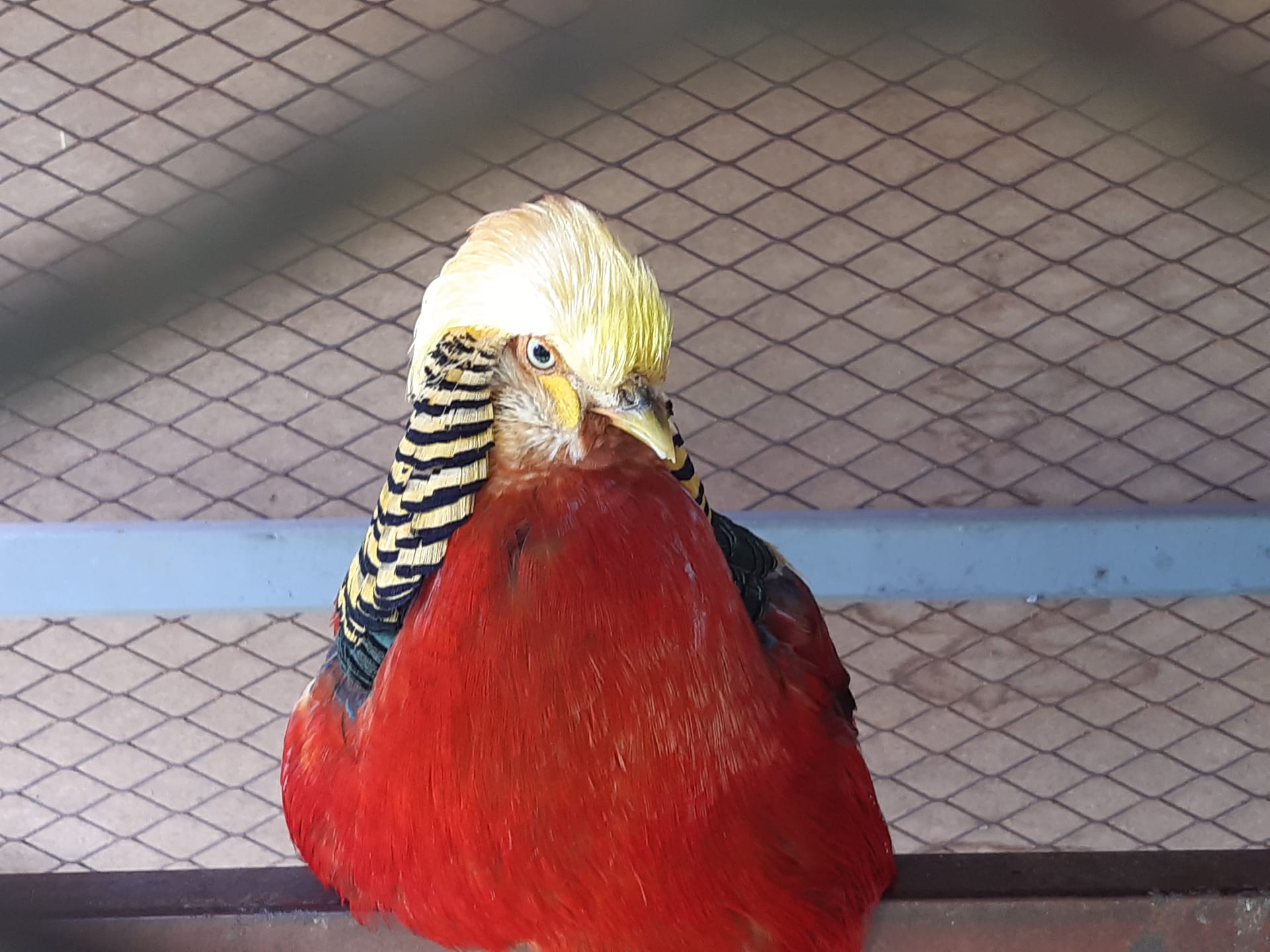
The male has a golden crest and rump and a bright red body, and two thirds of its 90 to 100 cm length is tail. It spreads a ruff of black and orange bars across the face in display. The female is a plain brown.
Difficulty
Intermediate
Temperature
15〜30℃
Lifespan
7-12 years
Size
90-100cm (male) / 50-60cm (female)
Humidity
40〜60%
Diet
Pheasant feed, grain, greens, fruit and insects
About
The golden pheasant (Chrysolophus pictus) is a gamebird of central and southern China. The genus name is Ancient Greek for golden-crested and the specific epithet is Latin for painted. It has a golden crest and rump and a bright red body, with a green upper back and golden-yellow lower back and rump. An orange ruff on the back of the neck can be spread in display as an alternating black and orange fan covering all of the face except the eyes. The eye is bright yellow with a pinpoint black pupil; the face, throat and sides of the neck are rusty tan, and the wattles and orbital skin yellow. The female, like other pheasants, is a plain brown barred with black. A captive variety in which the whole bird is bright yellow is known in Japan as the golden kinkei. The species is wary and skilled at staying hidden, so for all its colour it is hard to find in the field.
Source: Wikipedia (CC BY-SA 4.0)
Lifespan of the Golden Pheasant
The Golden Pheasant lives 7-12 years.
Size of the Golden Pheasant
The Golden Pheasant grows to 90-100cm (male) / 50-60cm (female).
The adult male is 90 to 100 cm long, two thirds of that being tail, and weighs 500 to 700 g.
Basic Info
Origin
Central and southern China
Lifespan
7-12 years
Size
90-100cm (male) / 50-60cm (female)
Care Specifications
References & Sources
Edited & verified by: BreederDirect editorial team
The taxonomic, regulatory, and husbandry data on this page are compiled and verified against the authoritative primary sources below.
Primary sources
- Wikipedia
- CITES Appendices (Chrysolophus pictus not listed)
- Annex to Council Regulation (EC) No 338/97 as amended by Commission Regulation (EU) 2026/1383 (post-CoP20)
- Ministry of the Environment, Japan - List of Invasive Alien Species designated under the IAS Act (birds)
- IUCN Red List
- Japanese Wikipedia - Kinkei (length of both sexes, morphology, habitat, captive variety, courtship)
- IOC World Bird List v15.2 (scientific name, authority, English name, range)
- GBIF
Taxonomy & Authority
Accepted name: Chrysolophus pictus (Linnaeus, 1758)
Synonyms: Phasianus pictus
Authority databases: GBIF
Nomenclature follows global taxonomic authority databases.
Regulations & Conservation Status
Not CITES-listedIUCN LC · Least Concern
Chrysolophus pictus belongs to the family Phasianidae but appears in none of the CITES Appendices; within the family the grey junglefowl Gallus sonneratii and the green peafowl Pavo muticus are in Appendix II. It is not designated an Invasive Alien Species in Japan. The IUCN assesses it as Least Concern.
Sources: CITES Appendices (Chrysolophus pictus not listed) / Annex to Council Regulation (EC) No 338/97 as amended by Commission Regulation (EU) 2026/1383 (post-CoP20) / Ministry of the Environment, Japan - List of Invasive Alien Species designated under the IAS Act (birds) / IUCN Red List
Regulations may change. Always verify the latest information with the relevant authorities.
Golden Pheasant Listings
Loading latest listingsFind listings for this species