Trachyphyllia (Open Brain Coral) Care Guide | Water Flow, Feeding, and Color Enhancement for Substrate-Dwelling LPS
Trachyphyllia (Trachyphyllia geoffroyi) is a popular LPS coral known for its vibrant green, red, and multicolor variations. This guide details placement, feeding, and water flow management specific to substrate-dwelling corals, along with color enhancement tips and troubleshooting for common issues.
Key Takeaways
Trachyphyllia (Trachyphyllia geoffroyi) is a popular LPS coral known for its vibrant green, red, and multicolor variations. This guide details placement, feeding, and water flow management specific to substrate-dwelling corals, along with color enhancement tips and troubleshooting for common issues.
Related Species
What Kind of Coral is Trachyphyllia?
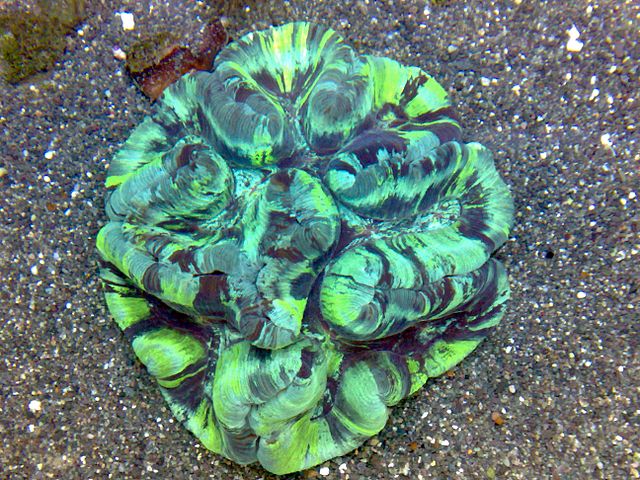
Trachyphyllia (Trachyphyllia geoffroyi) is an LPS (large polyp stony coral) belonging to the order Scleractinia and family Plerogyridae, commonly called the Open Brain Coral in English. It inhabits the sandy-mud substrates along the reef slopes of the Indian and Western Pacific Oceans and lives as a solitary, free-living substrate-dwelling coral.
Its most distinctive feature is its convoluted, brain-like skeletal structure and round, bulbous appearance when its polyps are fully expanded. It comes in a variety of stunning colors—fluorescent green, vibrant red, orange, and multicolor morphs—making it highly valued as a colorful addition to reef tanks.
Basic Information
| Item | Details |
|---|---|
| Scientific Name | Trachyphyllia geoffroyi |
| Common Name | Open Brain Coral |
| Classification | Hexacorallia, Order Scleractinia |
| Form | Solitary (free-living) |
| Skeleton | Cup-shaped, brain-like (thick coenosarc) |
| Care Difficulty | Beginner to Intermediate |
| Recommended Tank Size | 30L or larger |
Aquarium Setup and Environment
Placement
The basic principle is to place Trachyphyllia directly on the substrate. Fixing it to rock formations or frag plugs can tilt the skeleton and restrict polyp expansion.
- Place on sandy substrate (aragonite sand or coral sand)
- A substrate depth of 3–5 cm ensures good stability
- Provide adequate space (1.5× the diameter or more) for full polyp expansion
- Maintain a minimum distance of 10 cm or more from other corals, as sweeper tentacles can sting nearby corals
Water Parameters
| Parameter | Target Range |
|---|---|
| Temperature | 24–27°C |
| Specific Gravity / Salinity | 1.023–1.026 |
| pH | 8.1–8.3 |
| Alkalinity (KH) | 8–11 dKH |
| Calcium (Ca) | 380–450 mg/L |
| Magnesium (Mg) | 1,250–1,350 mg/L |
| Nitrate (NO₃⁻) | 5–20 ppm |
| Phosphate (PO₄³⁻) | 0.02–0.10 ppm |
Trachyphyllia prefers environments with moderate nutrient levels rather than extremely low nutrient systems (ULNS). Color expression tends to be better when nitrate levels are around 10–20 ppm.
Lighting
| Intensity | PAR Range | Characteristics |
|---|---|---|
| Low to Medium | 50–150 μmol/m²/s | Red morphs remain stable in lower light |
| Medium to High | 150–300 μmol/m²/s | Green morphs show enhanced fluorescent colors |
Light acclimation is critical: When first introduced, always place the coral in the darkest part of the tank (near the substrate edge) and gradually move it to its final position over 2–4 weeks. Sudden exposure to high light can cause fading and bleaching.
Water Flow
Trachyphyllia requires weak to moderate indirect water flow.
- Direct strong water flow causes polyps to remain contracted
- Indirect, random water flow (circulation without direct contact) is ideal
- Insufficient flow allows detritus to accumulate on the skeleton, leading to disease
Feeding (Target Feeding)
Regular target feeding significantly improves growth and color expression in Trachyphyllia.
Recommended Foods
| Food Type | Characteristics | Feeding Frequency |
|---|---|---|
| Frozen Mysis Shrimp | High nutrition, appropriate polyp size | 2–3× per week |
| Frozen Copepods | High nutritional value, suitable for small polyps | 1–2× per week |
| Finely Chopped Krill | High palatability | Once per week |
| Liquid Plankton (Phytoplankton) | Nutritional support for coenosarc | 2–3× per week |
Target Feeding Steps
- Feed 30–60 minutes after lights off (polyps are most expanded at night)
- Turn off or minimize the circulation pump
- Use a pipette to place food directly into the polyp's mouth (the central groove)
- Wait 5–10 minutes for the polyp to consume the food
- Remove uneaten food with a siphon
Post-feeding note: Digestion should complete by morning, after which polyps re-expand. If polyps remain contracted the next day, suspect digestive issues or water quality problems.
Color Enhancement Tips
Achieving vibrant coloration in Trachyphyllia requires balancing lighting, nutrient levels, and amino acid supplementation.
Enhancing Green Coloration
- Enhance blue and violet spectrum in lighting (activates fluorescent proteins)
- Maintain nitrate at moderately higher levels (10–20 ppm)
- Add amino acid supplements 2–3× per week in small amounts
Maintaining Red and Orange Coloration
- Avoid excessive lighting (PAR 100–200 is stable)
- Maintain temperature at 26–27°C (higher temperatures accelerate red pigment breakdown)
- Excessive nutrients (NO₃ over 30 ppm) promote brown algae and diatom growth, creating a brownish appearance
Common Problems and Solutions
Polyps Not Opening (1+ Week)
Causes and Solutions
| Cause | Symptom | Solution |
|---|---|---|
| Water flow too strong | Polyps remain contracted during the day | Adjust flow to indirect |
| Light too intense | Often occurs after shipping | Shade and gradually acclimate |
| Water quality issues (KH fluctuation, high ammonia) | Other corals also declining | Test water, perform water change |
| Post-shipping stress | May recover naturally in 2–3 days | Leave undisturbed, monitor |
Skeleton Becoming Visible (Bleaching/Tissue Loss)
- Partial bleaching (localized): Damage from sweeper tentacles or detritus accumulation. Move nearby corals away and clean the area
- Rapid overall bleaching: Sign of RTN (rapid tissue necrosis) or environmental shock. Isolate, test water parameters, consider treatment
- Gradual tissue recession: Indicates nutrient deficiency or lighting issues. Increase feeding and review lighting
Skeleton Rolling off Substrate
- Shallow substrate or overly large sand grains cause instability
- Use a small sand pedestal designed for corals (donut-shaped) or a coral-specific stand for stability
Benefits of Purchasing from Breeders
Trachyphyllia is available as both wild-caught (WC) and captive-bred (CB) fragments.
Advantages of Captive-Bred Fragments (CB)
- Higher adaptation to aquarium conditions (less acclimation stress than wild-caught)
- Color and form characteristics are more stable and consistent
- No concerns about illegal collection or environmental impact
Selection Tips
- Choose individuals with fully expanded polyps
- Check that the skeleton has no bleached areas or thin tissue sections
- Well-fleshed edges (crests) are a sign of good health
- Before purchasing, confirm the breeder's water parameters (KH, Ca, Mg) and match them in your tank
Summary
Trachyphyllia is among the most colorful and striking substrate-dwelling LPS corals, and with regular feeding and proper lighting and flow management, it can maintain beautiful coloration long-term. It displays its truest colors in systems with moderate nutrient levels rather than ultra-low nutrient systems, making it an excellent choice for first-time LPS keepers.
Raising fragments is less risky than wild-caught specimens, and purchasing directly from breeders allows you to confirm health status and lineage information. For anyone looking to add red, green, or multicolor accents to their coral tank, Trachyphyllia is definitely worth trying.