Complete Guide to Giant Japanese Stag Beetle Breeding | Egg-Laying Setup, Larval Care, to Emergence
Complete guide to giant Japanese stag beetle breeding methods. Covers pairing and egg-laying setup construction, proper use of fungal substrate vs. fermented mats, larval temperature management and substrate exchange timing, and management through pupation and post-emergence.
Key Takeaways
Complete guide to giant Japanese stag beetle breeding methods. Covers pairing and egg-laying setup construction, proper use of fungal substrate vs. fermented mats, larval temperature management and substrate exchange timing, and management through pupation and post-emergence.
Related Species

Giant Japanese Stag Beetle Breeding Fundamentals
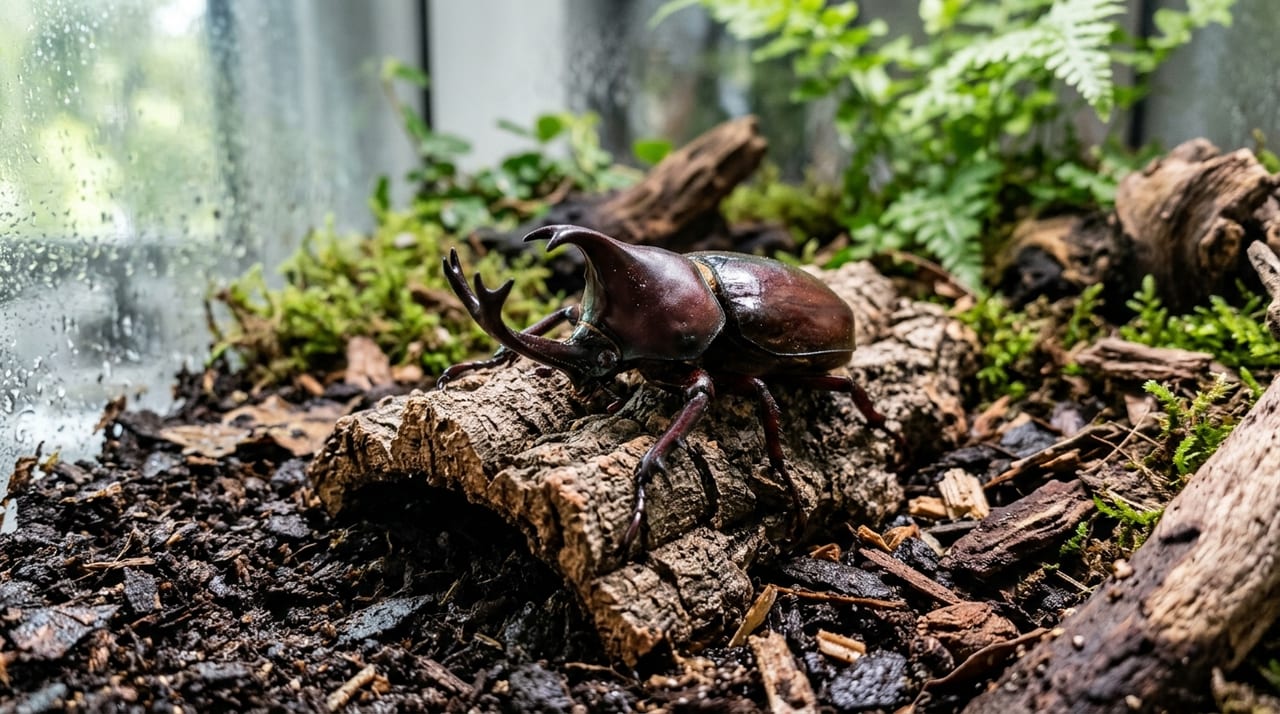
Giant Japanese stag beetle (Dorcus hopei binodulosus) is the most popular species among Japanese stag beetles. Breeding has low difficulty, and with proper environmental setup, even beginners can achieve successive generational breeding. Adult lifespan is long at 2 to 3 years, and you can expect approximately 20 to 50 eggs per spawning setup.
An important point to understand before starting breeding is the life cycle of the giant Japanese stag beetle. Adults undergo a post-emergence feeding period of 3 to 6 months after emergence before reaching sexual maturity. Attempting to mate without allowing this period will not result in egg-laying, so it is important to wait patiently for maturity. Additionally, unlike wild specimens, captive breeding allows year-round egg-laying through temperature management, but considering the physical stamina of females, spring to early summer is the ideal spawning period.
Parent Stock Selection and Mating Preparation
Selecting quality individuals requires careful parent stock selection. The key points to verify in selection are as follows:
- Body length: Males 70mm or more, females 45mm or more (tend to be genetically larger)
- Mandible shape
- Body shape balance
- Color intensity
As preparation before mating, begin feeding high-protein jelly one month before pairing to establish proper nutrition. Females expend significant physical stamina through egg-laying, so nutritional management is especially important. Pairing is performed in a plastic case (approximately 23cm wide × 15cm deep × 17cm high), with bark for anti-tipping placed inside and wood fragments serving as a spawning shelter. The co-habitation period should be approximately 3 to 7 days; if injuries appear on the female's body, separate them promptly.
Egg-Laying Setup Construction
The egg-laying setup uses a medium to large case (30cm wide × 20cm deep × 20cm high or larger). Pack fine-particle fermented mat firmly about 5cm from the bottom, then place the spawning wood on top.
Wood selection and preparation are key to success. For giant Japanese stag beetles, firm oak (Konara/Kunugi) wood is suitable, using two pieces approximately 8-10cm in diameter and 15cm in length. Pre-treatment before use is essential and should be done following these steps:
- Fill a bucket with water, submerge the spawning wood, and allow it to absorb water for 6 to 12 hours
- Dry in shade for half a day to one day
- Remove the bark before use (this promotes female egg-laying and improves larval feeding after hatching)
After placing the spawning wood on the mat, add mat around it until approximately half the wood is buried. Finally, place anti-tipping material and jelly, then introduce the female. The post-setup management conditions are as follows:
- Temperature: 20 to 25°C
- Humidity: 60 to 70%
- Location: Dark location
Egg-Laying and Extraction Timing
Egg-laying activity occurs 1 to 2 months after introducing the female. Signs of egg-laying include wood chips scattered on the mat surface and holes appearing in the spawning wood. However, frequent checking of the case causes the female stress, so limit observation to approximately once per week.
Extraction (removing eggs and larvae from the spawning wood) should be done approximately 6 to 8 weeks after setup. If done too early, eggs will be crushed at the egg stage; if too late, larvae will interfere with each other, increasing the risk of cannibalism. During extraction, remove the spawning wood from the case and carefully split it with a flathead screwdriver or knife. Since eggs are delicate, transfer them to individual management containers with a specialized spoon when found. First-instar larvae are individually placed in fungal substrate bottles or fermented mats.
Larval Breeding and Size Maximization Tips
The larval period of giant Japanese stag beetles varies significantly from 8 months to 2 years depending on temperature management. For producing large individuals, low-temperature extended breeding is effective, but standard breeding is easier to manage. The guidelines are as follows:
| Breeding Method | Temperature | Duration |
|---|---|---|
| Low-temperature extended breeding (for large individuals) | 18 to 20°C | 18 to 24 months |
| Standard breeding | 22 to 24°C | 12 to 18 months |
Containers are changed as the larvae grow.
- First to second instar: 500 to 800ml bottles
- Third instar: 1400 to 1500ml bottles
Fungal substrate bottle breeding produces the largest individuals most easily. Oyster mushroom (Hirataketei) substrate is stable, but king tuft mushroom (Kawaratake) substrate can produce even larger individuals. However, king tuft mushroom is difficult to manage, so it is recommended for intermediate breeders. Satisfactory results can be obtained with mat breeding as well; use fine-particle mat with advanced fermentation and perform substrate changes every three months. Size is slightly smaller compared to fungal substrate bottles, but the size guidelines depending on breeding method are as follows:
| Breeding Method | Male Size Target | Female Size Target |
|---|---|---|
| Fungal substrate bottle breeding | Over 80mm | Over 50mm |
| Mat breeding | Approximately 75mm | Approximately 48mm |
The key point in larval breeding is minimizing temperature fluctuations. Sudden temperature changes cause significant stress to larvae and can result in death in severe cases. Additionally, pay attention to fungal substrate bottle deterioration; if the surface becomes watery or develops an off-odor, replace it immediately.
Pupation, Emergence, and New Adult Management
When third-instar larvae begin to show yellowing and body contraction, this indicates pupation is approaching. Once at this stage, never apply vibration or impact. If disturbed while constructing the pupal chamber, there is a risk of emergence failure in an incomplete pupal chamber.
The timeline from pupation to emergence and sexual maturity is as follows:
- Pupation to emergence: Approximately 1 month
- Post-emergence hardening period (do not excavate until body is hardened): Approximately 1 month
- Dormancy period within the pupal chamber: 3 to 6 months
- Post-emergence feeding start to sexual maturity: 3 to 6 months
Newly emerged adults have soft bodies and should never be excavated even during the hardening period; wait for them to naturally emerge above ground. Artificial excavation causes hardening failure and deformation of the body. Once an individual emerges above ground, transfer it to a separate container and provide jelly. During the first 1 to 2 weeks, they will eat only small amounts, but appetite gradually increases.
If you wish to continue successive generational breeding, we recommend introducing new bloodlines every three generations to prevent genetic deterioration from inbreeding. With proper management, giant Japanese stag beetle breeding will proceed stably and successfully, and breeding skills will continue to improve with each passing generation.