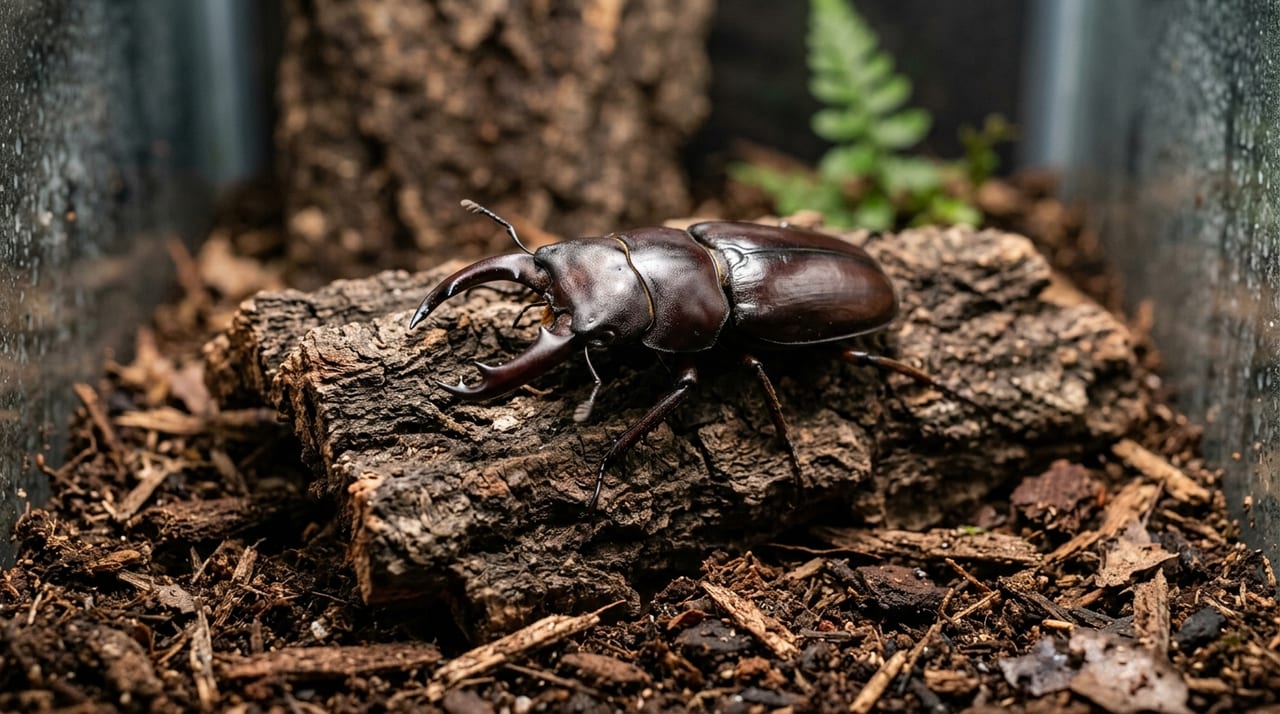
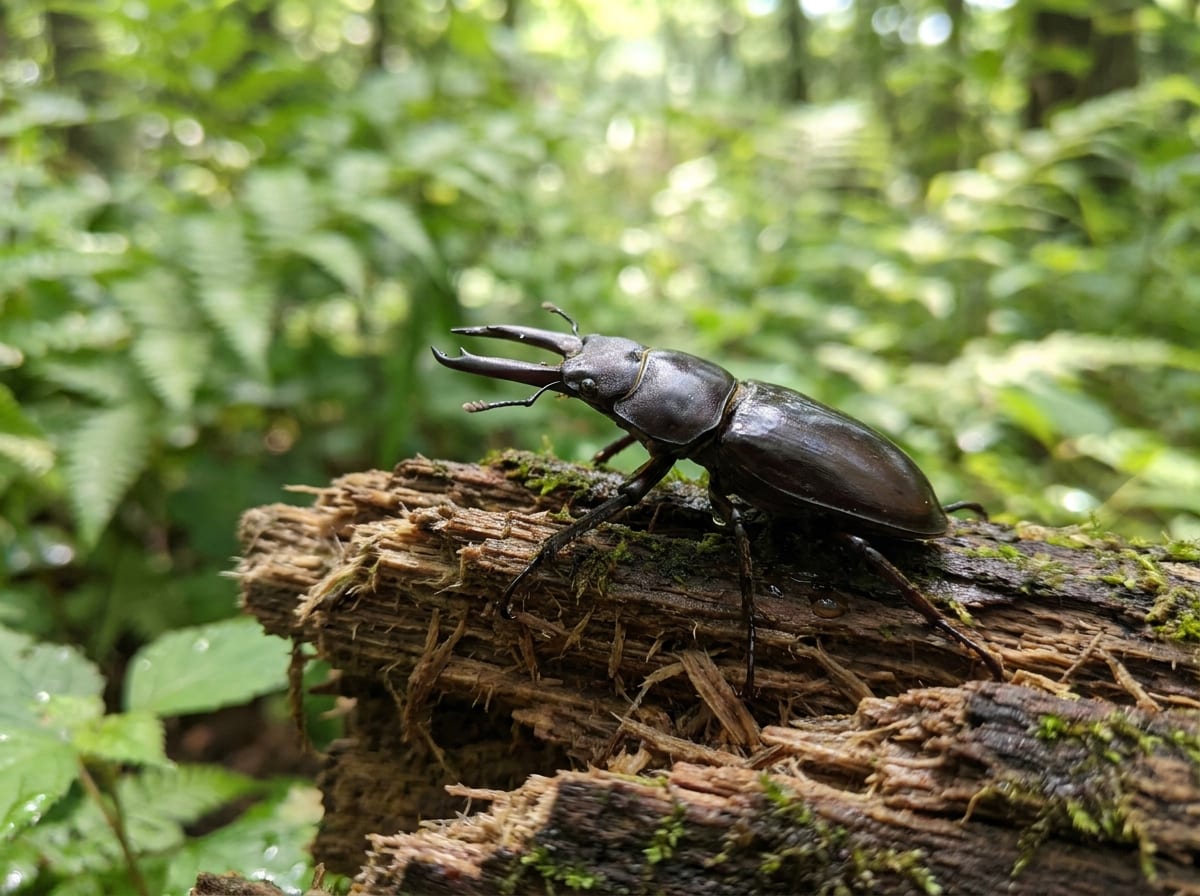
Basic Profile of Small Japanese Stag Beetles and Breeding Mechanisms
The Small Japanese Stag Beetle (Dorcus rectus) is one of the most accessible stag beetle species found throughout Japan. While males show individual variation in mandible development, they typically measure 17–54 mm in length overall, making them compact and easy to handle. They are popular with both beginners encountering stag beetles for the first time and serious breeders alike.
In the wild, they lay eggs in decaying wood such as Kunugi oak and Japanese oak, with larvae developing by consuming the interior of the wood. The fundamental principle behind a breeding setup is to recreate this natural ecology in captivity. Small Japanese Stag Beetles are relatively hardy with strong breeding drive, and with proper environmental conditions, even beginners can successfully produce a sufficient number of larvae.
The peak breeding season for adults is roughly June through August. Collected wild specimens are often already mated, but when pairing beetles in captivity, the standard method is to place males and females together in the same container for several days to a week, then transfer only the female to the breeding setup. Once mating is confirmed, remove the male promptly to reduce stress on the female.
Setting Up a Breeding Container | Selecting Breeding Wood and Substrate
For the breeding container, using a sealed container type such as a fruit fly-proof case is easiest to manage. A medium-sized container (capacity around 20–30 liters) allows comfortable placement of 2–3 pieces of breeding wood.
Breeding wood made from Kunugi or Japanese oak is readily available and standard. While Small Japanese Stag Beetles will lay eggs in hardwood, moderately soft wood (soft enough to yield slightly when pressed with a finger) is generally considered the best balance for egg-laying numbers and practical management. Before use, soak the breeding wood in a bucket or large container filled with water with a weight on top for 1–2 hours until fully saturated. After removing it, set it aside in a shaded location for several hours to allow excess surface moisture to evaporate before use.
Substrate (bedding material) should be fermented substrate or insect substrate formulated for breeding. Firmly pack 5–10 cm at the bottom of the container, then arrange the breeding wood horizontally on top, and loosely cover with the same substrate until approximately the upper half of the wood is exposed. Moisten the substrate as well, aiming for dampness that forms a ball when squeezed. Avoid excessive drying, which reduces egg-laying numbers, and regularly check and mist with water as needed.
Breeding Duration and Management Temperature | From Female Introduction to Container Opening
Once the female is placed in the breeding setup, keep the container in a quiet location and avoid opening the lid frequently. Females actively laying eggs are sensitive, and unnecessary vibration or light can reduce breeding drive.
Temperature of 23–27°C is ideal for breeding. Above 30°C, both adults and larvae are prone to damage, so summer management in a cool, dark area or air-conditioned room is preferable. Conversely, if temperature drops significantly below 20°C, activity slows and breeding nearly ceases, so be cautious of unseasonably low temperatures.
After introducing the female, open the breeding setup after approximately 4–6 weeks to collect larvae and eggs. Some individuals show visible gnaw marks on the breeding wood as early as 1–2 weeks after introduction, indicating active egg-laying. Increasing fine powder-like marks on the wood surface is a sign of normal progress. Typically, 20–50 larvae are obtained per breeding season, with numbers potentially higher depending on the number of wood pieces and the female's condition.
Larva Management | Characteristics of Fungal Medium and Substrate Rearing
Collected larvae may include newly hatched first instars and larvae already in the second or third instars. First instars are extremely small and fragile; when extracting, carefully crumble the substrate by hand and proceed with caution.
Substrate rearing is the simplest method. Use fermented substrate (secondary fermentation or higher) in 120–500 ml containers such as pudding cups, or transfer to bottles as they grow. Since Small Japanese Stag Beetles are small, larvae can successfully reach adulthood in 800 ml–1 liter bottles. Replace substrate when it becomes dark and compacted from feeding, typically every 2–3 months.
Fungal medium rearing accelerates growth and makes larger individuals more achievable. Oyster mushroom and King oyster mushroom fungi are standard for this species. However, since Small Japanese Stag Beetles have simple dietary needs, the difference from substrate rearing is not substantial, and substrate rearing is sufficient if cost is a priority.
Optimal larval rearing temperature is 20–25°C. Higher temperatures increase mortality risk, while lower temperatures slow development but tend to produce larger individuals. During winter, maintain at least 15°C to ensure continuous steady growth.
Pupation, Adult Emergence, and First Feeding Schedule
The larval period for Small Japanese Stag Beetles typically lasts 8 months to 1.5 years, varying significantly with rearing temperature and individual differences. After the third instar stage, feeding consumption decreases and larvae begin preparing to construct a pupation chamber. Once pupation chamber construction begins, avoid moving the container or causing vibrations, as chamber collapse increases the risk of emergence deformities.
Pupation to adult emergence takes approximately 3–5 weeks. Newly emerged adults have soft bodies and pale coloring, gradually hardening and darkening. Forcing extraction during this period damages individuals; wait until they emerge from the pupation chamber on their own. Even after self-emergence, body hardening may not be complete for 1–3 weeks, so minimize handling.
After emergence, when the adult begins eating jelly and other food, this is called first feeding, and confirming first feeding before using the individual for future breeding is the safe approach. The period from emergence to first feeding is typically 1–3 months but varies with season and temperature.
Common Mistakes in Small Japanese Stag Beetle Keeping and Solutions
No eggs or very few larvae: The most common cause is insufficient substrate moisture and drying. After setup, regularly check the surface and mist with water as needed. Additionally, if the female is immature (recently emerged and before first feeding), breeding will not occur. Confirm first feeding before placing females in the breeding setup.
Larvae die: Excessive moisture or oxygen depletion can cause this. Even in sealed containers, maintain small air holes, and keep substrate moisture at the "forms a ball when squeezed" level. When changing substrate, place larvae in room-temperature substrate and avoid sudden temperature changes.
Emergence deformities occur: The primary cause is pupation chamber collapse. If the chamber is visible from the outside of the bottle, observe without opening. If the chamber does collapse, move the individual to an artificial pupation chamber (commercial product or compacted damp tissue) for management.
Small Japanese Stag Beetles are hardy and provide an excellent introduction to the complete insect-keeping cycle—from breeding setup through larval rearing, emergence, and adult management. Experiencing the full progression builds confidence for advancing to larger and rarer stag beetle species.