Medaka and Paddy Field Conservation | The Role of Medaka in Protecting Japan's Traditional Landscape
An explanation of medaka and paddy field environment conservation. Introduces the current state of wild medaka, biotope conservation activities, and native species protection efforts.
Key Takeaways
An explanation of medaka and paddy field environment conservation. Introduces the current state of wild medaka, biotope conservation activities, and native species protection efforts.
Medaka were once essential to Japan's rural landscape. Walking along the paths between rice paddies, one could see the shadows of small fish rippling in the irrigation channels everywhere, with children chasing them with nets—but such scenes are now becoming distant memories. Once the epitome of a fish "found anywhere," medaka were designated as Vulnerable on Japan's Ministry of the Environment Red List in 1999. While the number of people enjoying medaka keeping is increasing, it is also the responsibility of hobbyists to properly understand the reality facing wild medaka. This article provides a detailed explanation of the current state of wild medaka, the frontlines of conservation efforts, and what we can do.
The Current State of Wild Medaka—Life Disappearing from Japan's Waterways
Medaka Designated as an Endangered Species
Medaka (Oryzias latipes) are freshwater fish found in Japan, the Korean Peninsula, southern China, and other regions. Despite being small fish, only 2–4 cm in body length, they have adapted to diverse environments such as rice paddies, streams, irrigation channels, and reservoirs, and have supported Japan's aquatic ecosystems for many years.
However, in 1999, they were designated as Vulnerable on the Ministry of the Environment's Red List. This designation means that "if current conditions continue, the risk of extinction will increase in the near future." Surveys of habitats have revealed that medaka populations have drastically declined or completely disappeared from most locations where they were once confirmed.
Genetic Diversity: Northern and Southern Japanese Populations
An often-overlooked but important fact is that Japanese medaka consist of two genetically distinct groups: the Northern Japanese population and the Southern Japanese population. While both have nearly identical appearances and are difficult to distinguish, they have over millions of years of divergence at the genetic level. This genetic diversity reflects regional environmental adaptations, and in conservation, the origin—"where the medaka are from"—is extremely important.
Three Reasons for the Drastic Decline of Medaka
Loss of Habitat Due to Concrete Lining of Irrigation Channels
Since the period of rapid economic growth, agricultural irrigation channels nationwide have been successively reconstructed with three-sided concrete lining to improve agricultural efficiency. In naturally banked channels, aquatic plants flourished abundantly, and medaka had plenty of places to spawn, rest, and take shelter, but concrete channels deprive them of all these. The water flow also becomes faster, making it impossible for medaka with weak swimming ability to survive, and their connection to rice paddies is severed.
In addition to irrigation channel problems, the reclamation of reservoirs and wetlands, the straightening of rivers, and riverbank construction projects have also accelerated habitat loss.
The Impact of Pesticides and Chemical Substances
Pesticides, including neonicotinoid insecticides, drastically reduce aquatic insects (such as chironomid larvae and water fleas) that medaka feed on, indirectly disrupting the food chain. Research has also shown that even low concentrations of pesticides themselves can affect medaka reproduction behavior and development. The elimination of aquatic plants due to herbicides is also a factor in the loss of spawning grounds.
Encroachment of Habitat by Invasive Species
The mosquitofish (North American native, designated invasive species), while preferring nearly the same environment as medaka, has far superior reproductive capacity and rapidly encroaches on medaka habitat. They are often confused because they look similar, but mosquitofish are ovoviviparous (giving birth to live young directly) and their tail fin shape differs from medaka. In addition to mosquitofish, bluegill and carp (large individuals) also negatively impact native medaka.
Conservation Efforts Spreading Across the Country
Biotope Channels and Winter Flood Water Rice Paddies
In recent years, various initiatives have been underway as part of "environmentally conscious agriculture" that balances agriculture with biodiversity.
- Biotope channels: Sections of concrete channels are restored to natural banks and aquatic plants are planted. These create spaces where medaka and other aquatic organisms can breed and reproduce.
- Winter flood water rice paddies: An agricultural method where water remains in paddies even after harvest, increasing aquatic organisms that can overwinter and enhancing biodiversity the following spring. This is also attracting attention as a feeding ground for migratory birds.
- Fish passage construction: Infrastructure that eliminates height differences between concrete channels and paddies, making it easier for medaka to enter rice paddies. This is an important infrastructure connecting spawning and rearing areas.
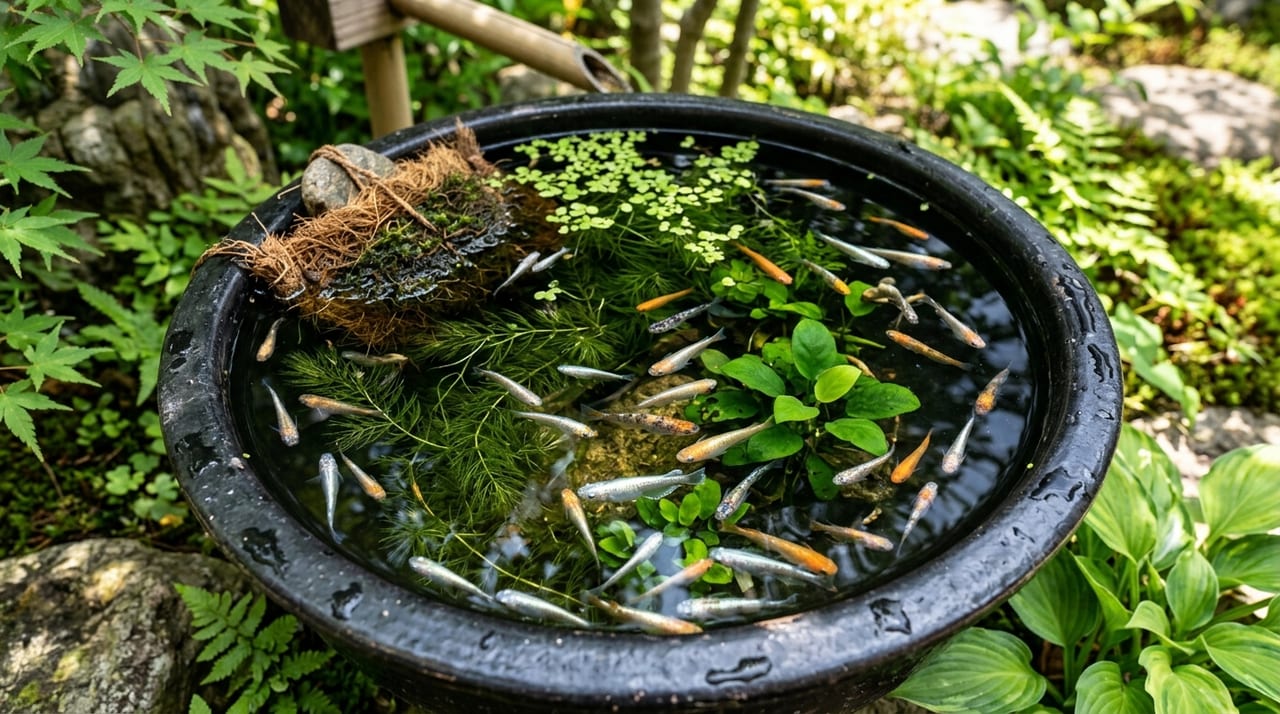
Similar concepts can be implemented at home. The method for creating outdoor biotopes is explained in detail at Medaka Outdoor Biotope Keeping Guide | How to Recreate a Natural Ecosystem.
School Biotopes and Regional Conservation Centers
School biotope initiatives, where small ponds or wetlands are created on school grounds, are expanding throughout primary and middle schools across the country. By having students observe and keep native medaka, understanding of the natural environment and conservation awareness are fostered. Additionally, local governments and NGOs are actively setting up protected pools called "Medaka Villages" to protect medaka with locally unique genetic traits.
Responsibilities Hobbyists Should Know
Never Release into Nature
Releasing into natural waters is strictly prohibited, whether they are cultivated varieties of medaka (such as Yougui-fei, Mikiyuki, or Daruma) or "ordinary medaka." Even if they appear similar to wild medaka, captive-bred individuals may carry genes from different regions. If genetic contamination (hybridization) occurs through release, regionally unique genetic diversity is lost and conservation efforts become futile.
Be Aware of the Distinction Between Native and Cultivated Varieties
Cultivated varieties are creations developed by humans over many years as ornamental fish, and many individuals possess traits that cannot survive in natural environments (such as reduced vision or body deformities). The principle in conservation activities aimed at protecting native medaka is to always use locally sourced pure individuals. Even when enjoying medaka keeping, "ornamental varieties" and "native species" should be clearly distinguished and managed separately. Characteristics of each variety can be reviewed at Medaka Variety Encyclopedia | Characteristics and Selection Guide of Popular Varieties.
Participate in and Support Local Conservation Activities
Individual contributions to conservation include participating in local biotope development and cleanup activities. Reconsidering the use of pesticides and herbicides, and creating small water basins in your garden or under eaves to increase water habitats where medaka can live, are small but meaningful actions. Donations to conservation organizations and raising awareness also help expand the movement.
Summary | Balancing the Joy of Keeping Medaka with the Responsibility to Protect the Wild
Medaka keeping continues to grow in popularity each year due to its depth and complexity. However, there is a dilemma: as the enjoyment of keeping medaka spreads, the risk of impact on wild medaka also increases. What is important is to separate the enjoyment of observation and keeping from conservation of wild species.
Breeders registered with BreederDirect treasure the characteristics of their varieties and proper husbandry management, providing healthy individuals responsibly. By being conscious of "impact on the natural environment" at all stages—purchase, keeping, and breeding—and avoiding release or improper disposal, we can pass Japan's waterways on to the next generation.
The sight of a rice paddy where small medaka swim is evidence that Japan's nature is healthy. Each keeper's individual awareness becomes the power to protect that original landscape.