Introduction to Medaka Genetics | Essential Genetics Knowledge for Selective Breeding
Explains the fundamentals of genetics necessary for medaka selective breeding. Introduces body color genetics and crossbreeding planning methods.
Key Takeaways
Explains the fundamentals of genetics necessary for medaka selective breeding. Introduces body color genetics and crossbreeding planning methods.
Related Species
Things to Know Before Learning Medaka Genetics
Medaka selective breeding is not merely a hobby of "raising beautiful fish," but also a practical learning ground for understanding genetic principles. Yo-Guifei, Mikino, Sanshoku, and Lame—all these beautiful varieties have been created by predecessors using genetic laws.
However, many people find genetics intimidating when they hear the word. Don't worry. The fundamental genetics knowledge needed for medaka selective breeding is not so complex if you learn it step by step. This article explains the basic genetic principles you should first understand when engaging in selective breeding, as simply as possible. For those who want to delve further into actual crossbreeding techniques, also see Medaka Breeding Guide | From Spawning Conditions to Fry Rearing.
How Pigment Cells Determine Medaka Body Color
Medaka body color is determined by the combination of multiple pigment cells present in their bodies. The types and quantities of these pigment cells are the fundamental factors that create the diversity of body colors.
Four Types of Pigment Cells
- Melanophores (black pigment cells): Cells containing black to brown pigments. Involved in the dark body coloration of black and blue medaka.
- Xanthophores (yellow pigment cells): Cells containing yellow to orange pigments. Closely related to the vermillion-red color of Yo-Guifei.
- Iridophores (iridescent pigment cells): Cells containing guanine crystals that reflect light. Form the basis of the body shine in Mikino medaka and the glitter in Lame varieties.
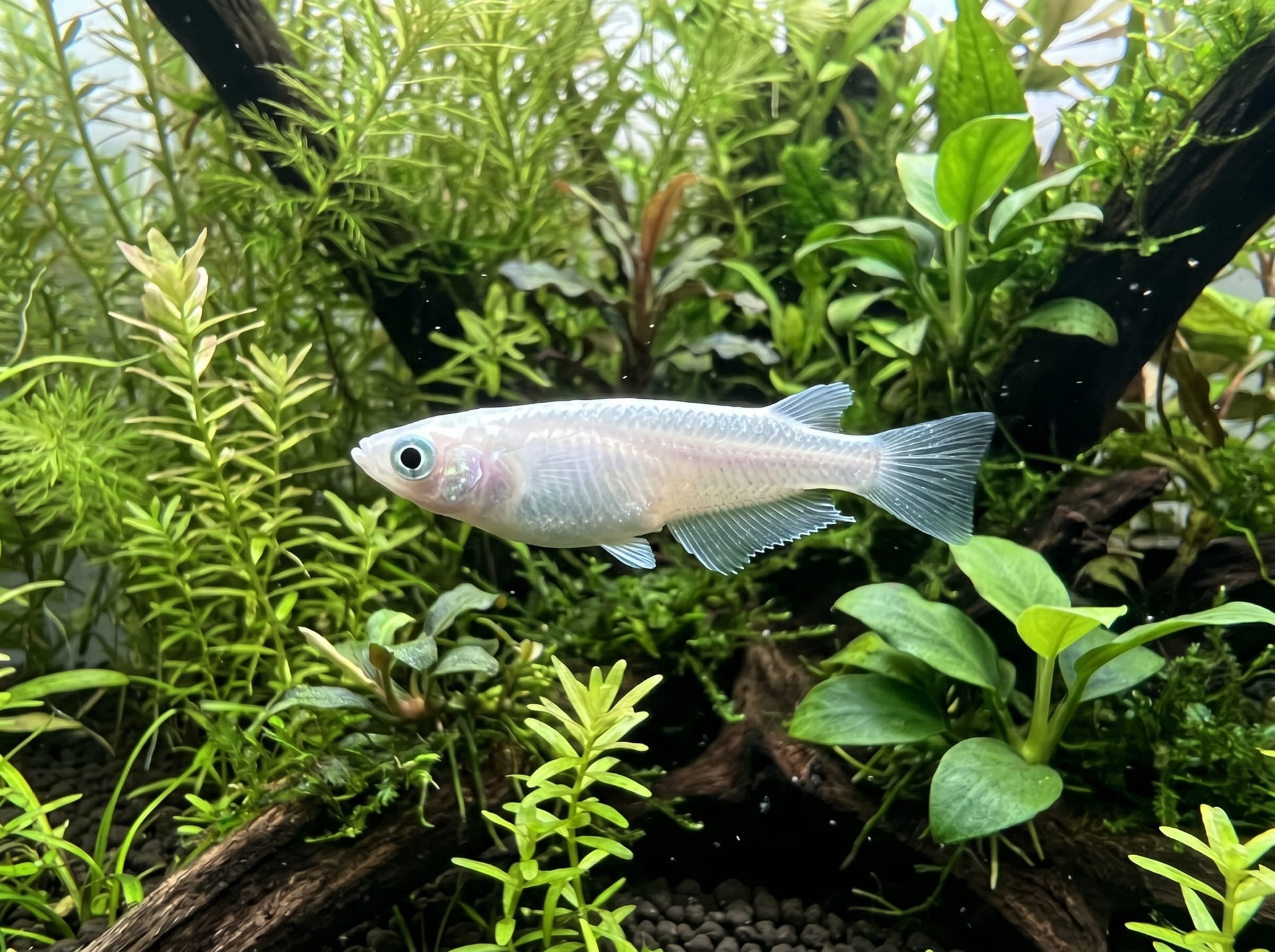
- Leucophores (white pigment cells): Cells containing white pigments. Involved in white medaka and milky-white coloration.
For example, "blue medaka" lack xanthophores, so only melanophores and iridophores remain, resulting in a bluish body color. "White medaka" are the result of lacking both melanophores and xanthophores. In this way, body color is determined by which pigment cells are "present or absent." For those who want to delve deeper into body color genetics, Medaka Body Color Genetics Guide | Basics of Crossbreeding and Variety Stabilization is also helpful.
Genetics Basics: Dominant, Recessive, and Codominant Traits
The presence or absence of pigment cells is controlled by genes. Genes have the concepts of "dominant" and "recessive" traits, and understanding this is essential for selective breeding.
Dominant and Recessive Genes
All organisms carry two sets of every gene (one from each parent).
- Dominant gene: When present in just one of the two sets, that trait appears in the phenotype.
- Recessive gene: Unless both sets carry the recessive gene, that trait will not appear in the phenotype. Even if carrying just one copy, it remains unexpressed and appears "as if not present" externally.
Albino medaka are a classic example of recessive inheritance. When two albino parents are crossed, all offspring are albino. However, even if a "normal-eyed medaka" carries one albino allele, it cannot be distinguished from appearance. This is called a "carrier."
Codominance (Incomplete Dominance)
Some traits show intermediate expression even when heterozygous (carrying only one of the two alleles), rather than following simple dominance or recessiveness. This is called codominance (incomplete dominance). It is often seen in complex traits controlled by multiple genes, such as the intensity of the body shine in Mikino medaka. More advanced crossbreeding strategies for controlling body color, body type, and fin shape are covered in Medaka Selective Breeding Genetics: Crossbreeding Strategies to Control Body Color, Body Type, and Fin Shape.
Reading F1 and F2 Generations and Their Application to Selective Breeding
In selective breeding, you often see the notation "F1" and "F2." These are symbols representing generations.
- Parental generation (P): The initial parent fish used for crossing
- F1 (first filial generation): Offspring resulting from crossing the parents
- F2 (second filial generation): Offspring resulting from crossing F1 individuals
Why F2 Is Important
Recessive traits rarely appear in the F1 generation. However, when F1 individuals are crossed, F2 generation individuals carrying recessive traits appear at a certain frequency (25% according to Mendel's law).
For example, F1 from albino × normal-eyed crosses all appear normal-eyed, but when F1 are crossed together, about 25% of the F2 generation will be albino. Selecting and stabilizing the albino individuals appearing in F2 is the basic process for creating an albino variety.
Basic Steps of Selective Breeding
- Goal Setting: Clearly define what traits or body color you want to achieve
- Parent Selection: Carefully select individuals close to the target traits
- F1 Crossing: Cross the selected parents and observe the offspring generation
- F2 Production: Cross F1 individuals and confirm whether recessive or target traits appear
- Selection and Line Breeding: Use only individuals close to the target as parents for the next generation, repeating the process
- Stabilization: Stabilize the traits over 3-5 generations
What Is Fixation Rate? ——An Index for Evaluating Quality by Numbers
In selective breeding, "fixation rate" is an important index that serves as a quality standard.
Fixation rate is the proportion of offspring from a variety's parents that display the same traits as their parents. The higher the fixation rate, the more stable the variety is as a "reproducible breed."
Fixation Rate Guidelines
| Fixation Rate | Evaluation |
|---|---|
| 90% or higher | Extremely stable variety |
| 80–89% | Practical level of fixation |
| 60–79% | In progress—selection needed |
| Below 60% | F2/F3 stage—not yet fixed |
To increase the fixation rate, rigorous selection in every generation is essential. An approach of "never use an individual as parent if it deviates even slightly from the standard" produces varieties with high fixation rates. Conversely, lenient selection leads to increasing trait variation across generations, reducing the variety's value. For tips on the selection work itself, see also Pro Tips | Medaka Selection Techniques | How to Identify Superior Individuals.
While inbreeding (close breeding) readily increases fixation rates, it also carries risks such as reduced immunity and increased deformities. It's equally important to incorporate occasional outcrossing (crossing with different bloodlines) to maintain long-term breed health.
Conclusion ——Understanding Genetics Makes Selective Breeding Even More Rewarding
Medaka genetics is profound, and even professional breeders continue researching daily. However, understanding the basics alone greatly changes how you approach selective breeding.
- Understanding the types and roles of pigment cells helps you see how body color works
- Grasping the concept of dominant and recessive traits makes it easier to predict crossbreeding outcomes
- Focusing on generational management of F1 and F2 helps you understand when target traits will appear
- Using fixation rate as a metric allows you to objectively assess a variety's completeness
On BreederDirect, breeders with deep knowledge of genetic backgrounds are offering medaka. The ability to ask breeders directly about information such as "which bloodline to cross" and "what fixation rate it has" is a distinctive strength of BreederDirect. For those wanting to challenge selective breeding, we encourage you to select high-quality parent fish from trustworthy breeders. With genetic knowledge and quality parent fish, you can surely achieve your ideal variety.