Medaka Container Comparison Guide | Pros and Cons of Aquariums, Plastic Tubs, Pots, and Buckets
Compare the pros and cons of 6 types of containers for medaka rearing—aquarium tanks, plastic tubs, water lily basins, buckets, and more. We explore differences in price, durability, insulation, and aesthetic appeal, provide a quick reference table to choose by rearing purpose, and guide you in selecting containers suited to your rearing style and installation location.
Key Takeaways
Compare the pros and cons of 6 types of containers for medaka rearing—aquarium tanks, plastic tubs, water lily basins, buckets, and more. We explore differences in price, durability, insulation, and aesthetic appeal, provide a quick reference table to choose by rearing purpose, and guide you in selecting containers suited to your rearing style and installation location.
When starting to keep medaka, the first dilemma is "what kind of container should I use?" Home centers and aquarium shops stock a wide variety of containers, each differing in price, durability, insulation, and viewing appeal. Choosing the wrong container can cause medaka to become ill due to water temperature fluctuations or lack of space, so selecting a container that suits your breeding style and placement location is important. This article provides a detailed comparison of six representative container types and offers selection tips useful for both beginners and experienced keepers. If you'd like to learn about outdoor medaka keeping from start to finish first, please also refer to Medaka Outdoor Care Complete Guide | How to Raise in Water Lily Basins, Plastic Tubs, and Styrofoam.
Basic Points to Remember When Choosing a Container
When selecting a container, you'll have fewer failures if you consider the following four perspectives.
Installation location (indoor or outdoor): Outdoor setups face UV exposure, temperature fluctuations, and rain, so weather resistance is essential. Indoor setups tend to prioritize viewing appeal.
Water volume and number of fish: A minimum of 1–2 liters per fish is the guideline. Small containers deteriorate water quality easily and water temperature spikes rapidly in summer.
Viewing style (top view or side view): Medaka reveal the beauty of their body color and shape best when viewed from above. If you want to enjoy specific varieties, a top-view container is recommended.
With these in mind, let's look at the characteristics of each container type.
Detailed Container Comparison
✍️
BreederDirect Editorial
The BreederDirect editorial team specializes in care information for animals, covering veterinary care and breeding to deliver beginner-friendly guides.
Find Medaka on BreederDirect
Buy directly from verified breeders
Browse Related Listings
Find Medaka listings related to this article on BreederDirect. Buy directly from verified breeders.
Glass aquariums offer high transparency, making it possible to observe medaka carefully from the side. They suit those who prioritize aquascaping with aquatic plants and appealing interior aesthetics.
Recommended Points
Body shape, color, and swimming patterns look beautiful from the side
You can enjoy aquascaping with aquatic plants, driftwood, and substrate
A 60 cm size provides stable water volume
Cautions
Low insulation means water temperature changes with room temperature
Direct sunlight easily causes excessive algae growth
Heavy weight requires attention to installation location and tank stand load capacity
For indoor aquariums, setting up lighting and a filtration filter together makes management easier.
Plastic Tubs (Toro Tubs) | The Standard of Standards for Outdoor Keeping
Toro tubs, used in plastering work, are the most popular containers for outdoor medaka breeding. They come in large capacities of 40L to 120L and are invaluable when raising multiple medaka or breeding them.
Recommended Points
Affordable and large capacity with excellent cost-performance
The shallow, wide shape is perfect for top-view observation
Larger water volume makes temperature and water quality more stable
Black types make medaka body colors stand out beautifully
Cautions
The material appearance is not suitable for gardens with particular aesthetic concerns
UV exposure causes deterioration over time (black lasts longer than white)
Large sizes exceed 100 kg when filled, making them difficult to move
Most breeders use these plastic tubs as their main breeding containers, and their track record and reliability are unquestionable.
Water Lily Basins | A Biotope Solution Combining Aesthetics and Function
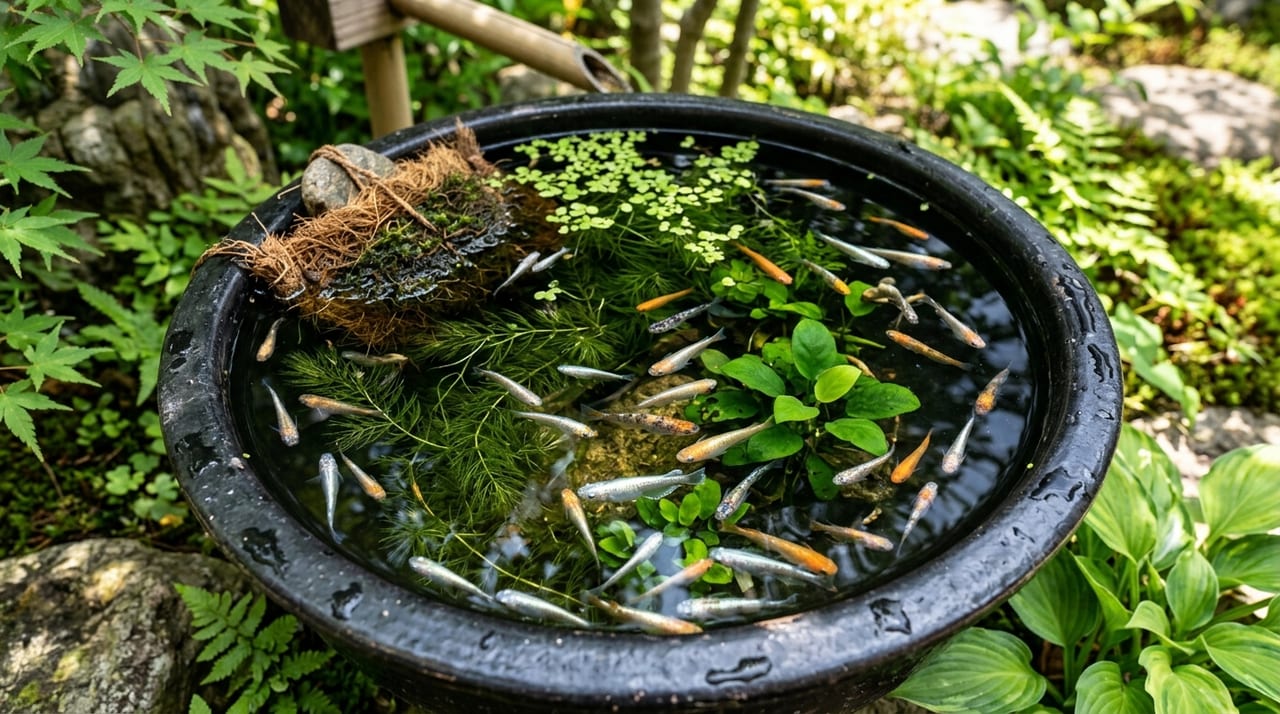
Ceramic or plastic water lily basins appeal with their design that naturally complements Japanese-style gardens and balconies. With greater water depth, water temperature stabilizes easily, and you can create beautiful biotopes by combining them with water lilies and floating plants. For detailed creation methods, see Complete Guide to Medaka Biotope Setup | Containers, Plants, and Layouts.
Recommended Points
Beautiful appearance that serves as a garden or interior accent
Greater depth provides protection against summer water temperature rises and winter freezing
Excellent compatibility with aquatic plants like water lilies, water sprite, and hornwort
Ceramic vessels gain character with age and can be enjoyed long-term
Cautions
Ceramic types are expensive, and large sizes are extremely heavy
Risk of cracking from falls, impacts, or winter freezing
Plastic types are lightweight but may lack quality appearance
Water lily basins are the ideal choice for those prioritizing aesthetics or wanting to cultivate a biotope slowly over time.
Styrofoam Boxes | The Ultimate Insulation Container for Winter Survival
Styrofoam boxes used for transporting fresh fish and produce far surpass other containers in insulation. Many medaka enthusiasts use them for winter outdoor keeping or to counter summer temperature spikes.
Recommended Points
Highest insulation minimizes water temperature fluctuations
Available free to low-cost from fish shops, supermarkets, etc.
Extremely lightweight and easy to transport
Low replacement cost even if cracks appear
Cautions
Plain appearance is visually unappealing
Deterioration and cracking from UV exposure occur within 1–2 years
Low durability makes them unsuitable for long-term use
The recommended approach is to use them temporarily as winter containers and transfer to main containers when spring arrives.
NV Boxes and Buckets | Convenient for Variety Management and Temporary Use
NV boxes (agricultural containers) come in 13L, 22L, and 30L sizes and can be stacked, making them ideal for managing multiple varieties in limited space. Buckets are useful for temporary housing during water changes and transfers or for spawning work.
NV Box Points
Affordable and stackable for ideal variety management
Easy for variety selection and spawning work
Lower insulation, so monitor water temperature carefully in summer and winter
Bucket Points
Convenient for water changes, transfers, and temporary housing
Often insufficient water volume for long-term breeding containers
Container Selection Quick Reference by Breeding Purpose
Breeding Style
Recommended Container
Viewing carefully indoors
Glass aquarium
Large-scale outdoor breeding on a budget
Plastic tub (toro tub)
Creating a biotope for your garden
Water lily basin
Safe winter survival
Styrofoam box
Efficiently managing multiple varieties
NV box
Temporary use
Bucket
Summary | Container Selection Determines Medaka Health and Enjoyment
Container selection for medaka breeding requires comprehensive consideration of "installation location, water volume, insulation, and viewing style" rather than appearance preference alone. For beginners, plastic tubs or water lily basins are easy to handle with sufficient water volume, while glass aquariums are ideal for those wanting careful indoor observation. Additionally, using styrofoam boxes for winter survival allows you to overcome the season safely and affordably.
Once your breeding environment is set up, the next step is choosing varieties. BreederDirect allows you to purchase high-quality medaka raised by breeders nationwide directly. A diverse range of varieties including tri-color lamé, Yamato, and Yang Guifei are available, and the appeal lies in consulting with breeders about varieties suited to your breeding environment. Key points to keep in mind when purchasing are also explained in Medaka Buying Guide | Variety Selection, Purchase Sources, and Shipping Tips, so once your containers are ready, try to find your favorite medaka.