Spotted and Splendid Garden Eels
Spotted Garden Eels (Heteroconger hassi) and Splendid Garden Eels (Heteroconger perissodon) are members of the Anguilliformes order and Congridae family. These marine fish exhibit a unique ecology, digging vertical burrows into sandy substrates where they establish their homes.
This group gained fame through aquarium "Garden Eel" exhibits, where their endearing behavior of remaining half-submerged in sand while swaying gently in the current captured many hearts. Among dedicated marine aquarium enthusiasts, they have become a coveted challenge in the hobby.
Basic Information
| Item | Spotted Garden Eel | Splendid Garden Eel |
|---|
| Scientific Name | Heteroconger hassi | Heteroconger perissodon |
| Common Name (English) | Spotted Garden Eel | Splendid Garden Eel |
| Length | 40–60 cm | 60–100 cm |
| Appearance | White with three black spots | White with many fine black spots |
| Native Range | Indian & Pacific Oceans | Pacific Ocean (including Japanese waters) |
| Difficulty Level | High | High |
---
Challenges of Care and Mindset
Although garden eels are commonly seen in aquariums, achieving long-term success in home tanks ranks among the higher difficulty levels. The primary challenges are these three points:
- Deep substrate required: A sand bed of 15–20 cm or deeper is necessary for burrow construction
- Difficult to acclimate to feeding: Wild individuals feed on passing plankton, requiring gradual acclimation to current-based feeding
- Stress-sensitive: Extremely sensitive to water quality changes, vibrations, and disturbances from other fish
Most short-lived cases result from one or more of these three factors: "shallow substrate," "feeding failure," or "stress-related death." Overcoming these challenges enables multi-year survival.
---
Required Tank and Equipment
Tank Size
| Number of Eels | Recommended Tank |
|---|
| 1–2 | 60 cm+ width (40 cm+ depth) |
| 3–5 (group care) | 90–120 cm width (45 cm+ depth) |
Critical: The tank's depth (height) is key to success. To accommodate 15–20 cm of substrate plus 20+ cm of swimming space, a water depth of 40 cm or greater is ideal.
Substrate Installation
Garden eels construct burrows in sand, making substrate depth the single most important factor.
Recommended Substrate
| Material | Depth | Characteristics |
|---|
| Coral Sand (fine grain 0.5–2 mm) | 15–20 cm | Burrows remain stable; optimal choice |
| Aragonite Sand | 15–20 cm | Promotes bacterial colonization |
- Layer sand deeply over the tank bottom using a mesh divider (commercial "garden eel cases" are convenient)
- Mix a small amount of live sand in the lower layer to accelerate bacterial establishment
Filter and Water Flow
Filter: A high-performance protein skimmer combined with a sump system is ideal. Since detritus accumulates on sandy bottoms, establish moderate water flow through the substrate.
Water Flow: Garden eels hunt floating plankton, so creating a gentle, unidirectional current throughout the tank is essential for successful feeding.
---
Water Parameters
| Parameter | Ideal Range |
|---|
| Temperature | 24–26°C |
| Specific Gravity | 1.023–1.025 |
| pH | 8.1–8.3 |
| Ammonia & Nitrite | 0 |
| Nitrate | 20 ppm or below |
Temperature stability: Garden eels are extremely sensitive to rapid temperature fluctuations. Maintain 24–26°C consistently using a tank chiller and precise thermostat.
---
Feeding Methods (The Greatest Challenge)
Feeding is the most difficult aspect of garden eel care. In the wild, they consume copepods, plankton, and small shrimp carried by tidal currents.
Step-by-Step Acclimation Process
Step 1: Flow-Based Feeding with Frozen Copepods and Brine Shrimp
During the first 1–2 weeks after introduction, eels typically remain hidden in their burrows. During this period, use the water current to deliver copepods or brine shrimp near their burrows. Don't expect immediate consumption—the goal is to teach them that "food comes from this direction."
Step 2: Transition to Syringe Feeding
Once acclimated to flow-based feeding, use a syringe to inject brine shrimp or copepods a few centimeters in front of the burrow. Success is confirmed when the eel emerges and actively captures food.
Step 3: Transition to Frozen Krill
Once consistently feeding on brine shrimp, gradually introduce finely chopped krill or frozen daphnia mixed with their regular food.
Feeding Tips
- Feed 2–3 times daily in small quantities (uneaten food degrades water quality)
- Avoid feeding during or immediately after lights-out (polyps retract); feed during daylight when lights are on
- Prevent other fish from stealing food (using a dedicated syringe for garden eels is highly effective)
---
Tankmate Compatibility
Garden eels are extremely stress-sensitive, making tankmate selection critical.
Compatible Species
- Small goby species (peaceful bottom-swimmers)
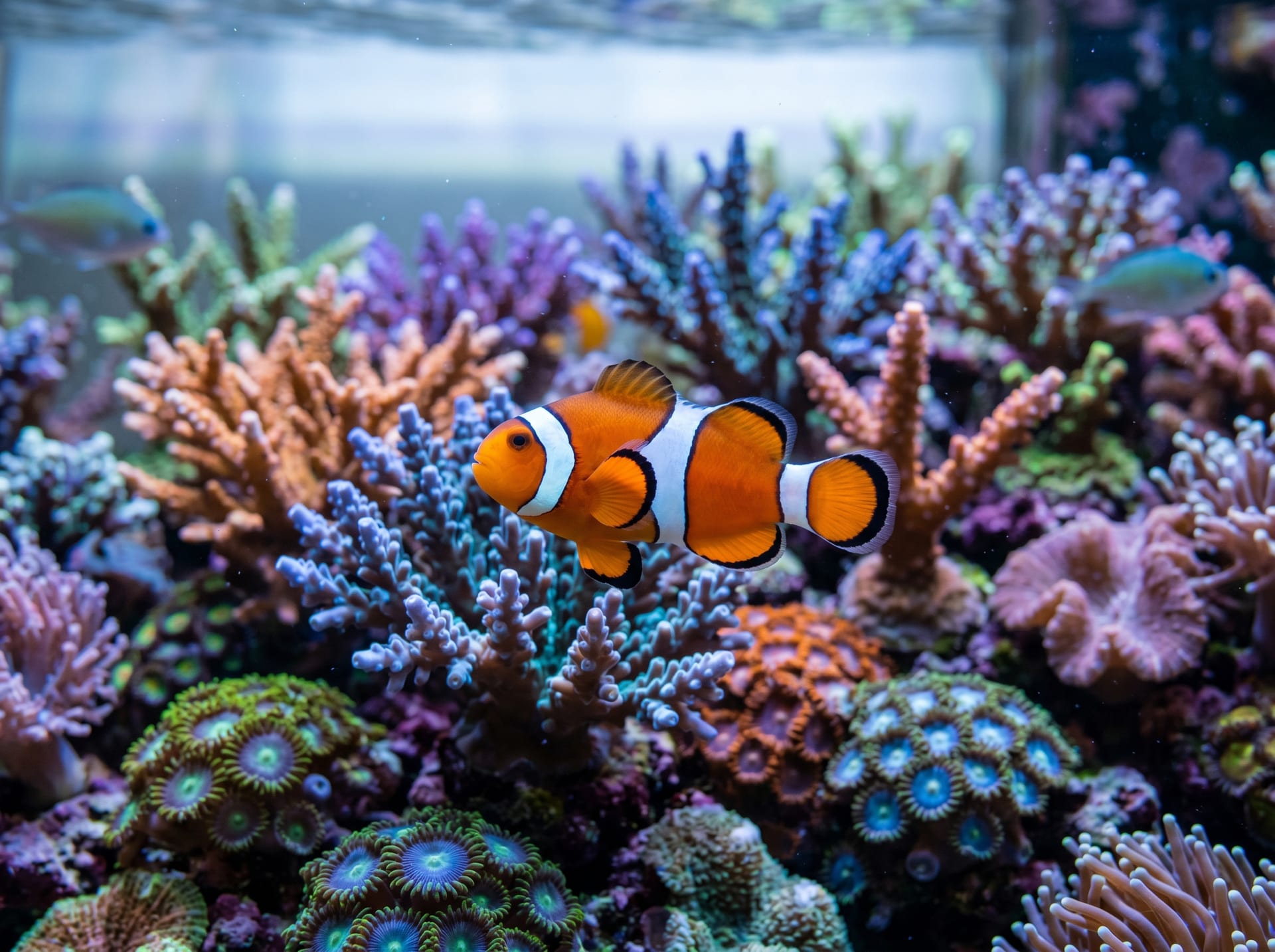
- Small Ocellaris Clownfish (don't disturb garden eels)
- Sergeant Major Damselfish (mid-water swimmers)
Incompatible Species
- Large Angelfish and Surgeonfish (excavate and destroy burrows)
- Aggressive fish (territorial damselfish and dottybacks)
- Jawfish and Blennies (dig into sandy substrates)
Ideal Setup: Garden eels form schools, so group care of 3–5 or more reduces stress through social reassurance, increasing the frequency with which eels emerge from burrows. Group care tends to have higher long-term success rates than solitary housing.
---
Common Failures and Solutions
Won't Emerge from Burrow (2+ Weeks)
- Substrate too shallow (less than 15 cm) → Add more sand
- Environmental stressors present (other fish harassment, vibrations, noise) → Move to isolation tank
- Water temperature too high (above 27°C) → Install a chiller
Won't Eat
- Water current direction misaligned with burrow → Adjust circulator position
- Food particles too large → Start with brine shrimp
- Other fish stealing food → Use a dedicated syringe for direct feeding
Completely Emerges from Burrow (Escapes)
- Sand composition unsuitable (grain too large) → Switch to fine-grain coral sand
- Tank lacks cover → Install escape-prevention lid (garden eels can exit their burrows)
---
Summary: Bringing the Aquarium Favorite Home
While garden eels present a high difficulty level, success delivers a uniquely rewarding experience—watching multiple eels simultaneously emerge from their burrows in your home tank is unmatched in the marine aquarium hobby.
The keys to long-term success are ensuring deep substrate, perfecting current-based feeding, and managing stress carefully. Starting with a small school of 2–3 eels and increasing numbers once the tank stabilizes reduces failure risk.