Goldfish Show Judging Criteria and Guide to Raising Award-Winning Specimens | Evaluation Points for Body Shape, Markings, and Swimming
Explanation of judging criteria evaluated at goldfish shows. We introduce evaluation points for body shape, markings, swimming behavior, and coloration, as well as practical methods for daily management and selective breeding to raise specimens appreciated by judges.
Key Takeaways
Explanation of judging criteria evaluated at goldfish shows. We introduce evaluation points for body shape, markings, swimming behavior, and coloration, as well as practical methods for daily management and selective breeding to raise specimens appreciated by judges.
Related Species

What is Goldfish Show Judging?
Goldfish shows (competitions) are held annually throughout the country, where specimens compete on beauty, health, and completeness by breed. Rather than simple appreciation, evaluation is conducted under strict judging criteria, making it a venue where breeders aiming to exhibit must prove their husbandry skills themselves. Understanding judging criteria is also the fastest route to raising your daily husbandry standards. This guide explains the evaluation points for body shape, markings, and swimming that judges emphasize, and presents concrete approaches for raising specimens at award-winning levels.
Body Shape Evaluation: Conformity to Breed Standards
Body shape evaluation is the foundation of judging. Each breed has a "breed standard," and specimens closer to this standard receive higher scores.
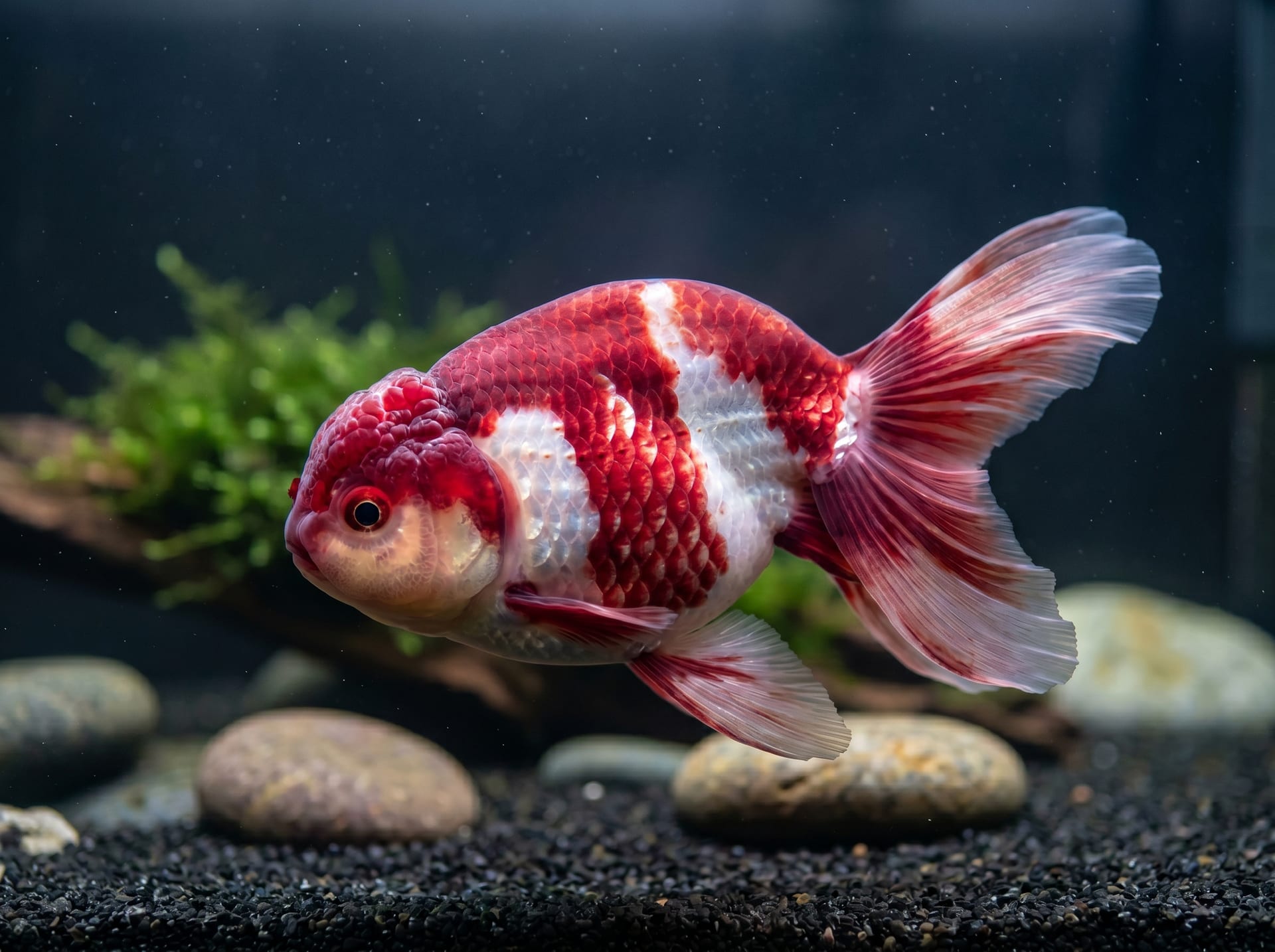
In Ranchu, the main evaluation points are the absence of a dorsal fin and the egg-shaped silhouette when viewed from above, the development of the head's hood (fleshy protuberance), and the opening angle of the tail fin. The hood must develop plumply and evenly, with no bias to left or right. When viewed from the front, the ideal posture is swimming horizontally from the mouth to the tail.
In Ryukin and Bubble-eye goldfish, the rounded body when viewed from the side, the protrusion of the abdomen relative to the short body length, and the height of the back are evaluated. Specimens with vertically elongated or slender bodies are subject to point deductions.
Common body shape standards place great emphasis on bilateral symmetry. Spinal curvature, swelling of only one gill, and asymmetrical abdominal swelling are all heavily penalized. Additionally, scratches, missing sections, and scale irregularities lower body shape evaluations.
Markings and Color Evaluation Points
Color and markings have the strongest visual impact, capturing the audience's eye while serving as an important evaluation criterion for judges.
Kohaku (red and white) pattern is the most common, with red on a white base, and highly evaluated specimens have crisp color boundaries and deep, vivid red coloration. Specimens with orange-tinted red, pale color, or blurred boundaries receive lower evaluations.
Color placement balance is also important. Specimens with even color distribution across the head, body, and tail fin are preferred over those with color bias. However, specific patterns such as Tanchō (red head only) that are breed characteristics are evaluated separately.
Many competitions divide into categories by color type such as Hi (solid red) and Shiro (white-predominant), competing on quality within the same color type. Preventing color fading requires controlling light levels in the rearing environment and managing feed composition. Use of specialized color-enhancement food containing astaxanthin is standard practice.
Swimming Behavior and Posture Evaluation Points
Even with excellent body shape and markings, problems with underwater movement make winning difficult.
Level posture: Specimens that swim horizontally without tilting forward, backward, or to the sides receive high marks. Problems with the swim bladder or body distortion cause diagonal swimming or tilting to one side.
Balance between belly fullness and buoyancy: Particularly in finless breeds like Ranchu, abdominal roundness directly affects buoyancy. Specimens with bellies too large, tending to sink to the bottom, or too light, causing them to lower their head, receive lower evaluations.
Fin movement: The ideal is for the tail fin to spread elegantly left and right while swimming, with a graceful undulating motion. Specimens with bent tail fins, one-sided deployment, or constantly closed fins are at a disadvantage in judging.
Management for Raising Award-Winning Specimens
Raising award-winning specimens requires three pillars: daily water quality management, feeding, and selective culling.
Water quality management: Goldfish are sensitive to water quality changes, and high ammonia and nitrite concentrations fade body color and damage fins. The basic routine is weekly water changes (replacing 1/3 to 1/2 of the total volume), with attention to pH 6.5–7.5 and temperature stability (variation within 2°C per day).
Feeding and color enhancement: Provide high-quality pellet feed with 40–45% protein and 5–10% fat 2–3 times daily in amounts the fish can finish. Feeding color-enhancement food containing astaxanthin and spirulina 3–4 times per week deepens red coloration. Overfeeding risks digestive disorders and swim bladder disease, so caution is needed.
Selective culling and individual management: "Culling inferior specimens" during the fry stage (1–2 months after hatching) is key to quality. By early removing specimens with body distortion, color bias, or abnormal swimming, and carefully selecting only superior individuals, you reduce stocking density and promote growth. A yearly cycle of carefully raising spring fry for autumn shows is the foundation of exhibition.
Disease prevention: Injuries and illness are the greatest pre-judging risks. Fin rot, ich, and dropsy require early detection and treatment. When introducing new specimens, always quarantine them in a treatment tank for 2 weeks to prevent infection of existing specimens.
Learning and Purchasing Directly from Breeders
Obtaining specimens from award-winning bloodlines is highly meaningful for attempting cultivation in your own environment. BreederDirect features goldfish directly raised by established breeders throughout the country, where you can select individuals with detailed profiles including breed, color, and origin. Use your eye for beauty honed at shows to find your ideal specimen.