Coral Color Enhancement Techniques|5 Ways to Bring Out Fluorescent Colors
An explanation of techniques to maximize coral fluorescent colors. This article introduces five approaches: nutrient salt control, lighting adjustment, amino acid supplementation, water flow optimization, and trace element management.
Key Takeaways
An explanation of techniques to maximize coral fluorescent colors. This article introduces five approaches: nutrient salt control, lighting adjustment, amino acid supplementation, water flow optimization, and trace element management.
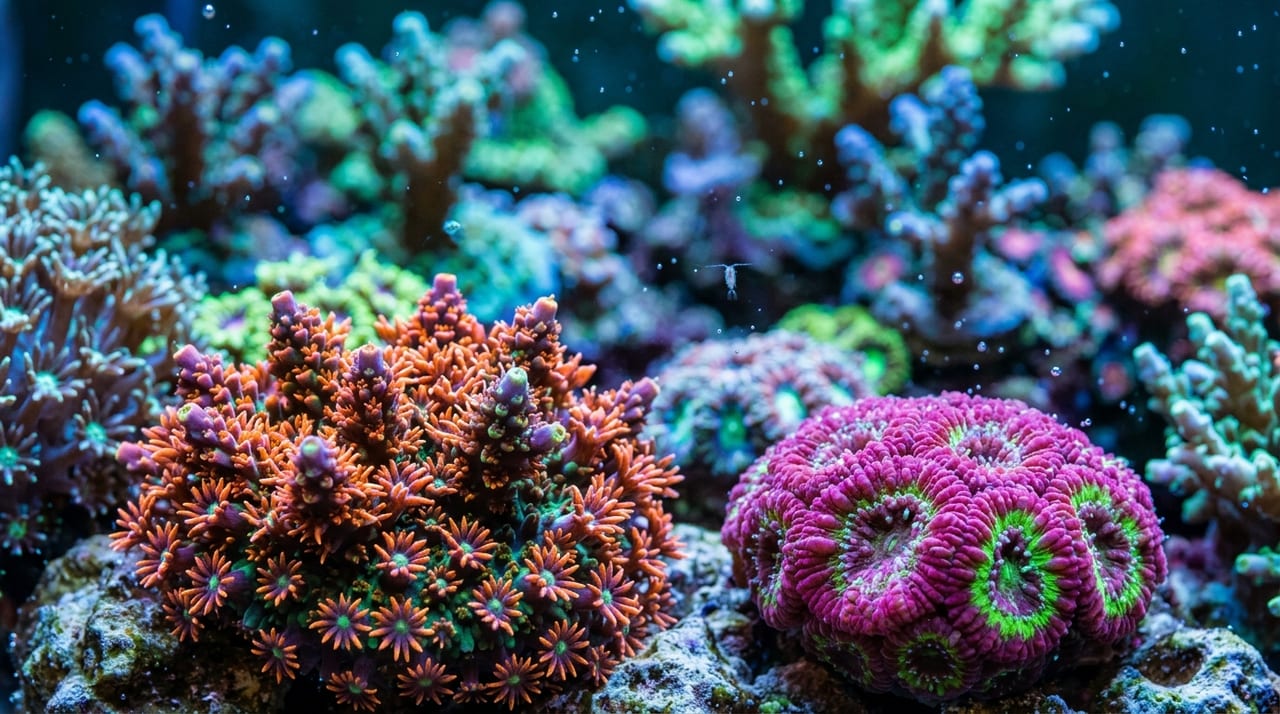
The appeal of a saltwater aquarium lies, above all, in the vibrant fluorescent colors of corals. You've surely seen the stunning greens, blues, and purples in shop and breeder tanks and felt your heart captivated by them—but have you found that in your home aquarium, they gradually turn murky brown?
In fact, coral coloration is not determined by "luck" or "individual variation" alone—it is greatly influenced by the rearing environment. This article explains five practical approaches to bring out corals' inherent fluorescent colors, starting from the underlying mechanisms.
Understanding How Coral Color Changes
Before putting color enhancement techniques into practice, it's important to understand the mechanism behind coral coloration.
Coral color is produced by two main factors. One is symbiotic algae called zooxanthellae, and the other is fluorescent protein that the coral itself produces.
Zooxanthellae are symbiotic algae within the coral's tissues that supply energy to the coral through photosynthesis. If their density becomes too high, brown coloration intensifies and the coral's true color is hidden. Conversely, if there are too few, nutritional deficiency increases bleaching risk. Controlling this balance is fundamental to managing coloration.
Fluorescent protein is a protein the coral itself produces; it absorbs light of specific wavelengths and emits it as light of different wavelengths. This is what appears to our eyes as vivid fluorescent colors—blues, greens, reds, and more. The amount of fluorescent protein produced depends greatly on water quality, nutritional status, and lighting conditions.
1. Nutrient Salt Control|The Most Critical Parameter Affecting Coloration
The most important factor in coral color management is controlling nutrient salts in the water.
Nitrate (NO₃) is produced as fish waste and uneaten food decompose. When this value is high, zooxanthellae overproduce and corals turn brown. Conversely, when nitrate is close to 0 ppm, zooxanthellae deficiency increases bleaching risk.
- Ideal value: Nitrate 1–5 ppm brings out fluorescent colors most effectively
- Phosphate (PO₄) should be maintained at 0.03 ppm or below
- If excessive, consider using a bio-pellet reactor or GFO reactor
Phosphate also affects zooxanthellae growth, so it's important to manage it in balance with nitrate. Make it a habit to conduct regular water quality tests to track fluctuations.
2. Optimizing Light Spectrum|Using Light to "Excite" Fluorescent Colors
Coral fluorescent proteins are excited and emit light when exposed to light of specific wavelengths. Since lighting selection and settings directly impact coloration, optimizing the spectrum is essential.
Wavelength and Color Relationships
- Blue LED (around 450nm):Excites fluorescent proteins most effectively. Increase the blue ratio if prioritizing coloration
- UV LED (380–420nm):Brings out pink and purple fluorescent colors even more intensely
- White light:Adding it appropriately maintains a natural appearance and improves visibility
Points to Note on Light Intensity Settings
Light intensity (PAR value) has different appropriate ranges depending on species. Species like Acropora that prefer strong light require high PAR (200–400+), while soft corals and LPS corals often do well with medium to low PAR (around 50–150). Light that is too intense triggers zooxanthellae expulsion, so gradual "acclimation" by increasing light intensity step-by-step is essential.
Aim for 8–10 hours of lighting per day, and avoid sudden changes.
3. Amino Acid and Vitamin Supplementation|Promoting Fluorescent Protein Production
Properly supplying amino acids, which are the building blocks of fluorescent protein, promotes their production.
Effective Additives
- Amino acids (particularly aspartic acid and glutamic acid):Support fluorescent protein synthesis
- Vitamin C (ascorbic acid):Reduces oxidative stress and helps maintain coral health
- Carbon sources (vodka, acetic acid, sugars):Activate bacteria to lower nutrient salts and optimize the coloration environment
Key Points for Supplementation
"Small amounts regularly" is the golden rule. Consistent supplementation two to three times per week yields stable results. Overdosing can cause algae and bacterial overgrowth, so always follow the dosage for each product. When introducing a new supplement, it's recommended to try one type at a time to assess its effects.
4. Water Flow Optimization|Enhancing Metabolism to Promote Coloration
Proper water flow is essential for healthy coral metabolism. Insufficient flow allows waste to accumulate around the coral, leading to zooxanthellae overgrowth and tissue necrosis.
Ideal Water Flow Characteristics
- Random wave flow:Optimal is flow that changes direction like waves rather than flowing in one constant direction
- Eliminate dead spots:Ensure circulation throughout the tank and avoid stagnant areas
- Adjust strength by species:Acropora prefers strong flow, while LPS corals like Euphyllia prefer gentle flow
Using multiple wave makers to create irregular flow brings the tank closer to a natural environment. Direct current can damage tissue, so angle the flow carefully.
5. Trace Element Management|Precise Control via ICP Testing
For coral coloration, the balance of trace elements is important as well as macronutrients. The following elements are strongly related to coloration.
| Element | Role |
|---|---|
| Potassium (K) | Particularly affects SPS coral coloration |
| Iodine (I) | Involved in soft coral coloration and health |
| Iron (Fe) | Determines zooxanthellae photosynthetic efficiency |
| Strontium (Sr) | Necessary for skeleton formation and works synergistically with calcium |
ICP-OES analysis (inductively coupled plasma optical emission spectrometry) is effective for managing trace elements. Simply sending tank water to a testing facility allows you to determine the concentrations of dozens of elements in detail. Based on the results, "evidence-based supplementation" that adds only the deficient elements is the most suitable approach for coral keeping.
Controlling Zooxanthellae
The key to color enhancement is managing zooxanthellae density. If zooxanthellae become overcrowded, corals turn brown and vibrant fluorescent colors are hidden.
There are several ways to moderately reduce zooxanthellae. Gradually increasing light intensity can suppress zooxanthellae overcrowding. Maintaining low nutrient salts prevents excessive zooxanthellae growth. Using activated carbon increases water transparency and light transmittance, maintaining appropriate zooxanthellae density.
The important thing is to avoid sudden changes. Rapidly intensifying lighting or suddenly dropping nutrient salts risks bleaching. Make all adjustments gradually over 2–4 week periods.
Color Enhancement Tips by Species
Tips for color enhancement vary depending on coral species.
Acropora: The basics are strong blue light and low nutrient salts. Green-toned species color up relatively easily, while red and purple types require high light intensity and stable trace element balance.
Goniopora: Colors well with moderate light intensity. Be careful, as light that is too intense can cause color washing. It responds well to amino acid supplementation, with polyps opening wide and colors becoming more vivid.
Euphyllia: Maintain low to moderate light, and periodically feed pellet foods like reef roids to increase volume and make colors stand out.
Start with Healthy Specimens from BreederDirect
Important to color enhancement is choosing the healthiest specimens at the point of introduction. No matter how well you set up the environment, corals that are already stressed or faded when obtained require significant time and effort to recover.
On BreederDirect, corals are listed directly by breeders with extensive experience raising corals. Listed specimens are photographed in the breeder's tank after color enhancement, and the actual coloration is reflected in the photos.
If a specimen interests you, you can send breeders specific questions like "What are your tips for maintaining this color?" and "What nitrate level do you maintain?" Getting advice based on years of experience is a unique advantage of buying directly from breeders.
By acquiring knowledge of color enhancement and starting with healthy specimens, you open the shortest path to creating a beautiful coral aquarium. Come find your ideal specimen on BreederDirect.