Chocolate Gourami Care Guide | Advanced Labyrinth Fish Requiring Soft, Acidic Water
The Chocolate Gourami (Sphaerichthys osphromenoides) is a beautiful gourami native to Borneo and Sumatra. This guide explains how to care for this advanced tropical fish, which requires demanding water chemistry management of soft, acidic conditions.
Key Takeaways
The Chocolate Gourami (Sphaerichthys osphromenoides) is a beautiful gourami native to Borneo and Sumatra. This guide explains how to care for this advanced tropical fish, which requires demanding water chemistry management of soft, acidic conditions.
Related Species
The Ecology and Appeal of Chocolate Gouramis
The Chocolate Gourami (scientific name: Sphaerichthys osphromenoides) is a labyrinth fish native to blackwater streams flowing through the tropical rainforests of Borneo and Sumatra. Having evolved to thrive in extremely soft, highly acidic water stained with humic acids, it is considered one of the most challenging tropical fish to keep.
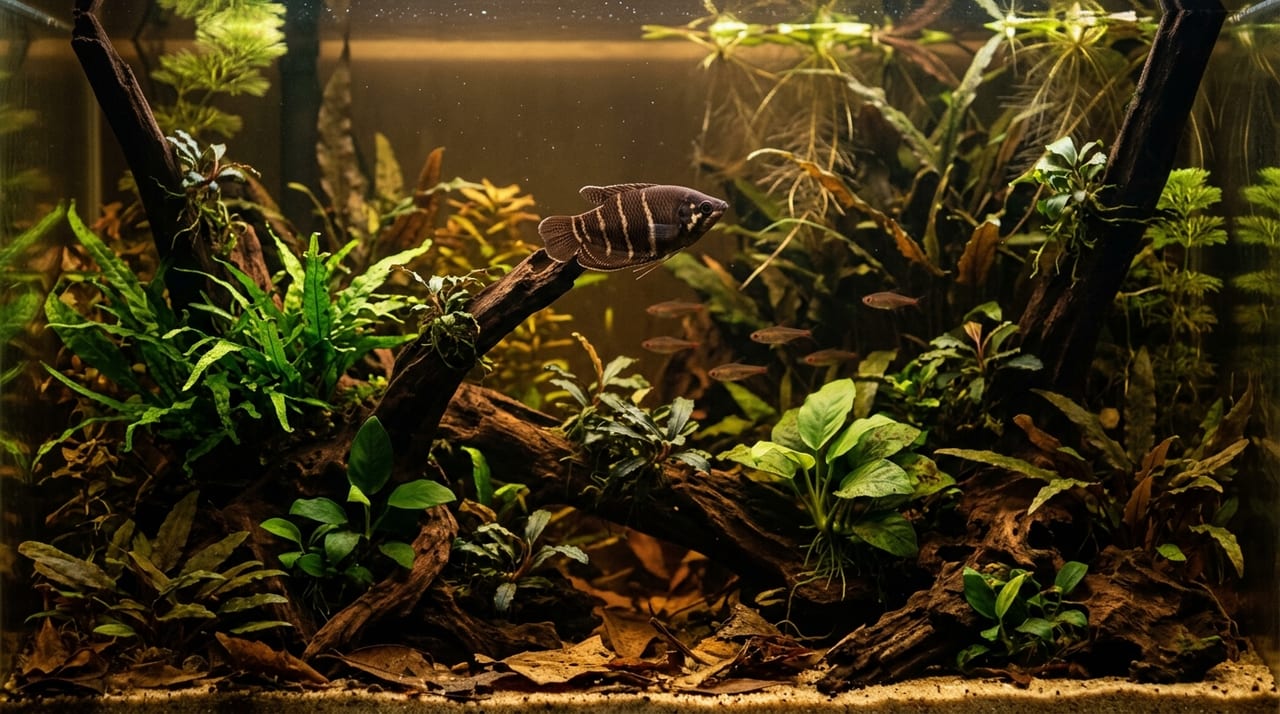
Its coloration ranges from dark brown to orange-tinted brown, with several cream to white vertical stripes, displaying a lustrous sheen depending on how light strikes the body. Even as an adult, it reaches only 5–7 cm, but its beauty is unmatched among small fish species. The same genus also includes Banded Chocolate Gourami (S. crossi) and Crimson Chocolate Gourami (S. vaillanti), each with distinct stripe patterns and color nuances.
It is significantly more challenging than common gouramis (such as Gold Gouramis and Dwarf Gouramis), so we recommend attempting this species only after gaining substantial experience with tropical fish keeping. However, the sense of accomplishment and visual beauty when successfully maintaining this species are exceptional, and many aquarists aspire to one day keep this fish.
Water Chemistry Management — The Most Critical Factor for Success
When keeping Chocolate Gouramis, water chemistry management takes priority over everything else. The water chemistry of their natural habitat is shown below, and recreating it is the first challenge.
| Water Chemistry Parameter | Target Range |
|---|---|
| pH | 4.5–6.5 |
| General Hardness (GH) | 1–3°dH |
| Carbonate Hardness (KH) | 0–2°dH |
| Water Temperature | 26–28°C |
Tap water in most regions of Japan has GH and KH levels that are far too high for direct use. Prepare soft water using one of the following methods.
- RO Filter (Reverse Osmosis): The most reliable method. Use purified water with only trace amounts of minerals added.
- Peat Moss Filtration: When commercially available peat moss for water conditioning is placed in a filter, humic acids leach out, lowering pH and softening the water. While the water becomes tea-colored, this mimics the natural environment and is ideal for Chocolate Gouramis. Humic acids are believed to support this fish's immune function, making them a standard addition to blackwater tanks.
- Almond Leaves (Magic Leaves): Simply adding a few leaves to the tank allows for fine pH adjustment and antimicrobial benefits.
Do not perform large water changes all at once; instead, change 10–20% of the water 1–2 times per week. It is essential to prepare water change water that matches both the existing water chemistry and temperature beforehand, avoiding any sudden shifts. Maintain water temperature between 26–28°C, using a thermostat-controlled heater to prevent sudden fluctuations.
Tank Layout and Equipment Selection
Chocolate Gouramis are timid, and they experience constant stress in environments lacking hiding spots. The basic layout principle is "densely planted areas" and "multiple hiding places."
Shade-loving aquatic plants that tolerate acidic water are ideal. Plants such as Microsorum (Java Fern), Anubias species, and Bucephalandra are easy to grow without CO2 supplementation and do not negatively impact water chemistry. Bright stem plants that require CO2 supplementation risk causing pH fluctuations, so it is best to avoid them until you are experienced.
Driftwood should always be included. Asian driftwood gradually releases humic acids, creating blackwater-like coloration that calms Chocolate Gouramis.
A filter with gentle water flow is ideal. Strong flow exhausts the fish and weakens immunity. Sponge filters provide gentle flow and stable biological filtration, making them highly recommended.
Tank size should be 45–60 cm for a pair, or 60–90 cm or larger for multiple individuals, ensuring each fish has room to escape.
Feeding and Nutrition
Chocolate Gouramis are strongly carnivorous and feed naturally on small insects that fall to the water surface, tiny crustaceans, and aquatic microorganisms. In captivity, the following diet is appropriate.
- Frozen Brine Shrimp: Well-balanced nutritionally, and readily accepted even by reluctant feeders; serves as the primary food.
- Frozen Bloodworms: Highly palatable and useful for stimulating appetite. However, overfeeding can foul the water, so exercise restraint.
- Dried Copepods and Dried Daphnia: Convenient supplemental foods. Experienced individuals will readily consume them.
- Small Pellet Artificial Foods: There is great individual variation; some fish accept them immediately, while others refuse them for extended periods.
When introducing new individuals, prioritize live or frozen foods to ensure they eat regularly; once their condition stabilizes, gradually introduce artificial pellets. A sudden drop in appetite often signals water chemistry problems, so measure pH and GH first.
Disease Prevention and Early Detection
One major reason Chocolate Gouramis are considered difficult is their vulnerability to bacterial infections and parasites. When water chemistry falls out of range, their immunity drops sharply, making them susceptible to Vibrio-like bacterial infections (Dropsy) and Velvet disease (Oodinium).
The following practices should be adopted for prevention.
- Daily Observation: Check visually for changes in coloration, increased breathing rate, and any white spots or gold-dust-like coating on the body.
- Regular Water Testing: Measure pH and GH at least once weekly; if values fall outside the target range, respond immediately.
- Quarantine of New Fish: Before introducing new fish to the main tank, always quarantine them in a separate tank for 2–4 weeks to confirm they are healthy.
- Maintain Blackwater Conditions: Keep Almond Leaves and humic acids present to leverage their natural antimicrobial properties.
If illness occurs, medication is necessary; however, because Chocolate Gouramis have low tolerance for medications, the standard approach is to start with a lower concentration than recommended and monitor closely.
Breeding: The Unique Wonder of Mouthbrooding
Chocolate Gouramis practice a rare form of reproduction among labyrinth fish called oral brooding (mouthbrooding). While most gouramis produce bubble nests, Chocolate Gouramis have females carry eggs in their mouths and protect them until they hatch. This reproductive strategy is deeply moving for keepers to witness.
To attempt breeding, condition a pair (males have pointed dorsal fins; females have rounded fins) with nutritious food, raise the temperature slightly to 28–29°C, and stimulate them with a small water change. After spawning, the female will fast during oral brooding; once she finishes, feed her nutrient-rich food intensively to restore her vigor.
The newly hatched fry are extremely small and initially require infusoria (microscopic single-celled organisms) or liquid food. Within about two weeks, they can consume newly hatched brine shrimp. During the fry stage, maintain soft, acidic water as you do for adults, and take great care to avoid water chemistry fluctuations.
Successful breeding represents the culmination of keeping skill. Once you become comfortable keeping Chocolate Gouramis, we encourage you to attempt breeding.