Butterfly Fish Care Guide | Feeding Methods, Beginner-Friendly Species, and Tank Setup
Explains how to care for butterfly fish, among the most beautiful saltwater fish. Covers step-by-step feeding methods with high difficulty levels, differences between beginner-friendly and challenging species, tank size and water quality settings, and detailed compatibility with corals.
Key Takeaways
Explains how to care for butterfly fish, among the most beautiful saltwater fish. Covers step-by-step feeding methods with high difficulty levels, differences between beginner-friendly and challenging species, tank size and water quality settings, and detailed compatibility with corals.
What are Butterfly Fish?
Butterfly fish (order Chaetodontiformes, family Chaetodontidae) are beautiful saltwater fish that inhabit coral reefs in tropical and subtropical regions. They are popular for their vibrant coloration, graceful butterfly-like swimming, and unique body shapes, but they are known as "intermediate to advanced saltwater fish" due to their moderate-to-high care difficulty.
✍️
BreederDirect Editorial
The BreederDirect editorial team specializes in care information for animals, covering veterinary care and breeding to deliver beginner-friendly guides.
Find Marine Fish on BreederDirect
Buy directly from verified breeders
Browse Related Listings
Find Marine Fish listings related to this article on BreederDirect. Buy directly from verified breeders.
Care difficulty: Intermediate to Advanced (feeding is the greatest challenge)
Recommended tank size: 90 cm or larger
Butterfly fish are broadly divided into three types: "coral-eating species (polypivores)," "benthic feeders (bottom-dwelling organism eaters)," and "omnivores." Failing to understand these types can result in corals being consumed entirely or long-term care failure.
Easy-to-Care and Difficult Species
Relatively Easy Species for Beginners and Intermediate Keepers
Beginner-friendly Chaetodontidae species
Spotfin Butterfly Fish (Chaetodon speculum): Striking black and yellow coloration. Omnivorous and transitions easily to prepared foods.
Vagabond Butterfly Fish (Chaetodon vagabundus): White background with black stripes—an excellent beginner species. Relatively easy to feed.
Sunset Butterfly Fish (Chaetodon ephippium): Beautiful orange spots. Omnivorous and among the easier species to keep.
Wimplefish (Heniochus acuminatus) group: Distinctive appearance with elongated dorsal fins. Impressive when kept in groups. Transitions smoothly to pellet foods. Relatively achievable for beginners.
Advanced Species (Difficult)
Redfin Butterfly Fish (Chaetodon trifascialis): Feeds exclusively on corals (Acropora) with virtually no possibility of transitioning to prepared foods.
Blackback Butterfly Fish (Chaetodon semilarvatus): Colorful but difficult to care for.
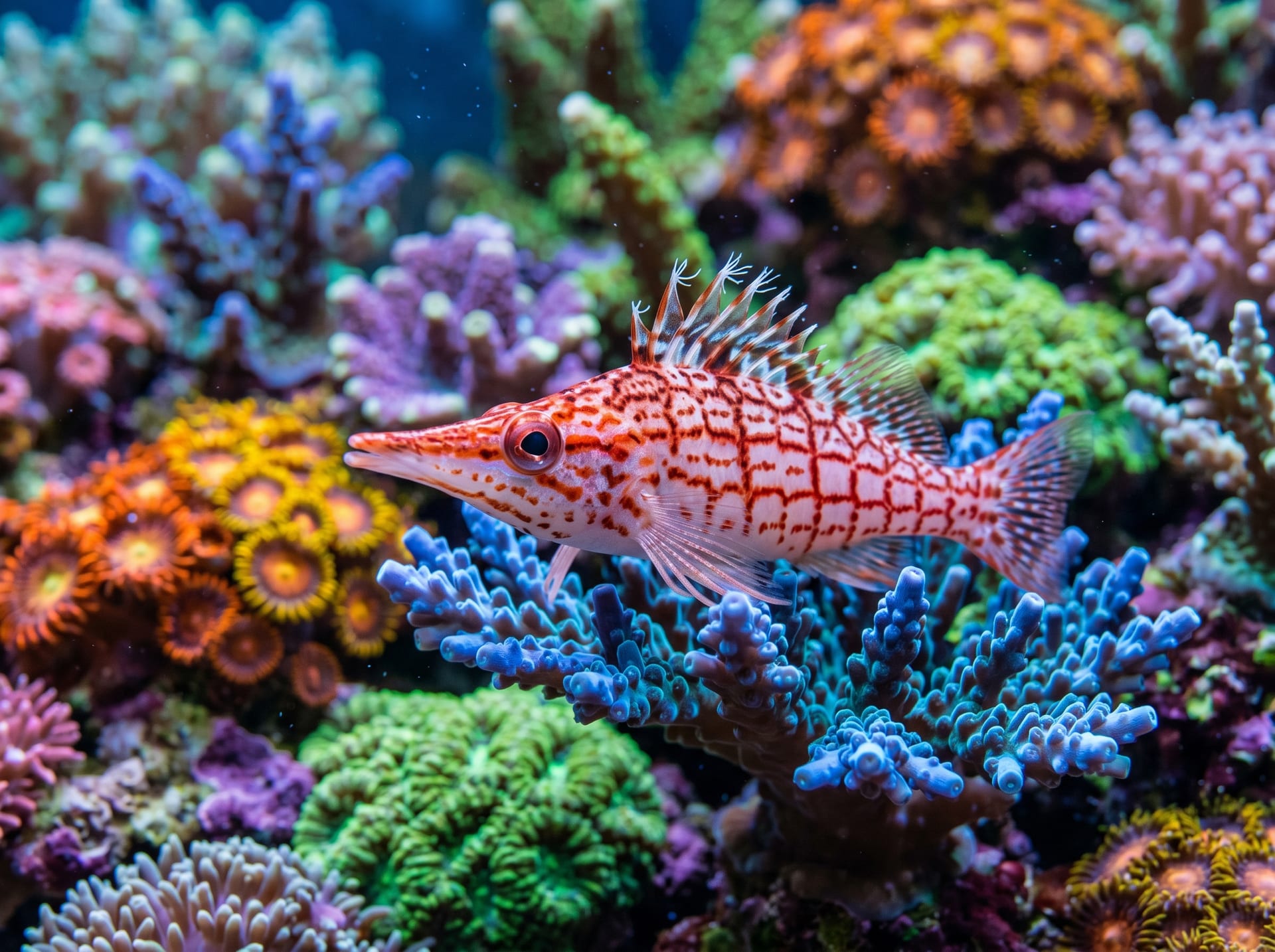
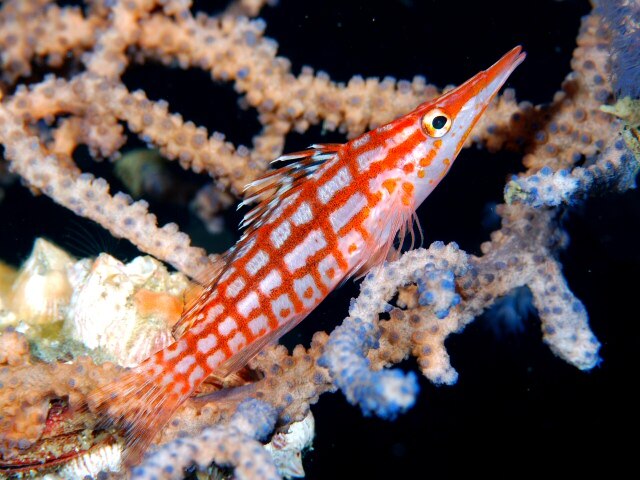
Longnose Hawkfish (Oxycirrhites typus) (technically family Cirrhitidae, but often discussed in mixed-tank contexts)
We strongly recommend that beginners start with species confirmed to accept prepared foods.
Tank Setup and Environment
Tank Size
Butterfly fish are strong swimmers and move freely throughout the tank. A 90 cm tank (180L or larger) is the minimum for one fish. If keeping multiple fish, provide 120 cm or larger tanks.
Small tanks tend to have unstable water quality and increased stress-related immune suppression, making them susceptible to ich.
Water Quality Parameters
Specific gravity: 1.020–1.025
Water temperature: 24–26°C
pH: 8.1–8.3
Nitrate: 50 mg/L or below (ideally 10 mg/L or below)
Ammonia and nitrite: Maintain near zero
A protein skimmer is essential. Butterfly fish leave significant food waste, and organic accumulation causes water quality deterioration. Always choose a skimmer larger than your tank capacity.
Importance of Live Rock
Butterfly fish prefer hiding places, and in secure environments their loss of appetite is reduced. Build a complex landscape with plenty of live rock. Live rock naturally harbors copepods, which serve as supplementary food for individuals struggling with feeding.
Feeding Methods: The Biggest Challenge
Feeding is the biggest challenge in butterfly fish care. Wild-caught individuals in particular may only eat natural coral polyps and benthic organisms, and acclimating them to prepared foods requires patience.
Step-by-Step Feeding Progression
Step 1: Stimulate appetite with live and frozen foods
First, offer frozen copepods, frozen daphnia, or live brine shrimp to confirm appetite. Frozen copepods are a preferred food for most butterfly fish.
Step 2: Switch to chopped frozen foods
Offer finely chopped high-palatability foods such as broccoli shrimp, sea urchin gonad, and spirulina algae. Finely chopped frozen white shrimp or frozen capelin are also effective.
Step 3: Mix in pellets
Sprinkle a small amount of crushed pellets onto frozen food. Gradually increase the proportion of pellets.
Step 4: Dried food and pellets alone
Success is achieved when the fish accepts marine-specific pellets such as New Spectrum or Ocean Nutrition independently.
Feeding acclimation can take 2 weeks to several months. Be patient and prioritize maintaining the fish's appetite.
Tank Mates and Compatibility Considerations
Keeping Multiple Butterfly Fish Together
Same and closely related species often fight over territory, so one species per individual is generally safest. However, if keeping multiple of the same species, introducing them simultaneously can help distribute territorial behavior.
Compatibility with Other Saltwater Fish
Due to their docile nature, they are unsuitable with aggressive fish (large angelfish, triggerfishes, etc.). Compatibility is relatively good with peaceful species (gobies, small surgeonfish, etc.).
Coral Compatibility
Polypivores (coral-eating species) cannot be kept in reef tanks. Always confirm the species characteristics beforehand. Omnivorous species such as wimplefish and vagabond butterfly fish are relatively safe in reef tanks, but individual variation exists.
Common Diseases and Treatment
Ich (Cryptocaryon irritans): The most common disease in butterfly fish. White sand-like spots appear on the body. Triggered by stress, temperature fluctuations, and water quality deterioration. Low specific gravity therapy (1.009–1.011) in a quarantine tank is effective.
Loss of appetite: Causes are varied, including environmental stress, water quality deterioration, and simple food preferences. Basic treatment involves improving water quality through water changes and finding foods the fish accepts.
Butterfly fish require higher care difficulty, but the satisfaction of successful long-term care is unmatched. Approach them with thorough research and proper equipment investment.