About the Atlas Beetle
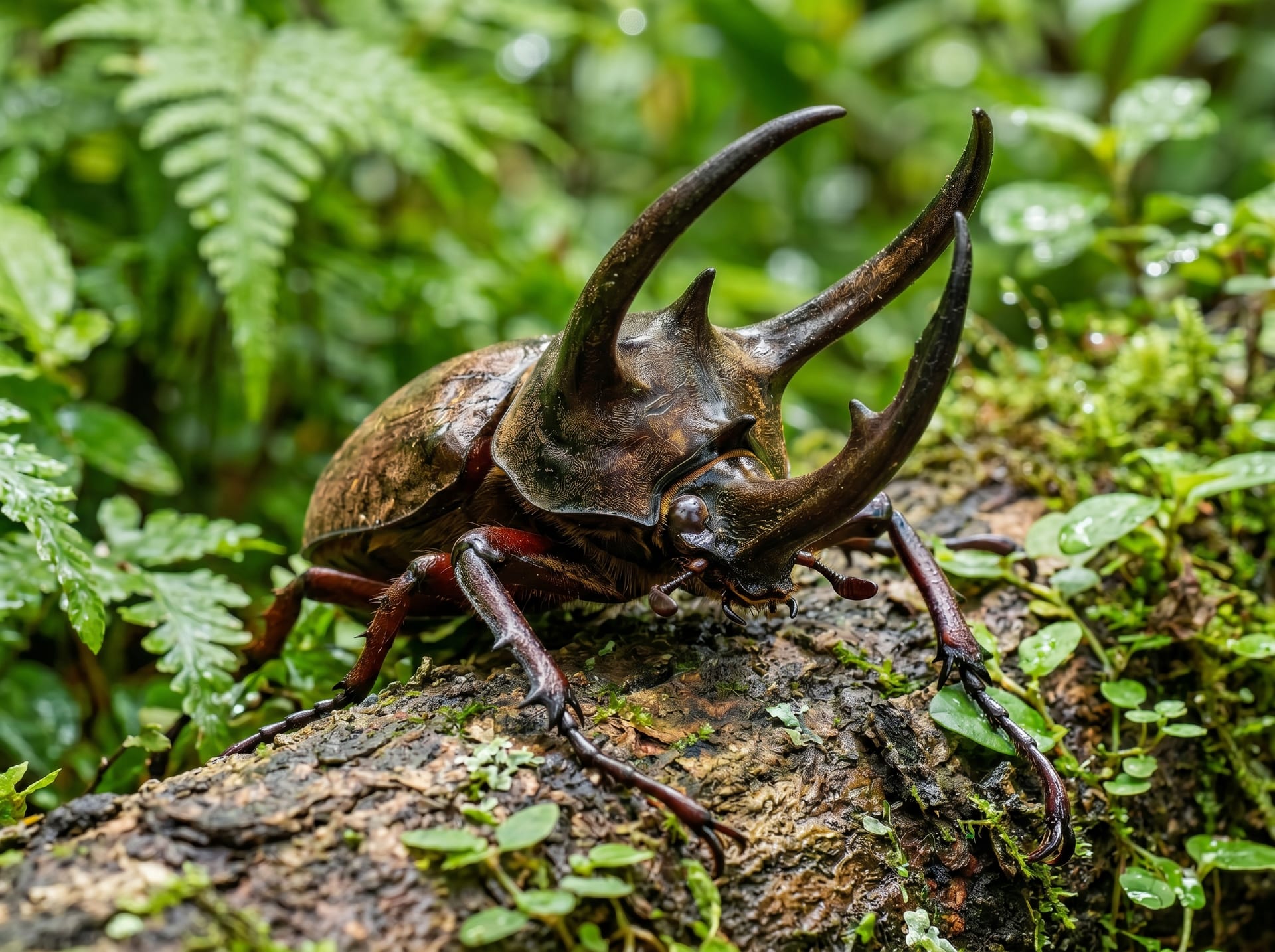
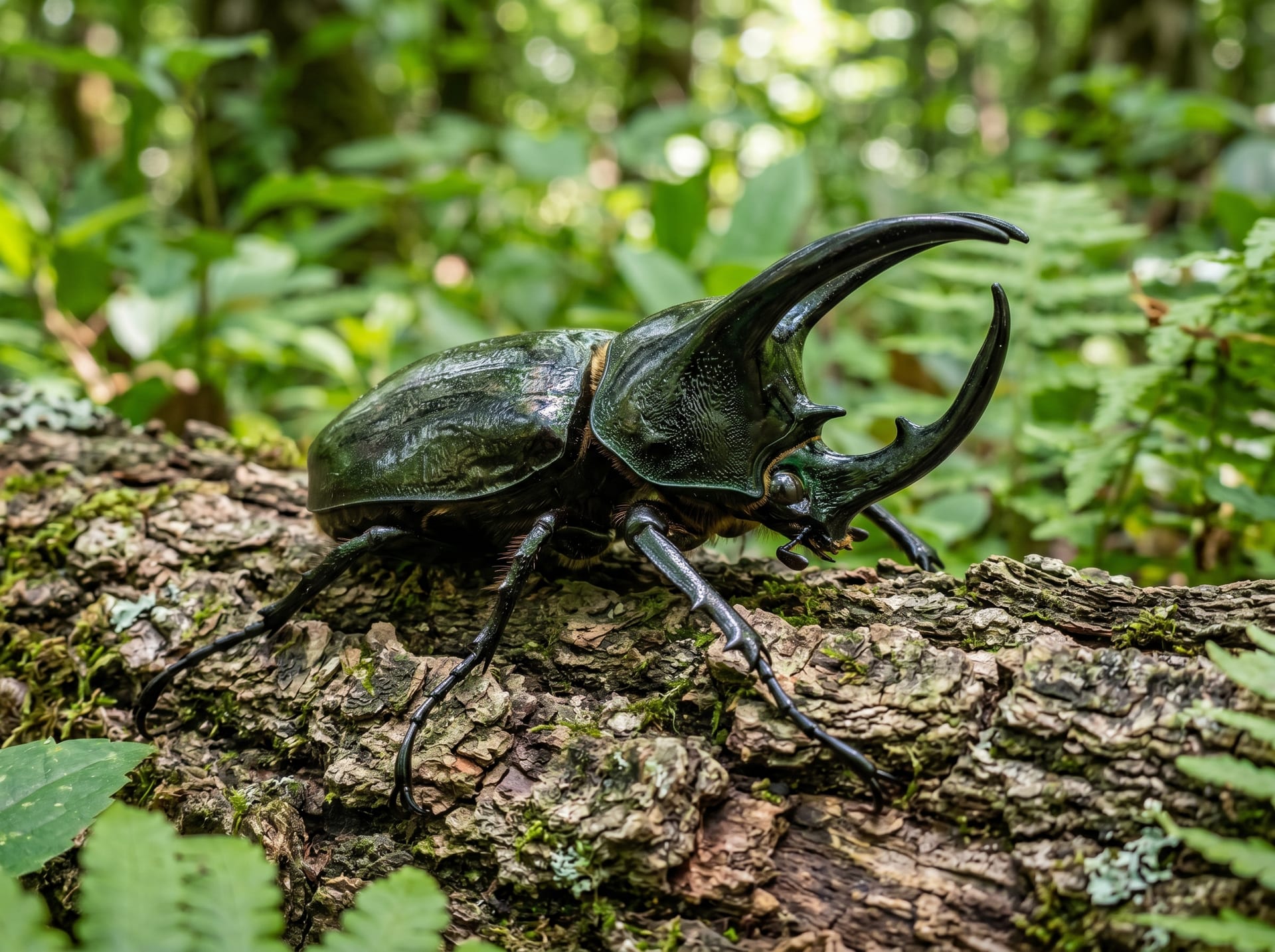
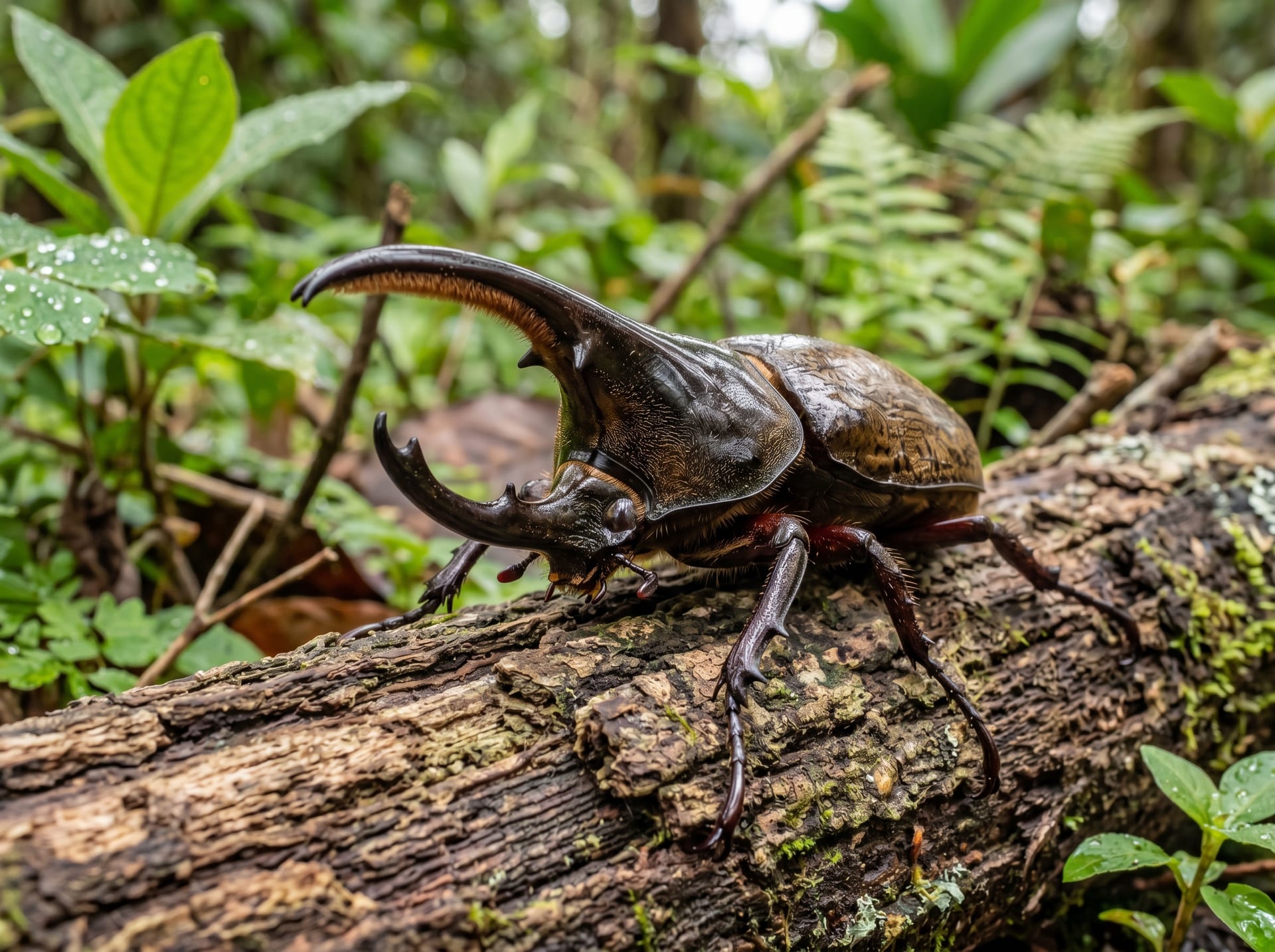
The Atlas beetle (Chalcosoma atlas) is a large rhinoceros beetle distributed widely across Southeast Asia, including Indonesia, Malaysia, Thailand, and the Philippines. Males are distinguished by three horns in total—one on the head and two on the thorax—one more than Hercules beetles, which is their most distinctive feature. Some males reach body lengths exceeding 7–10 cm, commanding a commanding presence among foreign-bred rhinoceros beetles.
A closely related species is the Chalcosoma rhinoceros beetle (Chalcosoma chiron). While Atlas beetles are somewhat smaller, their higher abundance in the trade and easier availability make them a popular choice for beginners. Within Japan, captive-bred (CB) lineages are actively maintained by breeders, and the quality of CB individuals improves each year.
Atlas Beetle Basic Data
| Item | Details |
|---|
| Body length (males) | 7–10+ cm |
| Horns | 3 (head 1, thorax 2) |
| Adult lifespan | Males 4–6 months / Females 5–7 months |
| Larval period | 12–24 months |
| Optimal temperature | Adults 22–26°C / Larvae 22–25°C |
| Price range | 2,000–5,000 yen (pair) |
| Eggs per session | 20–50 |
Adult Housing and Management
Choosing the Right Container
For housing a single male, a plastic enclosure measuring at least 30 cm wide × 20 cm deep × 20 cm tall is the standard. The three horns are prone to catching, so choose a lid that locks securely, such as a fruit fly-resistant type. If housing a pair, a larger enclosure (45+ cm wide) is required.
Substrate, Temperature, and Humidity
For adult care, use a commercial fermented substrate designed for rhinoceros beetles, laid to a depth of 5–8 cm. Atlas beetles have a strong burrowing instinct, and substrate that is too shallow can cause stress. Maintain temperatures between 22–26°C. Heat above 30°C in summer significantly reduces lifespan, so a cool, dark location or air conditioning is essential. Maintain humidity around 60–70%, using a spray bottle to prevent the substrate from drying out.
Food and Lifespan
High-protein, high-calorie jelly is optimal. Offer one 16 g cup per day, and remove uneaten portions daily to maintain hygiene. Adult lifespans are longer than some foreign-bred rhinoceros beetles: 4–6 months for males and 5–7 months for females. After the first feeding, allow 2–4 weeks of maturation before pairing to increase breeding success.
Pairing (Mating)
Male Atlas beetles have a habit of gripping females strongly with their three horns. Unsupervised cohabitation can result in fatal injury to the female, so hand-pairing under supervision is recommended.
Steps
- Position the male on the substrate; gently place the female on him from behind.
- When the male reacts (making a horn-gripping motion), mating is beginning.
- Mating typically lasts 5–30 minutes. Once complete, immediately separate the female.
- Repeat the pairing 2–3 times over subsequent days for certainty.
After mating, females increase their jelly consumption. Provide high-protein jelly consistently to trigger the egg-laying response.
Setting Up the Egg-Laying Container
An egg-laying enclosure should measure at least 40 cm wide × 30 cm deep. Use high-fermentation substrate, thoroughly moisturize it (when squeezed, it should clump and show finger impressions), and pack it firmly on the bottom to a depth of 20–25 cm. Pack the upper layer lightly so the female can burrow easily.
After setup, place the female alone inside and keep it in darkness. After 1–2 months, disassemble the container to check for eggs. Eggs are white, spherical, and approximately 4–5 mm in diameter. Expect 20–50 eggs per session. Carefully scoop out eggs with a spoon to avoid damaging them.
Larval Care
Management by Instar
- First to Second Instar (Hatch to ~1.5 months): House individually in ~800 ml deli cups. Fill with high-fermentation substrate to about 80% and watch closely for drying.
- Third Instar (the longest period): Transfer to individual 1,400 ml to 3 L bottles or containers. Third instar larvae are voracious and grow rapidly, so substrate volume is critical.
Substrate Changes and Tips
Change substrate every 2–3 months as a guideline. Retain about one-third of the old substrate and mix it with fresh to reduce stress and food refusal. Maintain temperatures of 22–25°C; temperatures above 30°C can cause larvae to thrash about and lose weight.
Some keepers use fungal substrate bottles; however, Atlas beetles do not benefit from fungal substrate as much as Hercules beetles, and high-quality fermented substrate tends to yield more consistent results. Larval duration ranges from 12–24 months depending on individual variation, temperature management, and substrate quality.
Pupation, Emergence, and First Feeding
Late third instar larvae become less active and enter the pre-pupal stage. At this point, avoid moving the container or causing vibrations. If the substrate is sufficiently deep, the larva will construct its own pupal chamber and pupate.
Emergence occurs approximately 2–3 months after pupation. Newly emerged adults have soft bodies; the exoskeleton takes several days to harden. After emergence, keep the individual isolated for about a month. Do not attempt pairing until the first feeding (when the beetle spontaneously begins eating jelly) is confirmed.
The final size of the emerged adult depends heavily on nutrition during the larval stage and temperature management. To maximize size, the weight during mid-third instar is a key indicator. Males weighing over 60 g have a high likelihood of reaching 9+ cm.
The Atlas beetle excels as an introductory species for foreign insect keeping not only for its striking appearance but also for its high egg count and relatively straightforward larval care. With attention to temperature management and two key points—individual selection (WD versus captive-bred) and emergence timing mismatches—even beginners can enjoy maintaining and breeding their own lineage.
Atlas Beetle Lifespan and the Adult Keeping Annual Cycle
"I started keeping an adult, but how much longer will it live?" is one of the most common questions among Atlas keepers. Here is a summary of expected lifespan and the year-long care progression.
| Life Stage | Expected Duration |
|---|
| Egg to hatch | ~1 month |
| Larval period | 12–24 months |
| Pupa | 2–3 months |
| Emergence to first feeding | 3–4 weeks |
| Adult lifespan (after first feeding) | Males 4–6 months / Females 5–7 months |
Among foreign rhinoceros beetles, they have a relatively long adult lifespan, and with proper temperature management can be kept across winter. However, adults purchased at retail often have an unknown time since first feeding, making remaining lifespan difficult to estimate. Choosing captive-bred (CB/F1) individuals with documented emergence dates makes it easier to plan breeding timelines and predict remaining lifespan.
Is Atlas Beetle Care Difficult? — The Real Challenges Lie in Individual Selection and Breeding, Not Adult Care
Simply put, keeping an adult for several months is not particularly difficult. With high egg counts and consistent larval development in fermented substrate, they are widely regarded as an introductory species for foreign beetles. Yet complaints of "difficulty" and "died shortly after purchase" persist because four key points remain poorly understood.
① Most cheap individuals are WD (wild-collected), with unknown remaining lifespan
Many individuals sold for just a few thousand yen are WD (wild-collected). Since the time elapsed since emergence in the wild is unknown, remaining lifespan in captivity is often less than half the average, and some die within days of arrival. It is not uncommon for them to carry mites or show minor damage such as missing tarsal claws, antenna malformation, or worn or broken wings.
In other words, "died in two weeks" does not necessarily mean poor care. If you want to calculate lifespan or use them for breeding, check the seller's designation of origin (WD/CB/F1, etc.) and select individuals with a documented emergence date. If unsure, contact the seller before purchase.
② Tarsal Claws Begin Falling Off Around Three Months After Emergence
In later life, many Atlas beetles lose their tarsal claws (the small claws at the tip of each leg). Beetles missing these claws cannot right themselves if turned over and may die from exhaustion. This is not disease but a natural aging process and cannot be prevented. Environmental measures can help: include climbing wood, fallen leaves, and bark so the beetle can grip and recover if it tips. For details, see Why Beetles Flip Over and How to Prevent It.
③ Emergence Timing Mismatches Prevent Pairing (the Biggest Challenge in Breeding)
Even siblings from the same egg-laying session often exhibit males with longer larval periods than females. Females emerge and reach end-of-life while males are still developing, causing "emergence timing mismatches." Reports from keepers indicate males 11–16 months and females 10–13 months; large males may lag by nearly half a year.
Two strategies address this: (a) Maintain excess males and females to ensure overlapping emergence windows. (b) Keep early-emerging individuals at lower temperatures to slow activity and maturation, while maintaining later-emerging larvae at higher temperatures to accelerate development. This temperature-based "synchronization" is the key practical technique in Atlas breeding.
④ Sensitive to Cold; Winter Requires Warmth, Not Cool
Treating them like native Japanese beetles by keeping them cool in winter will weaken them. As a Southeast Asian species, Atlas beetles are sensitive to cold. If overwintering, use a heat mat to maintain 22–26°C (as outlined above).
Why Are Atlas Beetles So Cheap?
"It's this large—surely 2,000–5,000 yen is suspiciously cheap?" is a common concern, but low price does not indicate low quality. The reason lies in supply and distribution.
- Abundant in the wild: They are distributed across a wide range of Southeast Asia (Indonesia, Malaysia, Thailand, Philippines), and significant numbers are collected locally.
- Short shipping distance: Compared to Central/South American species like Hercules, they are closer to Japan, reducing transport costs.
- Heavy WD imports: Wild-collected individuals are cheaper to supply than captive-bred lines.
In short, the primary factor in affordability is the large volume of WD imports. As a corollary, cheaper individuals carry the risk of unknown remaining lifespan, as noted above. Captive-bred (CB/F1) individuals with documented emergence dates command higher prices, but for planned breeding, such individuals ultimately avoid waste.
Atlas Beetles versus Chalcosoma and Hercules: Key Differences
Compared to other popular large-horned species, the Atlas beetle's position becomes clear.
| Species | Horns | Body length (males) | Adult lifespan | Difficulty | Characteristics |
|---|
| Atlas Beetle | 3 | 7–10+ cm | 4–6 months | Moderate | High abundance; easy to source |
| Chalcosoma Rhinoceros Beetle | 3 | 6–13 cm | 3–6 months | Moderate–Challenging | Larger than Atlas; aggressive temperament |
| Hercules Beetle | 2 | Up to 18+ cm | 6–12 months | Moderate | World's largest; longest-lived |
Atlas beetles resemble Chalcosoma beetles but are slightly smaller, more abundant, and more affordable, making them superior for beginners. Both have aggressive temperaments, and the three-horn grip poses a risk to females, so hand-pairing remains a mandatory technique for both.
Frequently Asked Questions
How long do Atlas beetles live?
After first feeding, adult males typically live 4–6 months and females 5–7 months. Counting from the egg, the larval period (12–24 months) plus pupal stage (2–3 months) leads to emergence, for a total lifespan of approximately 2–3 years.
Do Atlas beetles overwinter?
Adults do not typically overwinter. However, being Southeast Asian and sensitive to cold, winter care actually requires maintaining 22°C or warmer. They may survive across winter within their natural lifespan.
Do larvae grow larger in fungal substrate bottles than in fermented substrate?
Atlas beetles do not benefit from fungal substrate as much as Hercules beetles. High-quality fermented substrate tends to produce more consistent results. If fungal substrate is used, size differences compared to fermented substrate are minimal.