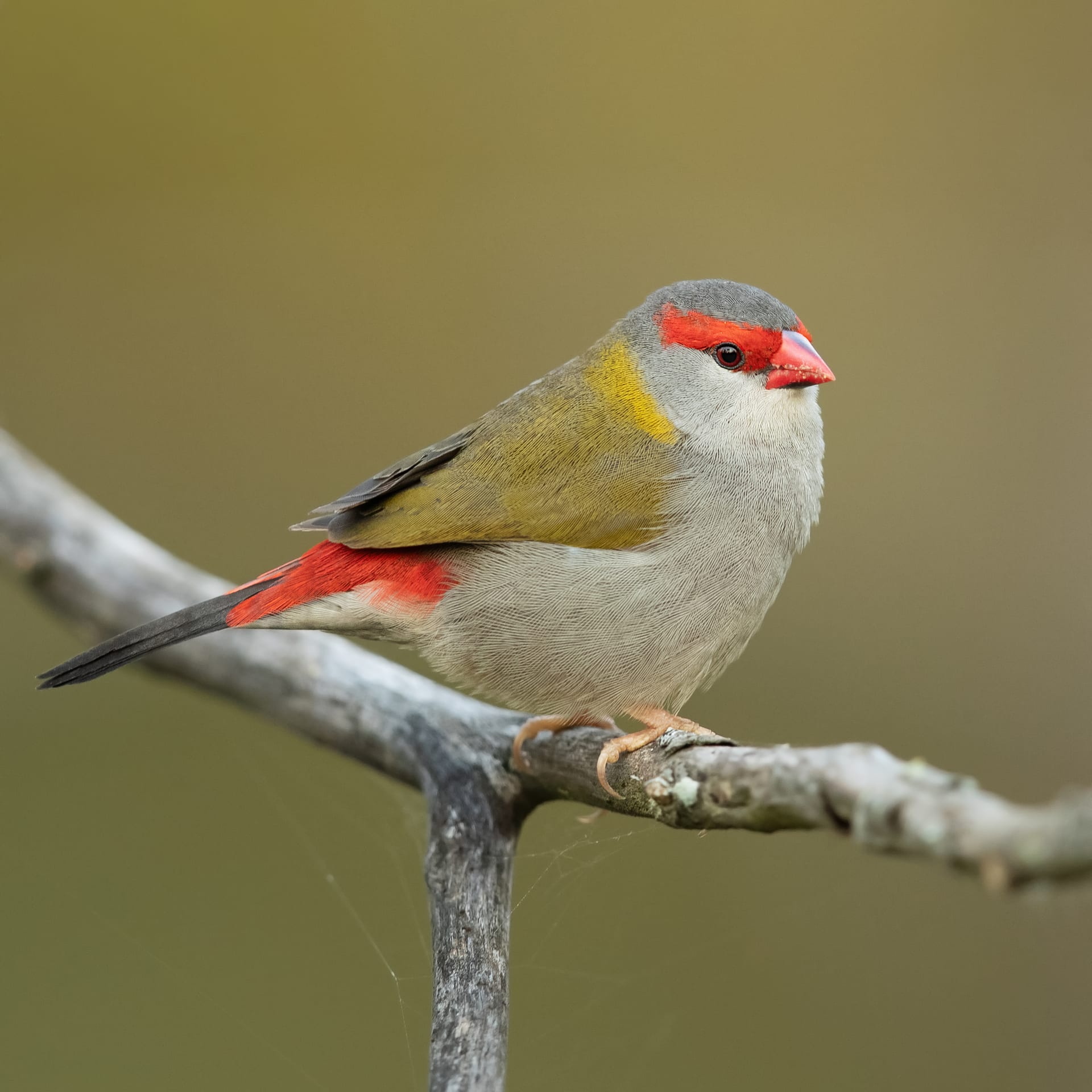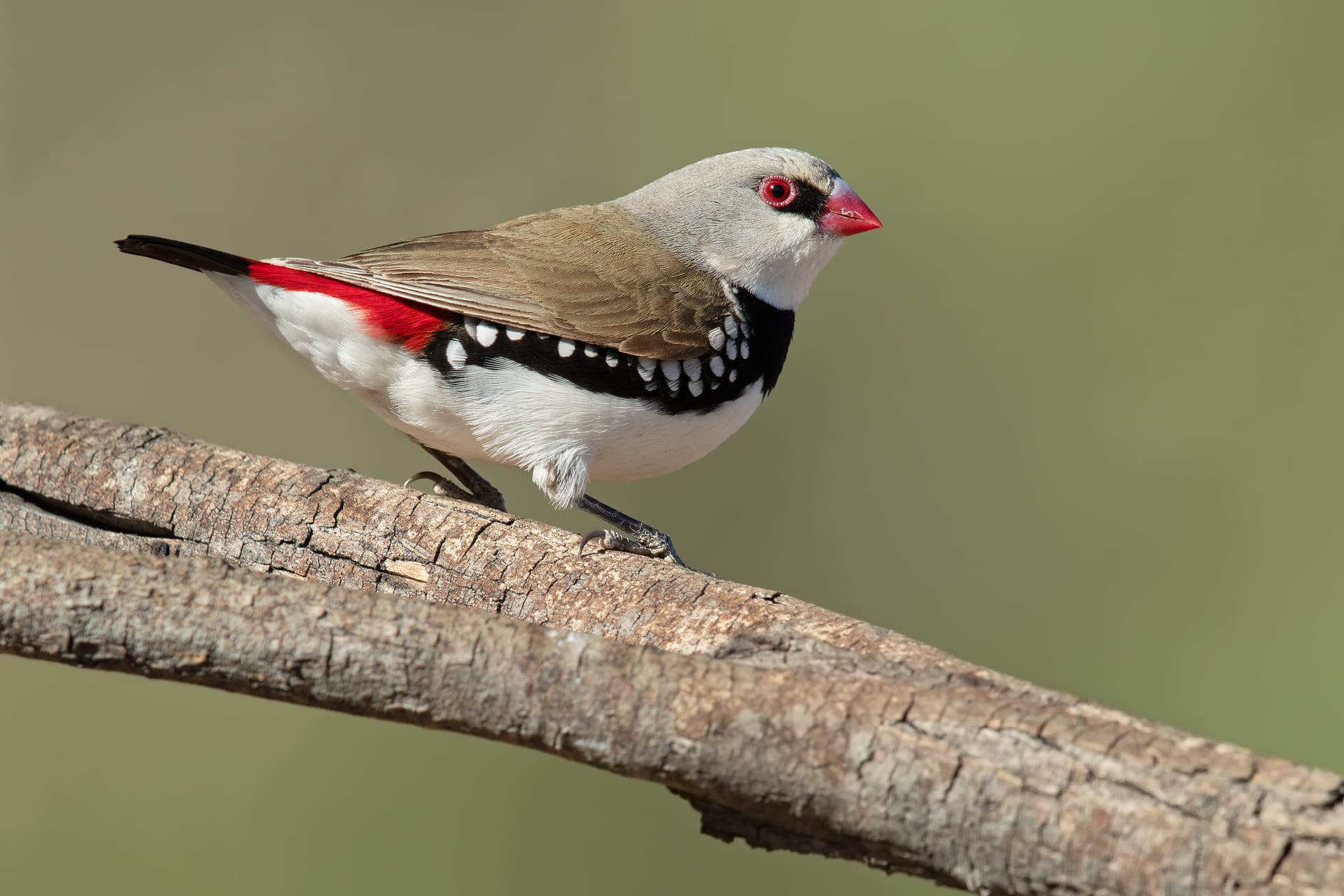
Source: Wikimedia Commons
Diamond Firetail
IntermediateStagonopleura guttata
An Australian estrildid with a white throat, a black breast band, black flanks marked with white spots and a bright red rump. By weight and wingspan it is among the largest Australian finches.
Difficulty
Intermediate
Lifespan
5-8 years
Size
11.5-12cm
Humidity
40〜60%
Diet
Mixed seed, spray millet, greens, small livefood when breeding
About
The diamond firetail (Stagonopleura guttata) is an estrildid finch of south-eastern Australia. It is 11.5-12 cm long but at 15-19 g and with a wingspan of 64-71 mm it ranks among the largest Australian finches. The back is olive and the head grey, the throat and belly white with a complete black breast band, and the black flanks carry distinctive white spots. The rump is bright red and the tail tip black, the rump being very conspicuous in flight. Juveniles are duller with a black bill. Birds are usually seen in pairs or small flocks, sometimes up to a hundred, flying low in long lines. Its patchy range runs from south-east Queensland to the Eyre Peninsula, and the IUCN assesses it as Vulnerable, a status echoed by Australian federal and state legislation. It has a long history in aviculture: in Germany between 1984 and 1987 one to one and a half thousand young were reared each year. Males react strongly to red tones, so tank mates must be chosen with care.
Source: Wikipedia (CC BY-SA 4.0)
Lifespan of the Diamond Firetail
The Diamond Firetail lives 5-8 years.
Size of the Diamond Firetail
The Diamond Firetail grows to 11.5-12cm.
Basic Info
Origin
South-eastern Australia, from south-east Queensland through Victoria to the Eyre Peninsula in South Australia
Lifespan
5-8 years
Size
11.5-12cm
Care Specifications
Semi-aggressivePairBreeding: Moderate
Sources: Wikipedia - Diamond firetail (15-19 g, 64-71 mm wingspan, morphology, range, conservation status) / Wikipedia (German) - Diamantamadine (11.5-12 cm, shelter above 10C, reaction to red, numbers bred)
References & Sources
Edited & verified by: BreederDirect editorial team
The taxonomic, regulatory, and husbandry data on this page are compiled and verified against the authoritative primary sources below.
Taxonomy & Authority
Accepted name: Stagonopleura guttata (Shaw, 1796)
Synonyms: Emblema guttata
Authority databases: GBIF
Nomenclature follows global taxonomic authority databases.
Regulations & Conservation Status
Not CITES-listedIUCN VU · Vulnerable
Stagonopleura guttata. The family Estrildidae is not listed in the CITES Appendices, so this species is not covered. However the IUCN assesses it as Vulnerable, and it is listed as Vulnerable under Australia's EPBC Act and in several state acts. Australia bans the export of wild birds, so traded birds are captive bred.
Sources: CITES Appendices (Estrildidae not listed) / IUCN Red List
Regulations may change. Always verify the latest information with the relevant authorities.
Diamond Firetail Listings
Loading latest listingsFind listings for this species