Complete Guide to Betta Tail Types | Differences and How to Choose Half-moon, Crown Tail, Double Tail
A detailed explanation of betta tail types and characteristics that determine the breed. Introduces how to identify major tail types such as half-moon, crown tail, double tail, plakat, delta, and rose tail, along with practical tips for breeding and selection.
Key Takeaways
A detailed explanation of betta tail types and characteristics that determine the breed. Introduces how to identify major tail types such as half-moon, crown tail, double tail, plakat, delta, and rose tail, along with practical tips for breeding and selection.
Related Species
What Are Betta Tail Types?
Betta (Betta splendens) is a tropical fish that combines the fierce nature of a "fighting fish" with jewel-like beauty. The element that deepens its appeal further is "tail type"—the classification of breeds by tail shape. Even bettas with the same coloration display completely different character when the tail type differs, and among enthusiasts, tail type is often valued equally to or even more than coloration.
In the world of contests and professional breeders, evaluation standards and value are clearly defined for each tail type. Whether you're welcoming your first betta or working toward breeding, having foundational knowledge of tail types dramatically improves your ability to select individuals and enhances the enjoyment of keeping them. This article provides detailed explanations of the major tail types' characteristics and also shares practical tips for keeping and breeding bettas.
Major Tail Types Gallery
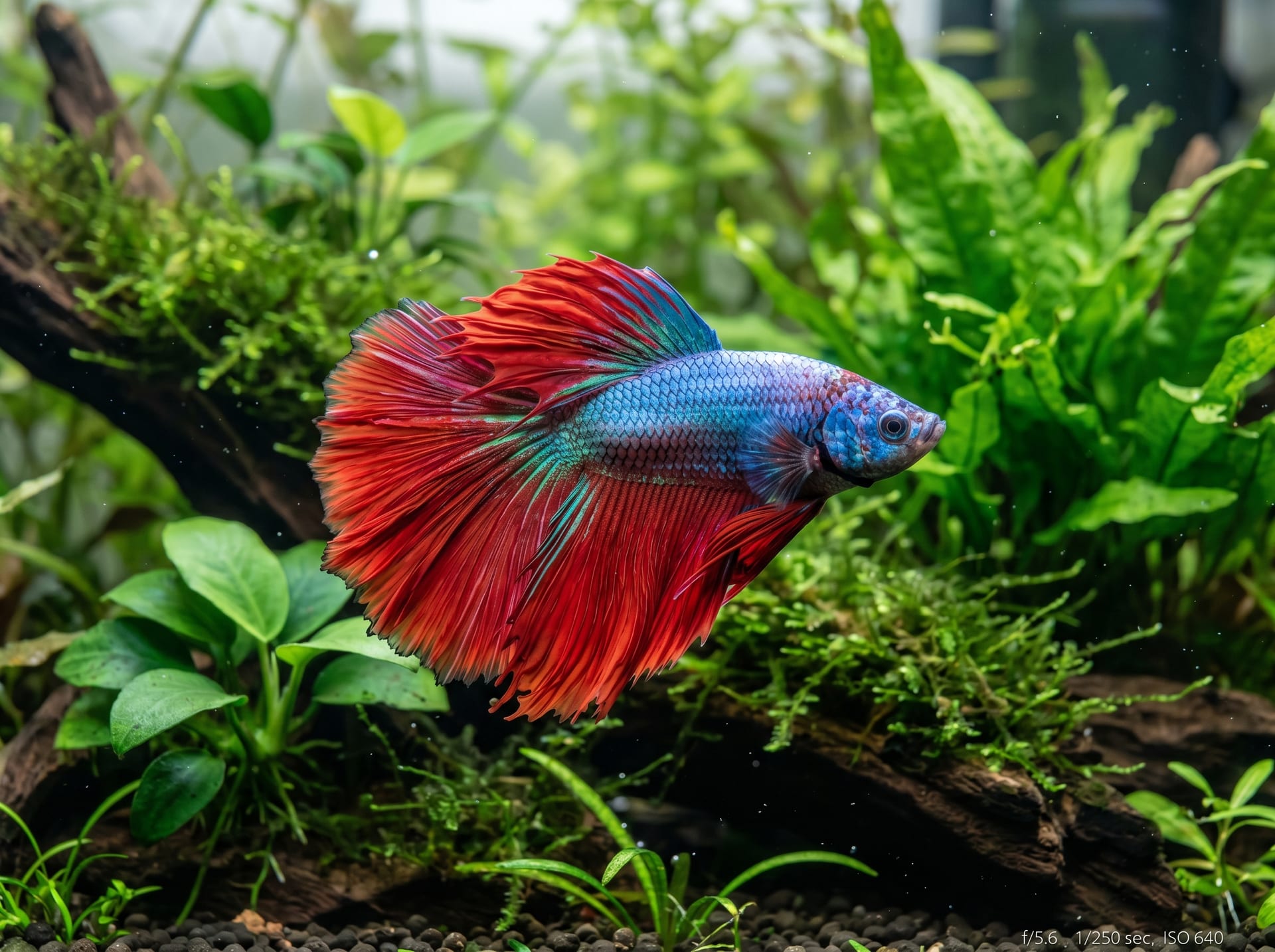
Half-moon (HM) A variety where the tail spreads exactly 180 degrees and forms a D-shape (semicircle) when viewed from the side. It is positioned as the standard for evaluation in the international contest IBC (International Betta Congress) and can be considered the quintessential betta. High-quality individuals have tail edges aligned in a straight line, with the dorsal fin, tail fin, and anal fin appearing to flow smoothly together. While the large tail area sometimes causes swimming to become sluggish due to the fin's weight, this heaviness is part of its elegant charm.
Over Half-moon (OHM) A premium variety that spreads beyond 180 degrees—expanding to 200–220 degrees. The overwhelming volume when fully displayed is like a dress, offering unparalleled viewing beauty. However, when the tail spreads excessively, it tends to fold inward under its own weight, increasing the risk of fin tearing. Because breeding difficulty is high and availability is limited, prices tend to be significantly higher than standard half-moons.
Crown Tail (CT) A variety where the fin membrane recedes and radiating fin spines (rays) protrude, forming a jagged silhouette like a crown. The appearance changes dramatically depending on the length and number of the protruding spines, with variations such as "single ray," "double ray," and "cross ray." Its unique rugged beauty attracts passionate fans, and in Thai contests, there is even a dedicated crown tail class. With less fin membrane, damage is less noticeable, but on the other hand, it has the husbandry advantage of quick regeneration.
Double Tail (DT) A variety where the tail is completely split into dorsal and ventral sections. It is characterized by vertically symmetrical tails and a correspondingly enlarged dorsal fin, with a symmetrical beauty that is uniquely different from other tail types. Since the double tail gene is recessive, it can be carried latently in non-DT bettas and may appear unexpectedly. Because there is a tendency for tail formation abnormalities and shorter body length, careful selection of healthy individuals is necessary.
Plakat (PK) The original short-tail type closest to wild bettas from the Mekong River region. The tail is small and rounded, with overall body proportions compact. They are quick swimmers with good stamina, relatively resistant to water currents, and robust, making them suitable for first-time betta keepers. In recent years, "HM PK Plakat," which combines plakat with half-moon genes, has appeared and gained popularity with a new beauty—short-tailed yet with fanning tail displays.
Delta / Super Delta (D / SD) A variety where the tail spreads into a triangular shape resembling the Greek letter Δ (delta). While not opening to a full 180 degrees like the half-moon, it achieves impressive impact at an opening of 150–170 degrees. Super delta opens even wider, giving an intermediate impression between delta and half-moon. Because it offers ease of care and good cost balance, it is popular as a beginner variety.
Rose Tail / Feather Tail A further development of the half-moon where fin edges wave in overlapping layers. The name rose tail comes from the tail appearing like rose petals. More extremely layered versions are called feather tail. While viewing beauty is exceptional, excessive fin development increases water resistance and makes this a delicate variety prone to fin tearing and self-injury.
Husbandry Environment by Tail Type
Appropriate husbandry environments differ clearly depending on tail type.
For half-moons, OHMs, and rose tails with large tail areas, strong water currents are the enemy. Choose a sponge filter or low-flow filter, and adjust the outlet direction to keep the water surface calm. In contrast, plakats and crown tails have no problem with moderate water flow and can use standard hang-on filters.
Water temperature of 25–27°C is ideal for all types. Above 28°C, metabolism rises too much, placing strain on fin blood vessels, and especially in large-tailed varieties, the risk of tail rot disease (columnaris) increases due to immune suppression. Use a heater with a thermostat and adjust for seasonal temperature changes.
Secure a minimum of 3–5 liters or larger for your tank. While bettas are kept individually, larger tanks result in less stress on fins and allow maintaining a beautiful appearance longer.
Genetics and Selection in Breeding
Tail type is genetically determined, and in planned breeding, line stability is important. While crossing same tail types is basic for quality improvement, there are several genetic characteristics worth knowing.
The double tail gene is recessive and appears as DT only when both parents carry the DT gene. Even when crossing HMs, DT individuals can appear if ancestors carry the DT trait. Conversely, this characteristic is leveraged in widely known breeding techniques that cross DT with HM to enhance fin spread.
Selection criteria for tail fin evaluation are as follows:
- Uniformity of opening angle: Are the left and right sides symmetrical and consistently spread to the target angle?
- Alignment of fin edges: Do the tail tips line up in a straight line? (Raggedness is penalized)
- Continuity of three fins: Do the dorsal fin, tail fin, and anal fin flow continuously without interruption?
- Fin membrane transparency: Are blood vessels densely distributed, showing beauty when backlit?
Since fry tail shape is not fixed at the larval stage, by gradually growing them after 2–3 months while maintaining proper water temperature, final traits can be determined.
Finding Your Favorite Tail Type
Betta tail types possess such diverse character that they hardly seem like the same fish. It's recommended to start with readily available and affordable varieties like half-moons and crown tails as your first step. As you gain experience, challenge yourself with more difficult varieties like OHMs and rose tails, and by advancing to breeding, you can fully enjoy the essence of betta keeping.
When purchasing directly from a breeder, ask about the tail type lineage and parent fish information. Individuals with clear lineage deepen the enjoyment of breeding. Finding your own favorite variety is the gateway to the wonderful world of bettas.