Star Polyps (Pachyclavularia) Care Guide | Beginner-Friendly Soft Coral Growth Management and Placement Techniques
A detailed guide to caring for Star Polyps (Pachyclavularia violacea). Learn the fundamental water parameters, lighting, and flow settings for this beginner-friendly soft coral, troubleshoot why polyps won't open, and master frag propagation and growth control to successfully manage this popular reef tank species.
Key Takeaways
A detailed guide to caring for Star Polyps (Pachyclavularia violacea). Learn the fundamental water parameters, lighting, and flow settings for this beginner-friendly soft coral, troubleshoot why polyps won't open, and master frag propagation and growth control to successfully manage this popular reef tank species.
Related Species
About Star Polyps
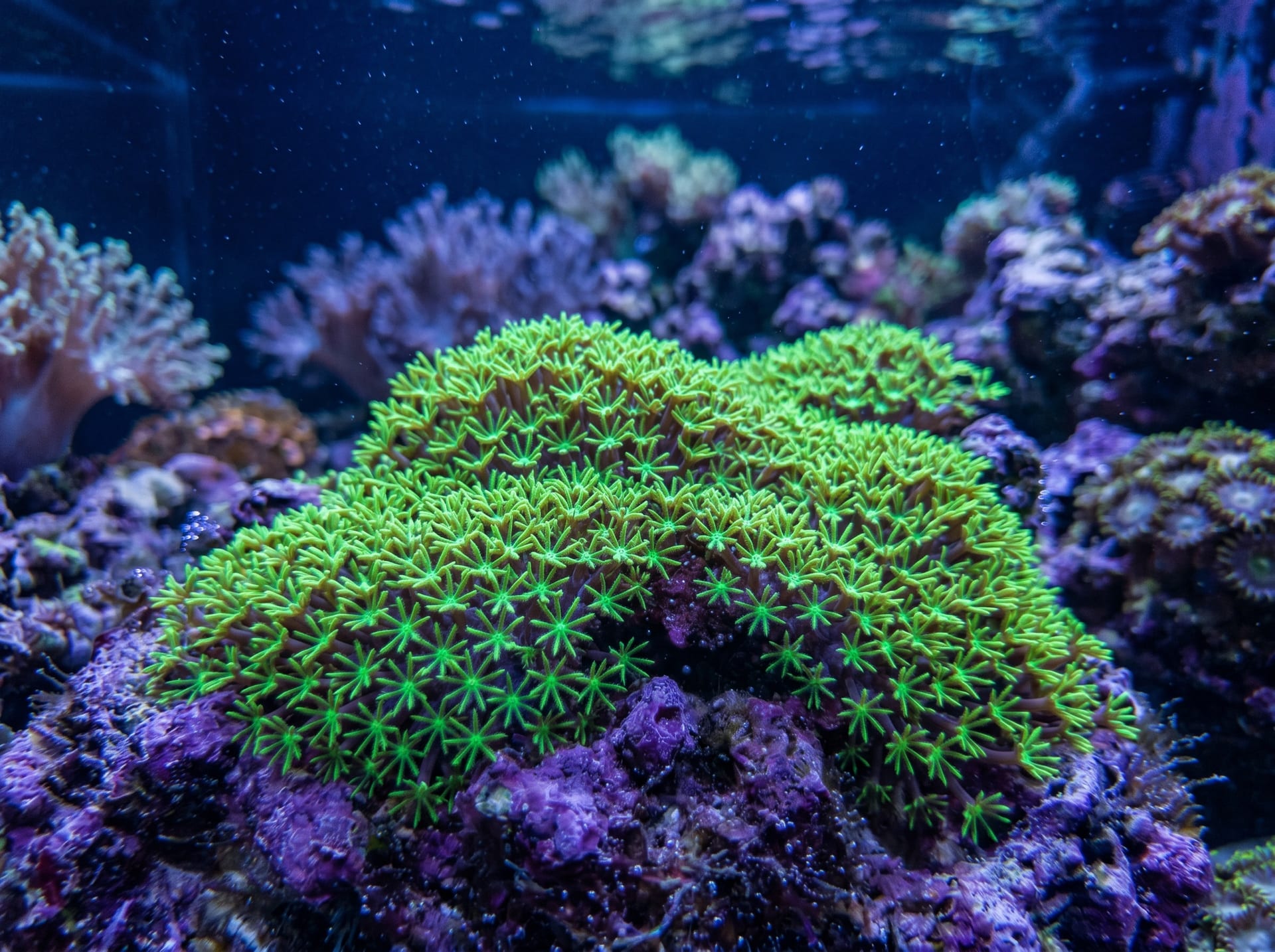
Star Polyps (Pachyclavularia violacea, formerly Briareum spp.) are among the most beginner-friendly soft corals available. With vibrant colors ranging from green to blue-green to brown, they form thin mat-like colonies across live rock, sand, and glass surfaces as they spread outward.
Each polyp measures roughly 3–8 mm in diameter and bears 8 tentacles (most soft corals are "octocorals" with 8 tentacles). When polyps open simultaneously, they create a beautiful landscape that resembles a swaying green lawn.
Star Polyps at a Glance
- Difficulty: Easy to Moderate (suitable for beginners)
- Growth Rate: Fast (can expand several-fold in weeks under ideal conditions)
- Photosynthetic Capacity: High (can be maintained on light alone without feeding)
- Price: Affordable (typically $5–50 USD per specimen)
Required Water Parameters
Star Polyps, like most soft corals, tolerate a relatively wide range of conditions, but optimal parameters dramatically improve growth and coloration.
Recommended Water Parameters
| Parameter | Target Range |
|---|---|
| Salinity (Specific Gravity) | 1.025–1.026 |
| Temperature | 23–26°C (73–79°F) |
| pH | 8.0–8.3 |
| Alkalinity (KH) | 7–11 dKH |
| Calcium (Ca) | 380–450 mg/L |
| Magnesium (Mg) | 1200–1350 mg/L |
| Nitrate (NO₃) | 5–25 ppm (tolerates wider range) |
| Phosphate (PO₄) | 0.05–0.2 ppm |
Star Polyps tolerate moderate KH fluctuations but show stress from rapid changes (>1–2 dKH per day). Weekly water changes help maintain stability.
Lighting
Star Polyps adapt well to medium to high light levels. Since they rely on zooxanthellae symbiosis, adequate light is their primary energy source and drives growth.
Recommended PAR: 100–300 PAR
- Low Light (≤100 PAR): Polyps extend but growth is slower
- Medium Light (150–200 PAR): Best balance of growth and coloration
- High Light (200–300 PAR): Strong green coloration and rapid growth
Avoid sudden increases in light intensity, as this risks photoinhibition. Gradually acclimate the coral to higher light levels.
Water Flow
Star Polyps prefer moderate water flow.
Recommendation: Medium-Strength Random Flow
- Strong unidirectional flow: Polyps get pushed around and fail to open fully
- Proper random flow: Polyps sway naturally, optimizing photosynthetic efficiency
- Weak flow: Leads to organic accumulation and algae growth
If polyps remain closed, first review your flow direction and strength.
Placement and Growth Management
Star Polyps spread aggressively, making careful placement planning essential.
Growth Characteristics
Star Polyps extend thin stolons (runners) across surfaces—live rock, glass, and sand—forming new colonies. Under ideal conditions, they can expand several-fold within a month.
Placement Tips
- Place on isolated live rock pieces to prevent overgrowth onto other rocks
- To limit spread, regularly trim colony edges (creating frags)
- Maintain adequate spacing from other corals; direct contact can smother neighboring species
- Like Zoanthus, they encroach rapidly on surrounding corals, so monitor distance carefully
Why Polyps Won't Open
The most common complaint among hobbyists is "polyps stay closed and won't open."
Common Causes and Solutions
| Cause | How to Check | Solution |
|---|---|---|
| Water Quality Decline (low KH, Ca, Mg) | Test with test kit | Water change / supplement additives |
| Excessive Water Flow | Observe polyp movement | Adjust pump direction and intensity |
| Light Too Bright | Measure with PAR meter | Relocate to lower position |
| Allelopathic Compounds | Check nearby corals | Replace activated carbon / isolate coral |
| Skeleton Clogged with Mucus or Debris | Visual inspection | Light brushing or gentle blowing off |
| Shipping Stress (new acquisition) | Check date of introduction | Allow 1–2 weeks acclimation period |
Most recover naturally within 1–2 weeks. Avoid moving the coral unnecessarily, as this increases stress.
Feeding
Star Polyps derive most of their energy from photosynthesis and typically require no supplemental feeding. However, liquid phytoplankton additives (PhytoPlankton, NanoCorn, etc.) can promote growth and color enhancement.
Turn off your circulation pump, add a small amount of food to the tank, then restart the pump after 30–60 minutes. Overfeeding degrades water quality, so limit to once or twice weekly in small amounts.
Frag Propagation
Star Polyps are among the easiest soft corals to frag.
Frag Creation Steps
- Use scissors or a coral cutter to remove a section of the mat (approximately 2 cm × 2 cm)
- Attach to a frag plug using cyanoacrylate adhesive
- Return quickly to water before the cut dries
- Recover in low light and weak flow for 1–2 weeks
Recovery is rapid, with visible attachment within 1–2 weeks. Frags are excellent for trading and sharing within the coral hobby community.
Summary
Star Polyps are an ideal entry point into reef aquascaping. With medium light, moderate flow, and stable water parameters, beginners can enjoy beautiful green polyps. Because they grow so rapidly, regular frag propagation is key to managing colony expansion long-term. Monitor for overgrowth onto neighboring corals, and use them to create eye-catching aquascapes.