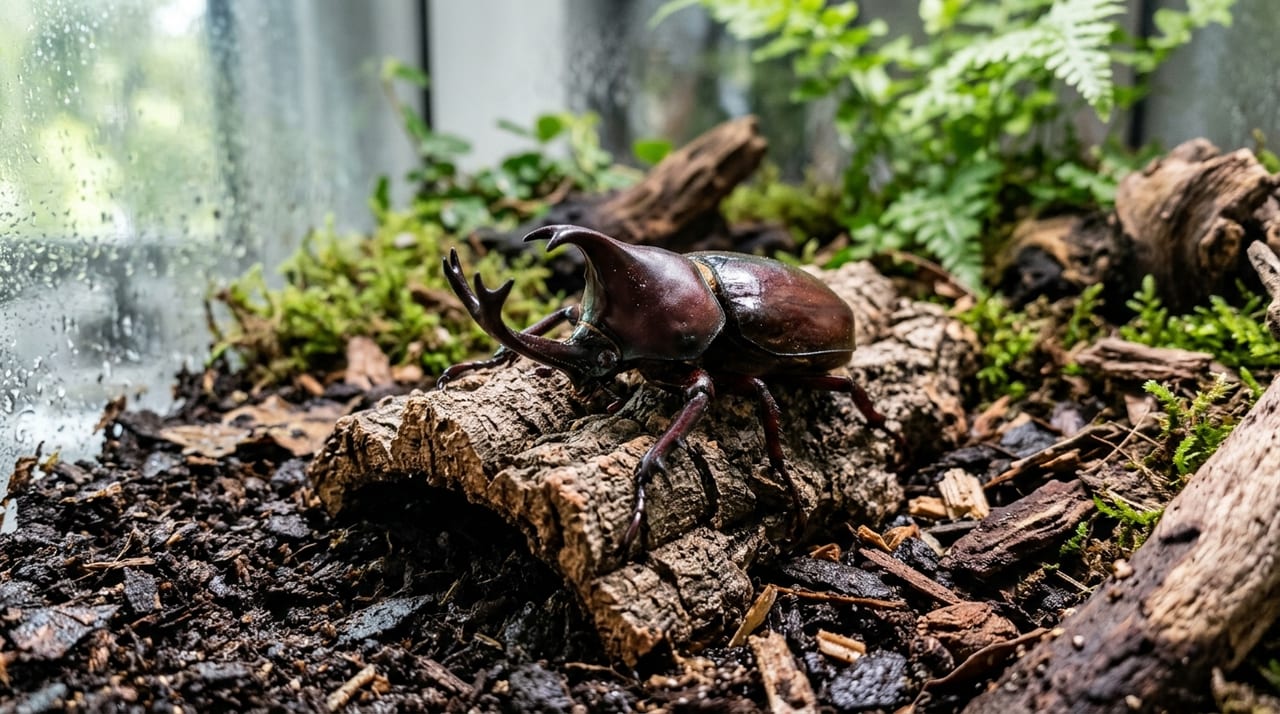
What Kind of Insect is the Flower Beetle?
The Flower Beetle (genus Pachnoda) is a scarab beetle widely distributed across the African continent, with adults displaying a striking pattern of yellow, orange, and black, also known as the "Sunburst Beetle." With a body length of roughly 2–4 cm, they fit comfortably in the palm of your hand, have a docile temperament, and show no aggression; even when held or grasped, they do not experience significant stress. They are also widely used as feeder insects for reptiles (such as leopard geckos), and beyond keeping them as pets, hobby breeders are increasingly using them for breeding and sales.
In the wild, they have the habit of flying to flowers and licking pollen and nectar, which is the origin of the name "Flower Beetle." Among beetles, they have strong flight abilities and may spread their wings and fly when startled or when temperatures rise. When observing them outside their container, it's reassuring to do so in a closed room where they can be easily recaptured if they escape.
Adult Housing
| Item | Details |
|---|
| Container | A fruit fly-proof container or reptile plastic case (approximately 30 cm) is suitable. Prioritize floor space over height, and line the case with 5–8 cm of fallen leaves. Adults have the habit of burrowing into soil, which can also double as a laying substrate. A mesh-topped lid that prevents fruit flies is ideal, and ensuring adequate ventilation is important. |
| Temperature | 25–30°C is the optimal activity range; activity drops noticeably below 18°C. In winter, maintain warmth with a heating panel or warm enclosure. Avoid direct sunlight, dryness, and sudden temperature fluctuations. |
Placing small pieces of driftwood, bark, and rolled-up broadleaf leaves on top of the bedding helps the beetles grip with their legs and maintain posture; if they flip over, they can more easily right themselves. If the case becomes too dry, the bedding will compact and become difficult to burrow into, so when the surface dries out, lightly mist it to maintain moisture. Conversely, prolonged high humidity can promote mold and mites, so the key to good care is to strike a balance between ventilation and moisture retention with daily adjustments.
Multiple Housing and Cohabitation Precautions
When keeping multiple Flower Beetles in the same container, it is desirable to have adequate floor space relative to the number of individuals; preparing multiple hiding spots and climbing wood reduces contact between individuals. Males may quarrel over feeding spots and territory, so observe their behavior regularly, and if you notice individuals with prominent injuries or sluggish movement, promptly isolate them in a separate container. Mixing different beetle species in the same container is not recommended to avoid problems arising from size differences.
Feeding: Fruit and Commercial Food as Basics
Adults prefer ripe fruits such as banana, pineapple, and mango. When sweet fruits are placed on the bedding, they will fly to them and eat by licking the pollen and juice from the front. Commercial jelly food (for rhinoceros beetles) can also be used as a substitute. Since fruit spoils easily, replace it every 2–3 days and keep the container clean.
Wash fruit thoroughly with water before offering it, and if you're concerned about dirt on the skin, it's safer to cut it first. Rather than placing it directly on the bedding, placing it on a small dish or fruit stand prevents sticky fruit juice from soaking into the bedding and reduces cleaning effort. Uneaten food and moldy fruit easily become sources of fruit flies and mites, so promptly removing them as soon as you notice them is key to maintaining a clean care environment.
Larval Care: Leaf Mold is Essential
Larvae are raised on a substrate made from a mix of broadleaf tree leaf mold, black soil, and mat. The substrate conditions are as follows:
- Fully matured leaf mold (with fungal threads almost gone) is ideal; avoid conifer components and immature mat
- Substrate depth should be 15–20 cm
- Maintain adequate moisture (just enough that it holds together when squeezed but crumbles)
Temperature management of 22–28°C is appropriate, with a larval period of 4–6 months as a guideline. Once they reach the third instar, mat consumption increases, so add or replace mat every 2–3 months. Larvae are observed in a C-shaped curl; even when touched they do not experience significant stress, but once pupation chamber formation begins, absolutely do not dig them up.
If white mold-like growth appears on the mat surface, it is a sign of insufficient ventilation or excessive moisture. Cracking the lid to exchange air or gently loosening the upper layer of mat can sometimes improve this. Conversely, if the mat surface appears dry and whitish, add moisture gradually with a mister. Do not give a large amount of water at once, as this can cause the entire mat to become overly moist and lead to hypoxia in the larvae.
Breeding: Preparing the Laying Substrate
The breeding procedure is as follows:
- After confirming mating, move the female to a separate laying container
- Prepare the laying substrate with leaf mold mat (as described above) at a depth of 20 cm or more, maintaining a temperature of 25–28°C
- Each female lays 10–30 eggs, with hatching occurring in approximately 2–3 weeks
- Be careful not to dig around eggs or first-instar larvae; moving to individual management once they reach the second instar improves survival rate
Newly emerged adults have pale coloration, and their elytra are still soft. Handling or lifting them forcefully during this period can damage their bodies, so it is important to place them gently in a quiet environment and watch over them until their color and shell hardness are fully stable. If the pupation chamber collapses within the mat, there is a method to transfer them to an artificial chamber, but moving pupae carries the risk of emergence failure, so it is safer to allow natural emergence within the mat as much as possible.
Enjoying the Flower Beetle as a Pet
While Flower Beetles may seem like a byproduct of reptile keeping, the adults themselves have high ornamental value, and among insect enthusiasts and collectors, species-specific care and breeding (P. marginata, P. sinuata, P. flaventiventris, etc.) are enjoyed. With their warm coloration and endearing movements, they are also suited for beginners seeking beetles other than rhinoceros beetles and stag beetles.
Through daily observation, you can gain a reasonable understanding of their health from their appetite, burrowing behavior, and leg movements. If you notice signs such as sluggish movement, lack of response to food, or dull, dry-looking bodies, it's good to interpret these as signals to review temperature, humidity, and food freshness. As an easy-to-care-for beetle with a strong presence, they are counted among the introductory species for insect keeping.