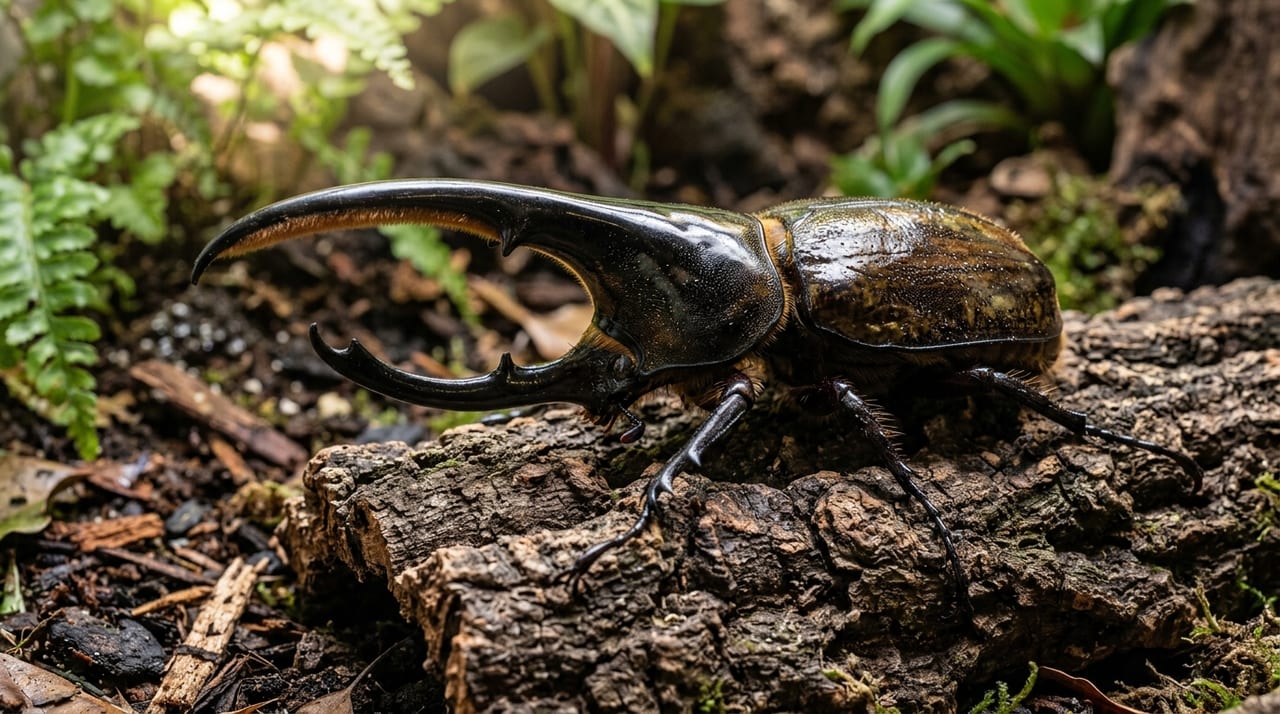
Why Rainbow Stag Beetles Are Popular and Their Breeding Characteristics
The Rainbow Stag Beetle (scientific name: Phalacrognathus muelleri) is a beautiful species native to Australia, characterized by its distinctive "iridescent" exoskeleton mixing green, red, purple, and golden hues. Due to their docile temperament and relatively straightforward breeding requirements, they have become a popular species among domestic breeders.
However, temperature control is the most critical factor for Rainbow Stag Beetle breeding success. Unlike domestic species, they originate from subtropical-to-tropical mountain regions (elevations of 600–1000m) and are sensitive to high temperatures. Deviating from appropriate temperature ranges dramatically reduces egg production and shortens lifespan. This guide explains the entire breeding process with temperature management as the central focus.
Temperature Control: The Most Critical Factor for Breeding Success
Adult Management Temperature
| Phase | Recommended Temperature | Notes |
|---|
| General Care | 20–26°C | Above 30°C is dangerous and risks mortality |
| Egg-Laying Period | 23–26°C | Optimal egg-laying temperature |
| Winter | Not required (maintain above 18°C) | Weak to cold. Death risk below 10°C |
Summer heat prevention is essential. Rearing in environments exceeding 28–30°C significantly increases mortality risk. Strongly recommended: coolers with ice packs, small air conditioners, or dedicated cooling units.
Winter also requires attention—Rainbow Stag Beetles do not undergo true dormancy. Below 15°C, activity declines, and below 10°C, death risk is high. During winter, maintain a minimum temperature of 18–20°C or higher.
Larval Management Temperature
| Larval Stage | Recommended Temperature | Effect |
|---|
| 1st–2nd instar | 22–24°C | Stable growth |
| Early 3rd instar | 22–25°C | Optimal size-up period |
| Late 3rd instar (pre-pupation) | 20–22°C | Lower temperature promotes pupation |
| Pupa and Eclosion | 22–24°C | Prevents eclosion failure |
Larval rearing above 28°C accelerates growth but increases risks of miniaturization and eclosion failure. The standard approach for developing large, vibrant individuals is "slow, temperature-controlled rearing over time."
Post-feeding Completion and Maturity Confirmation
Rainbow Stag Beetles mature earlier than other exotic stag beetles.
- Post-feeding Start: 1–2 months after eclosion (earlier if eclosed in summer)
- Maturity Completion: 3–4 months after eclosion. Pairing is safest after 2+ months from post-feeding start
Signs of maturity to confirm:
- Vigorous appetite
- Female's abdomen becomes rounded
- Male shows interest in female (chasing, attempting to mount)
Pairing and Egg-Laying Setup
Pairing Method
Rainbow Stag Beetles are relatively docile, but accidents where males pinch females can occur. Cohabitation pairing should be limited to 2–3 days in a constantly observable situation, or hand pairing is recommended.
Cohabitation Pairing Procedure:
1. Add 3–5cm of substrate and anti-escape material to a small container
2. Place male and female in the container in the evening to night
3. Separate them 1–3 days later and move the female to the egg-laying setup
How to Set Up an Egg-Laying Setup
Rainbow Stag Beetles are substrate spawners. Breeding wood is generally unnecessary.
Egg-Laying Setup:
1. Container: Medium-to-large plastic case (30cm width or larger recommended)
2. Substrate: Secondary fermentation to fully fermented substrate (additives acceptable)
3. Packing Method: Firmly pack 10–15cm from the bottom; lightly add 5cm on top
4. Humidity: Damp enough to feel moisture when squeezed, but not dripping
5. Temperature: Maintain 23–26°C
Adding a piece of breeding wood (not too hard) provides a rest spot where the female may settle and spawn more readily.
Larval Rearing: Fungal Substrate vs. Fermented Substrate
Initial Rearing
Freshly-separated eggs or larvae are first housed in small containers (300–500ml cups) filled with secondary fermented substrate. Eggs hatch in approximately 2–3 weeks. Early instars are delicate, making substrate safer than fungal media.
2nd Instar and Beyond: Choosing Your Method
Fungal Substrate Bottles (Recommended):
- Use oyster mushroom (Pleurotus spp.) or similar fungal strains (King Oyster also works)
- Standard progression from 800ml to 1400ml bottles
- Fast growth, better for developing large individuals
- Fungal deterioration accelerates at high temperatures, so maintaining 23–24°C is essential
Fermented Substrate:
- Fully-fermented or additive-supplemented substrate is effective
- Does not achieve the large sizes of fungal bottles but easier to manage and lower cost
- Suitable for first-time breeders or handling many larvae
| Method | Maximum Size | Management Difficulty | Cost |
|---|
| Fungal Substrate | Males 60–80mm+ | Medium (temperature control essential) | Medium–High |
| Fermented Substrate | Males 55–65mm approx. | Low | Low |
Pupation, Eclosion Management, and Eclosion Failure Prevention
Rainbow Stag Beetle larval duration varies significantly with temperature.
- High temperature (25–26°C): Pupation in 8–12 months
- Low temperature (20–22°C): Slow growth over 14–18 months
Preventing Eclosion Failure
Eclosion failure is the most frustrating problem in Rainbow Stag Beetle breeding. Main causes and countermeasures:
- Pupation Chamber Collapse: Stop fungal bottle changes before the pre-pupal stage (discontinue once yellowing begins). If the chamber collapses, immediately create an artificial pupation chamber (Oasis foam) as backup.
- Temperature Fluctuation: Maintain stable temperature during the pupation-to-eclosion period (2–3 months). Temperature changes during this period are fatal.
- Insufficient Humidity: Dryness increases ecdysis failure risk. Maintain adequate humidity in bottles and containers.
Even after eclosion, leave the specimen undisturbed for 2–3 weeks until the body completely hardens before removing it.
Summary
Success in Rainbow Stag Beetle breeding comes down to "proper temperature control." Maintain adults in the optimal egg-laying temperature of 23–26°C, protecting them from summer heat and winter cold. Rear larvae in fungal substrate under low temperature for slow, large-scale development. Prevent chamber collapse and eclosion failure. Master these three points, and even beginners can reliably enjoy stable Rainbow Stag Beetle breeding with beautiful results.