Montipora Care Guide | Management of Beginner-Friendly SPS Corals and Characteristics by Type
Comprehensive guide to caring for Montipora species (Montipora spp.). Covers morphology-specific characteristics such as foliose, encrusting, and branching forms, water quality management, lighting setup, and fragging techniques—a practical guide for long-term maintenance of Montipora, a popular beginner-friendly SPS coral.
Key Takeaways
Comprehensive guide to caring for Montipora species (Montipora spp.). Covers morphology-specific characteristics such as foliose, encrusting, and branching forms, water quality management, lighting setup, and fragging techniques—a practical guide for long-term maintenance of Montipora, a popular beginner-friendly SPS coral.
Related Species
What is Montipora?
Montipora (genus Montipora) is a genus of SPS (Small Polyp Stony) coral belonging to the family Acroporidae, and is a representative small-polyp stony coral alongside Acropora. Widely distributed across tropical and subtropical coral reefs worldwide, they are extremely popular as accents in aquarium layouts due to their diverse morphologies.
Since they are not as sensitive to water quality as Acropora, they are widely recommended as an "entry-level SPS coral" for hobbyists attempting SPS for the first time.
Main Morphological Types
| Morphology | Representative Species | Characteristics |
|---|---|---|
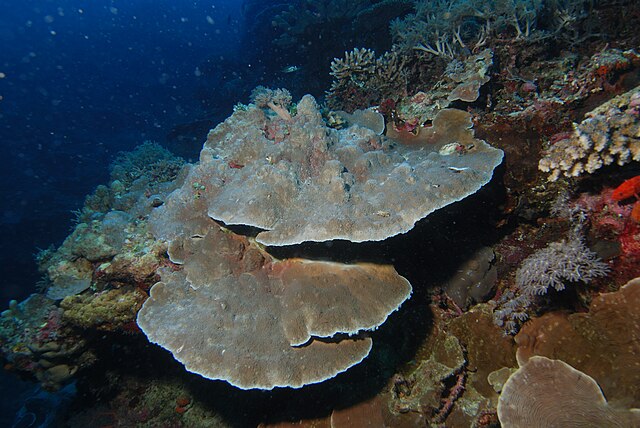
| Foliose | Montipora capricornis | Thin, plate-like; spreads in undulating, leaf-like form |
| Encrusting | Montipora uniculata | Grows encrusting over live rock and substrate surfaces |
| Branching | Montipora digitata | Finger-like branches extend radially |
| Cup-shaped | Montipora conica | Inverted cup-like morphology |
Color variations are abundant, with numerous color morphs in circulation including green, purple, orange, pink, and bicolor.
Water Quality Management Fundamentals
While Montipora has a wider tolerance range for water quality among SPS corals, maintaining a balance of trace elements necessary for skeleton formation is key to long-term husbandry success.
Recommended Water Quality Parameters
| Parameter | Target Value | Notes |
|---|---|---|
| Salinity (Specific Gravity) | 1.025–1.026 | Stability is paramount; avoid rapid changes |
| Temperature | 24–27°C | 25–26°C is the most stable range |
| pH | 8.1–8.3 | Ideally, fluctuations between day and night should be ≤0.2 |
| KH (Alkalinity) | 8–10 dKH | Foundation for skeleton formation; measure weekly |
| Calcium (Ca) | 400–450 ppm | Balance with KH is important |
| Magnesium (Mg) | 1250–1350 ppm | Supports Ca and KH metabolism |
| NO₃ (Nitrate) | 1–5 ppm | Too low causes color loss; too high inhibits growth |
| PO₄ (Phosphate) | 0.03–0.08 ppm | Too low causes chlorophyll deficiency; too high reduces zooxanthellae |
Methods for Stabilizing Parameters
- Maintain KH, Ca, and Mg through quantitative management using two-part solutions (Calcium and KH components) or the Balling Method
- Use an auto top-off (ATO) system to prevent salinity fluctuations from evaporation
- Perform 15–20% water changes 1–2 times weekly to reset NO₃, PO₄, and trace elements
Lighting Setup
Montipora requires less light than Acropora and can be maintained at moderate light levels, though optimal placement varies by species and morphology.
Recommended Lighting Conditions
| Morphology | Recommended PAR | Tank Position |
|---|---|---|
| Foliose | 100–200 µmol/m²/s | Mid-water to lower regions |
| Encrusting | 100–250 µmol/m²/s | Mid-water to near substrate |
| Branching | 150–300 µmol/m²/s | Mid-water |
Compared to Acropora, Montipora tends to color well even at lower light intensities. When introducing new specimens, light acclimation is essential: always start at low PAR and gradually move to the target position over 2–4 weeks. Rapid exposure to high light can trigger bleaching and RTN (Rapid Tissue Necrosis).
Fragging (Propagation)
Montipora is easy to frag and can be propagated with minimal impact to the parent colony with proper management.
Fragging Steps
- Cut fragments 2–3 cm or larger using bone cutters or a sharp knife
- Attach the fragment to a frag plug (ceramic or rock) with coral-safe cyanoacrylate adhesive
- Dip for 15–20 minutes in diluted Lugol's solution or commercial frag dip to eliminate pests
- Place in a frag rack (low light, moderate flow) for 1–2 weeks of recovery
- Move to desired position once stabilized
Montipora heals relatively quickly; new encrusting growth begins within 2–4 weeks. Frag sales typically operate on an "as-is, no color guarantee" basis, but frags from stable parent colonies tend to have high color fidelity.
New Specimen Acclimation Considerations
Montipora may bleach or develop RTN when newly introduced. Primary causes are water quality differences, light shock, and pests (such as red bugs).
Acclimation Checklist
- Dip in diluted Bayer Complete Insecticide or commercial coral dip to remove pests
- Verify that new tank parameters are stable before introducing the specimen
- Acclimate light gradually from lowest setting over 2–4 weeks
- Maintain moderate flow (polyps should remain extended)
- Observe daily for one week after introduction; isolate if problems arise
About Red Bugs (Tegola)
Montipora can be infested with parasitic microcrustaceans commonly known as "red bugs." Infestation impairs polyp retraction and extension, halting growth. Bayer Complete Insecticide (dip) and Panacur (Interceptor) are effective treatments, but these medications are highly toxic to shrimp and crustaceans, so treatment should be done in a dedicated coral tank or isolation tank.
Conclusion
Montipora is an approachable SPS coral that offers diverse morphologies and colors. With consistent water quality maintenance and proper light acclimation, stable long-term care is achievable. Montipora offers diverse enjoyment—whether as a stepping stone before advancing to Acropora or as a collection in its own right.