Breeding Guide for the Black Leaf Beetle | How to Raise, Feed, and Breed the World's Hardest Insect
How to raise the world's hardest insect, the Black Leaf Beetle. Detailed explanation of host plants, temperature and humidity, breeding, and larval management.
Key Takeaways
How to raise the world's hardest insect, the Black Leaf Beetle. Detailed explanation of host plants, temperature and humidity, breeding, and larval management.
The World's Hardest Insect — The Black Leaf Beetle
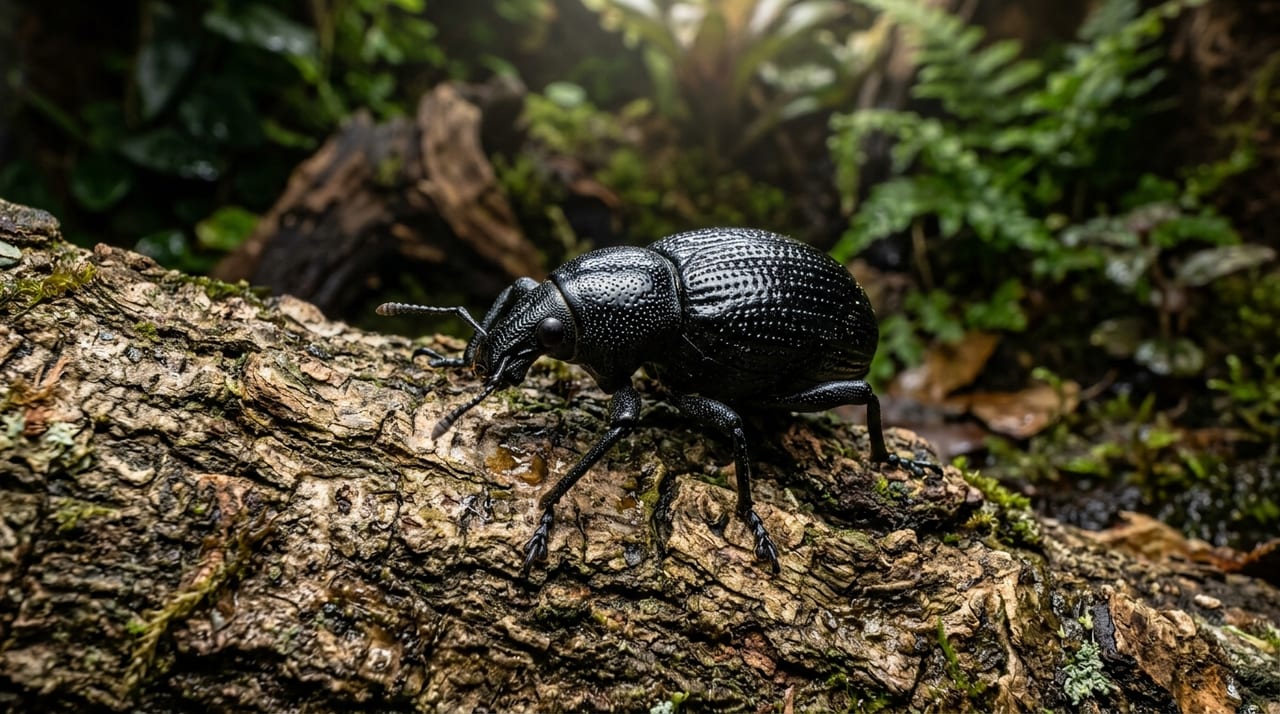
The Black Leaf Beetle (Pachyrhynchus obesus) is a beetle known for holding the record for hardness. A study published in an academic journal in 2020 demonstrated that this insect can withstand pressure 39,000 times its own body weight. Its exoskeletal structure possesses such sophisticated design that it has been referenced in aircraft parts design.
It is distributed in the tropical and subtropical forests of Okinawa and Southeast Asia, and in Japan it is particularly seen in the Ryukyu Islands. With a body length of 15–20 mm and a lustrous jet-black color, it has attracted attention from some insect enthusiasts as an ornamental species. Raising it is not particularly difficult, but securing host plants and humidity management are key points.
The secret of the exoskeleton's hardness lies in what is called an "interlock structure"—an arrangement of fine protrusions that interlock like puzzle pieces. This structure disperses impacts throughout the entire body, making it resistant to fatal damage even when the beetle is stepped on or dropped. Even while raising it simply as an ornamental, observing this structural beauty with a magnifying glass provides intellectual enjoyment.
Regarding flying ability, most species in the genus Pachyrhynchus have degenerated hind wings and cannot fly, or have significantly reduced flight ability. This is believed to be the result of evolution specializing in a hard exoskeleton as a defense against predators. Because they lack flying ability, they are easy to manage even in relatively open environments, which is an advantage in husbandry.
Obtaining Specimens and Legal Considerations
Domestically, the Black Leaf Beetle is primarily distributed through specimens from Okinawa. Collection and sale may be subject to local ordinances and rules such as collection bans within national parks, so when purchasing it is advisable to obtain specimens from trustworthy sellers.
Multiple species of Southeast Asian Pachyrhynchus are imported and readily available. Confirm that the species is not subject to regulation under the Invasive Species Act before raising it. When purchasing, verify the seller's information about the country of origin, husbandry history, and locality, and if the specimen is captive-bred (domestically bred), you can more easily avoid issues related to wild collection regulations.
On BreederDirect, specimens bred by domestic breeders are sometimes listed in the insect category. The listing page includes information about husbandry conditions and locality, so be sure to check the details before purchasing. As a marketplace among insect enthusiasts, being able to obtain rare species directly from breeders is a major advantage.
Housing and Environmental Setup
Given their medium body size, a small plastic container (approximately 15×10×10 cm) is sufficient as a rearing enclosure. Multiple individuals can be kept together, and they show virtually no aggression as long as they are not overcrowded. However, if you wish to manage mating and egg-laying, consider individual housing for easier observation.
A temperature of 22–28°C is appropriate, and during Japan's summer, room temperature management is possible. Since they are tropical and subtropical in origin, desiccation must be avoided, and humidity should be maintained at 60–80%. The substrate should be managed at 2–3 cm using leaf mold, coconut fiber soil, akadama clay, or similar materials. Since larvae develop in the soil, substrate quality and depth directly affect breeding success.
To maintain airflow while preserving humidity, either convert part of the lid to metal mesh or maintain humidity with misting 2–3 times per week. Puddles inside the container must be avoided as they pose a drowning risk. Check daily that the substrate is neither too wet nor too dry and dusty.
In winter, activity drops significantly if the temperature falls below 15°C, and the risk of death increases below 10°C. Since they are tropical, assume they cannot survive overwintering and maintain room temperature (20°C or higher). A convenient method is to use a heat panel attached to the side of the rearing container to maintain temperature.
A summary of husbandry environment guidelines follows.
| Item | Target Range |
|---|---|
| Temperature | 22–28°C |
| Humidity | 60–80% |
| Substrate Depth | 2–3 cm |
| Winter Lower Limit | Activity decreases below 15°C; risk of death increases below 10°C |
Host Plants and Practical Feeding
The Black Leaf Beetle primarily feeds on plants from the mulberry and legume families. Adults are relatively omnivorous, and keepers have reported them consuming the following foods.
- Mulberry leaves
- Apple (sliced)
- Banana (small pieces)
- Carrot
- Komatsuna (Japanese mustard greens)
- Insect jelly (high-protein type)
Mulberry leaves are considered to have the best nutritional balance, and if available should be provided preferentially. If mulberry is not available, banana or insect jelly can be used as substitutes, but be mindful of nutritional imbalance in long-term keeping. Carrot also serves a water-replenishing role, so use it actively in drying-prone environments.
In the wild, they also consume bark and plant sap, so providing cork pieces or natural materials encourages natural behavior. Remove uneaten food daily to maintain hygiene. Fruits in particular decay quickly, and in summer should ideally be replaced within half a day.
Water can be safely provided by misting the walls or placing water-saturated cotton. If using a water dish, ensure it is shallow with sufficient footing so the insects do not become submerged.
Breeding and Larval Management
Mating is relatively easy; placing mature males and females together will result in natural copulation. Egg-laying occurs as single eggs buried in the soil, with 10–30 eggs produced per season. Preparing deeper soil (4–5 cm) before egg-laying increases the egg-laying rate.
Eggs are white, spherical, and approximately 1–1.5 mm in diameter. Incubation takes 20–30 days (at 25°C). Eggs are small and easily damaged, so minimize disturbance to the container after egg-laying is confirmed.
For larval rearing, success is most often achieved using leaf mold and fermented substrate (for stag beetle larvae). Keep the substrate from drying out. Larvae grow by consuming organic matter in the soil, so substrate quality affects growth rate.
The larval period lasts approximately 3–5 months at around 25°C. After pupation, adults emerge in 2–4 weeks. It is important not to significantly disturb the substrate during larval development to avoid destroying the pupation chamber. As pupation approaches, larvae become less active and curl up in the soil. At this stage, be cautious of vibrations and keep the container in as quiet a location as possible.
Adult lifespan varies depending on husbandry conditions, but records show 1–2 years under favorable conditions. To maximize longevity, stable temperature and balanced nutrition are key. The strength of the Black Leaf Beetle is evident not only in its exoskeleton but also in the vitality of its life force.