Many breeders start by thinking, "If we keep crossing large specimens, they should get bigger and bigger," but then hit a plateau after a few generations. This is the most common dead-end in insect breeding. The cause is not usually a matter of husbandry skill, but rather lies in what comes before that—specifically, what is being recorded and on what basis the next pairing is decided.
This article addresses how to read generation notation correctly, when to use inbreeding versus outbreeding, and how to count "blood thickness" as a measurable lineage path rather than just a feeling. The content is aimed at those already actively breeding.
Why bloodline management is necessary
Both genetic and environmental factors influence the body size and shape of beetles and stag beetles.
Genetic factors
- Parental body size (body length, head width, mandible length, etc.)
- Growth rate and length of larval period
- Body color and pattern variation
Environmental factors
- Rearing temperature
- Food quality (nutritional value of substrate or fungal media)
- Space available in the rearing container
- Stress during the larval period
For example, even a larva with the genetic potential to grow large will become a small adult if reared in low-quality substrate or at too high a temperature. Conversely, no amount of perfect husbandry can overcome genetic limitations. There is always a ceiling.
In other words, to consistently produce large specimens, "good genetics × good environment" must both be present, and this is why bloodline management becomes necessary.
From this premise, one principle emerges: You cannot determine genetic superiority by comparing individuals reared under different conditions. Only by comparing siblings raised in the same temperature range, from the same substrate batch, with identical feeding schedules do you gain genetic information from the observation "this individual grew larger than the others." Comparing specimens reared under different conditions only tells you about your husbandry skill, not their genes. If you cannot control conditions, do not use that comparison for selection. This is the entry point to bloodline management.
How to read generation notation (WD, F1, F2, CB)
In insect trading and record-keeping, generation notation is used to indicate how many generations removed an individual is from the wild. However, this notation has no industry-wide standardized definition, and usage varies among sellers. First, understand what is common ground and where the divisions occur.
| Notation | General meaning | Points to verify |
|---|
| WD | The individual itself collected from the wild | Collection location and year; serves as the basis for origin information |
| WF1 | Offspring from eggs carried by a wild-caught female | Male parent cannot be identified; some sellers use this synonymously with F1 |
| F1 | A generation produced by crossing two WD individuals in captivity | Were both parents WD? If one parent is already a captive-bred generation, it cannot be called F1 |
| F2, F3… | Sequential generation numbering within the same line | How each generation was paired (siblings or separate lines) cannot be determined from the notation alone |
| CB | Broadly meaning "bred in captivity" | Does not indicate generation number; must be verified separately |
| CBF1 | First generation from crossing two different lines, resetting the generation count | Which line crossed with which must be specified; not all sellers use this notation |
WD and the F1/F2/F3 sequence are generally understood consistently. Usage diverges with WF1 and CB/CBF1. In particular, WF1 can mean either "offspring from a gravid female" or simply "wild-origin next generation," used interchangeably with F1, making it impossible to tell from the notation alone whether the male parent is known. If you don't verify this at purchase, your record-keeping starts from an ambiguous baseline.
Generation number is not the same as inbreeding degree
This is the most commonly misunderstood point. Generation notation is a label showing how many generations a line has continued, not a measurement of how concentrated the bloodline is.
Two F3s can have completely different compositions:
- F3 maintained by crossing siblings from the same WD pair in every generation
- F3 where a different line was introduced at the F1 stage, then generations accumulated from there
The first accumulates inbreeding in a straight line, but the second has an infusion partway through. Though both are labeled F3, the amount of accumulated inbreeding differs entirely.
Therefore, the judgment "it's F3 now, so it's time to introduce new blood" is weak reasoning. Generation number itself is not what causes decline; rather, how you pair each generation is what matters. What you should examine is not the notation but the record of which pairings were made in each generation.
Inbreeding versus Outbreeding | Two breeding strategies
The breeding strategies used in insect breeding fall into two broad categories: "inbreeding" and "outbreeding."
Inbreeding
Pairing individuals within the same bloodline (siblings, parent-child, etc.).
Advantages
- Desired traits (large size, thick mandibles, specific body color, etc.) are more easily fixed in offspring
- High probability that offspring resemble the parents
- Traits become more uniform, with less variation
Disadvantages
- Genetic diversity decreases; weak individuals appear more frequently (inbreeding depression)
- Reduced fertility (lower egg production, reduced hatch rates)
- Increased risk of deformities and incomplete eclosion
- Disadvantages become more pronounced with each generation
Fixation and depression are not two separate phenomena—they are two sides of the same mechanism. As homozygosity increases, desired traits become more uniform, and for the same reason, previously hidden recessive problems also surface. You cannot have one without the other.
This "surfacing" property can become a goal in itself: deliberately concentrating inbreeding to identify what is hidden in a line. However, this presupposes that some individuals will be unsuitable for breeding, and the plan must account for the final disposition of all eclosed individuals.
Outbreeding
Pairing individuals from different bloodlines or geographic origins.
Advantages
- Genetic diversity increases; vigorous individuals with good vitality are more likely to appear (hybrid vigor)
- Fertility recovers and often improves
- New trait combinations may emerge
Disadvantages
- Trait variation becomes larger; offspring are less predictable
- Previously fixed characteristics may be disrupted
A common misunderstanding: outbreeding is not a "reset." The infusion temporarily disrupts uniformity, and returning to your original goal takes several more generations. This is why deciding what to do in the generation after the infusion is equally important as deciding which individual to infuse. If you simply introduce new blood and leave it at that, your line will thin out.
Note: When crossing individuals from different origins, the origin information ends there. You cannot later market mixed individuals as being from a particular origin.
Practical breeding cycles used by experienced breeders
Many veteran breeders operate according to the following cycle:
- Obtain quality breeding pairs (select foundation stock)
- F1 generation: Rear the offspring of the breeding pair, record size and form, select superior individuals
- Advance inbreeding to fix traits: Cross siblings to standardize traits across generations. Record egg production, hatch rate, and incomplete eclosion in each generation
- Outcross: Introduce superior individuals from another line at the stage when records show signs of decline
- Return to selective breeding: Select superior individuals from the outcross offspring and begin a new cycle
The critical step is the decision to move to step 4—what data you use to make it. Not "because it's F3," but because your records show change.
Understanding inbreeding coefficient | Which overlaps matter
The tool for treating "blood thickness" as a number rather than a feeling is the inbreeding coefficient, formalized by Sewall Wright in a 1922 paper and widely used in dog and cat breeding. For insects, the same logic applies as long as records exist.
The principle of calculation
The inbreeding coefficient sums only paths of this form:
Trace from the father through a common ancestor to the mother, counting each individual only once, then sum all such paths. The formula is:
f = Σ (1/2)^(n + n' + 1) × (1 + fa)
Here, n and n' are the number of generations from father and mother respectively to the common ancestor, and fa is the inbreeding coefficient of that common ancestor itself. Applying this to typical pairings:
| Pairing | Inbreeding coefficient |
|---|
| Parent-child | 0.25 (25%) |
| Full siblings (same parents) | 0.25 (25%) |
| Half-siblings (same father only) | 0.125 (12.5%) |
| Grandparent × grandchild | 0.125 (12.5%) |
| Cousins | 0.0625 (6.25%) |
These values assume the common ancestor itself is not inbred. As the formula shows with the (1 + fa) term, if the common ancestor is already inbred, the value will be higher. Think of the table as showing minimum values.
Overlaps on one side only do not affect that offspring
This is the most overlooked point in practice. When the same individual appears twice in a pedigree, whether that overlap spans both paternal and maternal lines versus appearing only on one side makes a fundamental difference in meaning.
| Type of overlap | What it means |
|---|
| Same individual on both paternal and maternal sides | That individual is the pathway connecting the father and mother. This offspring's blood is only concentrated this way |
| Only one side appearing twice (e.g., twice on the father's side) | The individual in question is not what's concentrated; rather, that parent itself was produced from close blood. This is information about the parent's makeup, not this offspring's |
| Scattered across multiple positions | That individual is the founding point of the entire line |
The reason lies in the counting method itself. The inbreeding coefficient sums only pathways that go "from father through a common ancestor to mother," so overlaps contained on one side do not create this path and do not contribute to this offspring's coefficient.
It is incorrect to read "the same number appears twice = this individual has concentrated blood." One-sided overlap provides information for evaluating that parent, but is separate from the inbreeding degree of the individual in question. When reviewing your own pedigree, start by making this distinction.
The number changes depending on how many generations you trace back
The formula is "the sum of pathways back to common ancestors." This means if you stop tracing partway back, pathways to common ancestors beyond that point are not included in your sum.
As a result, the coefficient calculated at three generations back differs from one calculated six generations back, and values climb higher the further back you trace (pathways only accumulate; they never decrease). A practical conclusion follows:
- Inbreeding coefficients without stated generation depth cannot be compared with others' numbers
- When comparing with someone else's line, always match the number of generations you trace back
- A low number from shallow tracing is not proof that "no close blood is present"—it means you've only looked that far back
This is where insects have an advantage over dogs and cats. Most lines originate from WD stock, with the starting point in your own records. Unlike dogs, where you might need to trace back dozens of generations, it is theoretically possible to count all pathways from WD across just a few generations yourself—provided records are maintained.
There is no universal "danger threshold"
Let me be direct: There is no widely agreed-upon standard for "inbreeding coefficients above X% are dangerous" in insect breeding. Situations differ by species, and no universally validated threshold has been established. Numbers given without a source should not be taken at face value.
So what do you compare against? In the absence of an absolute standard, your comparison point becomes the generation-by-generation trend in your own line. Did the number go up or down compared to the previous generation?
And actual results are stronger information than the number itself. Inbreeding coefficient is a prediction; records of egg production and incomplete eclosion are facts.
Creating a bloodline record (breeding log)
Organized breeding requires record-keeping via a bloodline table.
Essential information to record
- Individual ID: Assign a unique number to every individual (e.g., 2026-OKW-001)
- Species and origin: Species and location (collection location if wild-caught)
- Parent IDs: Numbers for both male and female parents
- Eclosion date: The date the adult emerged
- Body measurements: Body length, head width, mandible length, etc., depending on species
- Larval weight: Maximum larval weight is an indicator of adult size
- Generation: WD, WF1, F1, F2, CBF1, etc.; also record "which line crossed with which line"
- Rearing conditions: Temperature range, substrate/fungal media used, feeding schedule. Necessary to recreate comparison conditions for selection later
- Notes: Distinctive features of form, health status, temperament (aggressive or docile), etc.
Having both parent IDs is critically important. Only with this information can you use the path-counting method from earlier. A record that only says "F2" cannot be used to determine which overlaps span both sides of the pedigree.
Recording tools
- Notebook or handwritten pedigree: The simplest method, but becomes cumbersome as specimen numbers grow
- Excel or Google Sheets: High visibility; easy sorting and searching. Recommended
- Dedicated insect management app: Some include label-printing functions and are very convenient
With spreadsheet software, structure as one row per individual, with parent numbers in separate columns so you can trace lines afterward. Splitting generations into separate sheets prevents cross-generational tracking, so avoid that approach.
Individual labeling
Label rearing containers to identify individuals. At minimum, record individual ID, species, sex, and eclosion date. Using a label maker improves readability. For larvae, masking tape written directly on the bottle is convenient.
Include parent numbers on the label too. Being able to read "whose offspring is this?" at a glance from the container determines how quickly you can select.
Selection points for aiming at large specimens
Consistent production of large individuals requires rigorous selection in every generation.
Look at form, not just size
A large individual with thin mandibles, narrow body width, or weak tarsi is unsuitable as breeding stock. Evaluate based on "size × balance" for a comprehensive assessment.
Example selection criteria for Japanese giant stag beetles
- Body length (total length): larger is better
- Head width: prioritize individuals proportionally wide relative to body length
- Large mandible thickness and curve: thick with beautiful curvature
- Prothorax width: prioritize wide individuals
- Body thickness: deep profile when viewed from above
- Tarsal condition: all segments intact
Female selection matters too
Focusing only on males when aiming for large size is a common error. For autosomal genes, male and female contributions are equal, and selecting only on the male side moves only half the needle. Female selection criteria:
- Body size: Large females tend to produce larger eggs, giving larvae an advantage in early growth
- Egg-laying ability: Offspring of prolific females often show high fertility themselves
- Size of female's brothers: If a female's brothers are large, that female likely carries large-size genes
- Body thickness and weight: Among same-sized females, prefer heavier (more robust) individuals
The third point is particularly effective. Since females have less range of expression and are difficult to judge visually, read a female's genetic information from how her brothers turned out. Selecting from a clutch where all siblings are good is more reliable than selecting one standout from an otherwise mediocre clutch.
Use larval data
Beyond just adult size, larval data aids bloodline management.
- Maximum larval weight: Large adults tend to have larger maximum larval weight
- Growth rate: Among siblings reared identically, faster-growing individuals may have higher genetic potential
- Larval period: Individuals reaching large size in a short larval period possess efficient genetic traits
All of these comparisons presuppose identical rearing conditions among siblings.
Body color variation and genetics | Fixing red-eye and white-eye
Beyond size, color variation is part of the appeal of insect breeding.
Common color variations
- Red-eye: Compound eyes turn red. Considered recessive in most species
- White-eye: Compound eyes turn white. Even rarer than red-eye
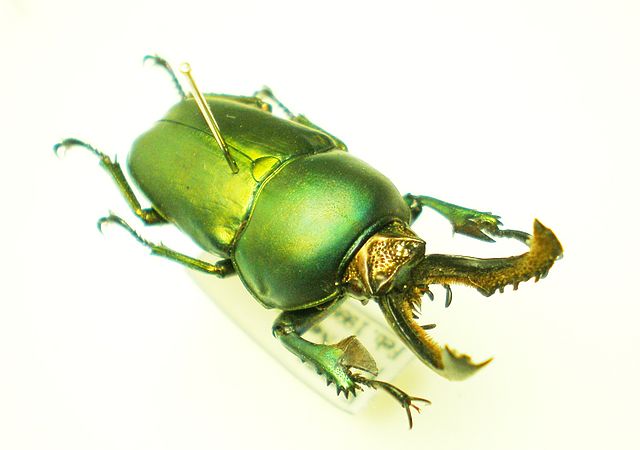
- Red body color: Normally black bodies become reddish-brown. Prominent in species like Papuan jewel beetles
- Purple and blue series: Color variation seen in rainbow stag beetles and others
Methods to fix color variation
Most color variations are recessive, so fixing requires inbreeding.
- Variation individual (homozygous) × normal individual (homozygous) → all F1 normal color (heterozygous)
- F1 × F1 → approximately 25% of F2 show color variation
- F2 color variation individuals × each other → all offspring are color variation (fixed)
This process is fundamentally inbreeding. Fixing a recessive trait means making that gene region homozygous throughout, which simultaneously tends to fix other undesired recessive problems. This side effect explains why lineages pursuing color often show incomplete eclosion and reduced egg production.
To achieve both color fixation and large size, outcrossing with color-variation individuals from a separate line is effective. If both parents are variation individuals (homozygous), the line origin does not matter—all offspring will show the color variation, allowing you to introduce new blood while preserving color consistency (the logic parallels color genetics in killifish).
Common mistakes and solutions
Deciding outcross timing based only on generation number
Numbers like "introduce new blood every 2–3 generations" or "aim for every 3 generations" are widely shared as practical rules among hobbyists. However, these are not standards validated across species and lineages, nor are they based on published sources. No consensus exists on how many generations are safe, so there is no need to treat these numbers as absolute.
Instead, look at the changes appearing in your records:
- Egg production declined compared to the previous generation
- Hatch rate dropped; increased first-instar mortality
- The proportion of incomplete eclosion rose
- Maximum larval weight plateaued or declined
- Adults are large but increasing numbers show tarsal or wing defects
These are not data "to check against a threshold"—they are measurements themselves.
Failing to keep records
Record-keeping is the foundation of bloodline management. Without records, you lose track of which parent produced which individual, making planned pairings impossible. Establish the habit from the start.
Focusing only on males
Neglecting female selection slows progress toward larger size. Evaluate males and females equally, and maintain complete records for both.
Overlooking rearing environment
No matter how good the genetics, poor husbandry prevents the genetic potential from expressing. Approach both bloodline management and husbandry skill as two wheels on the same axle.
Changing too many variables at once
If you introduce new blood, change the substrate type, and shift temperature ranges all at the same time, you cannot tell what made the difference, whether positive or negative. Unverifiable changes do not build on your system, so change only one element at a time.
Get superior bloodline specimens through BreederDirect
Successful breeding begins with quality foundation stock. Acquiring individuals with known size, bloodline information, and generation data lets you plan breeding with clear objectives from the start.
When purchasing, verify:
- What the generation notation actually means: What specific pairing does F2 or CBF1 represent?
- Size of both parents and overall clutch quality: Full clutch consistency tells you more than a single number
- Rearing conditions: Which temperature and which substrate produced that size? Without conditions, you cannot replicate results
- Origin: Collection location if wild-derived; what mixed with what if already combined
BreederDirect connects you directly with specialist breeders, so you can verify detailed bloodline information and rearing data before selecting breeding stock. Information like "how large were this individual's parents?" or "how many generations of inbreeding?" is rarely available through shops. Direct breeder-to-breeder transactions give you access to data that makes the difference—use it to pursue your ideal specimens.