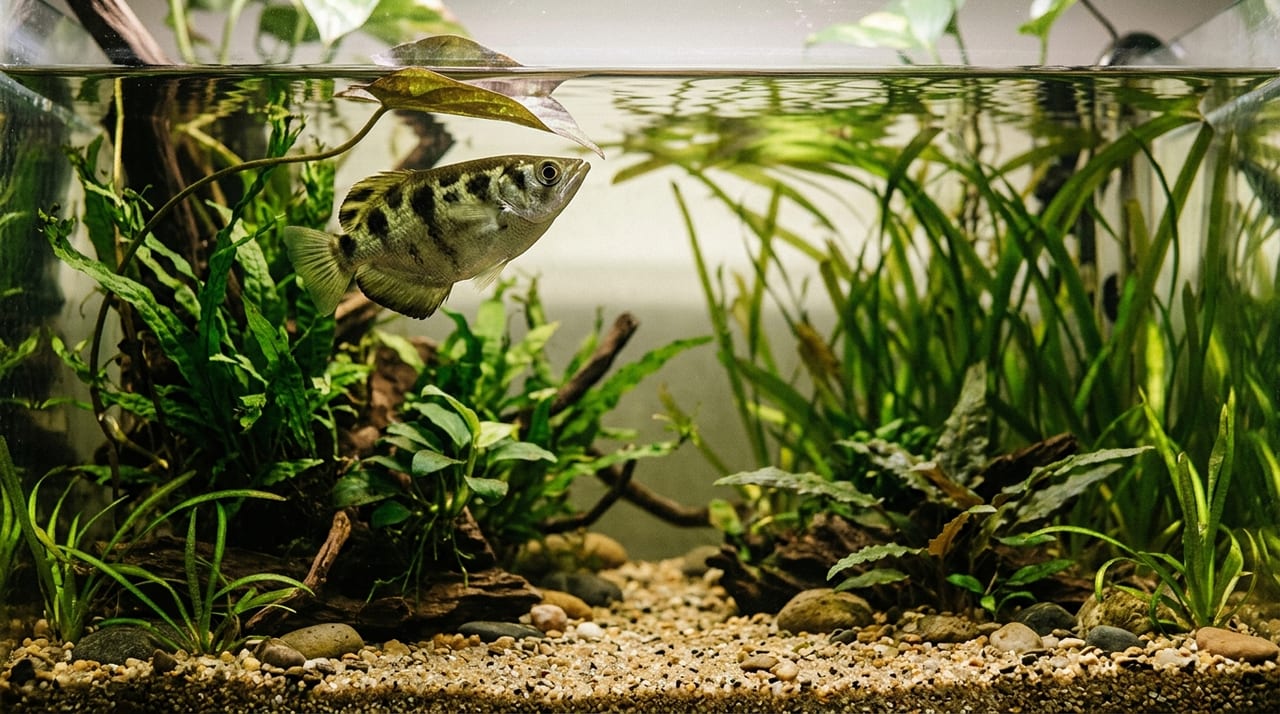
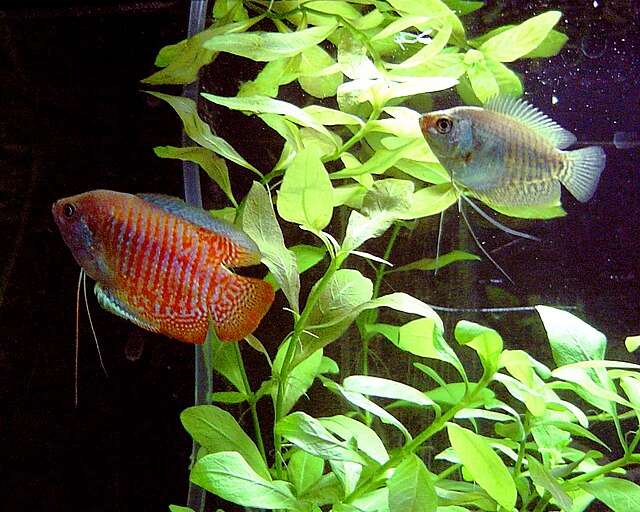
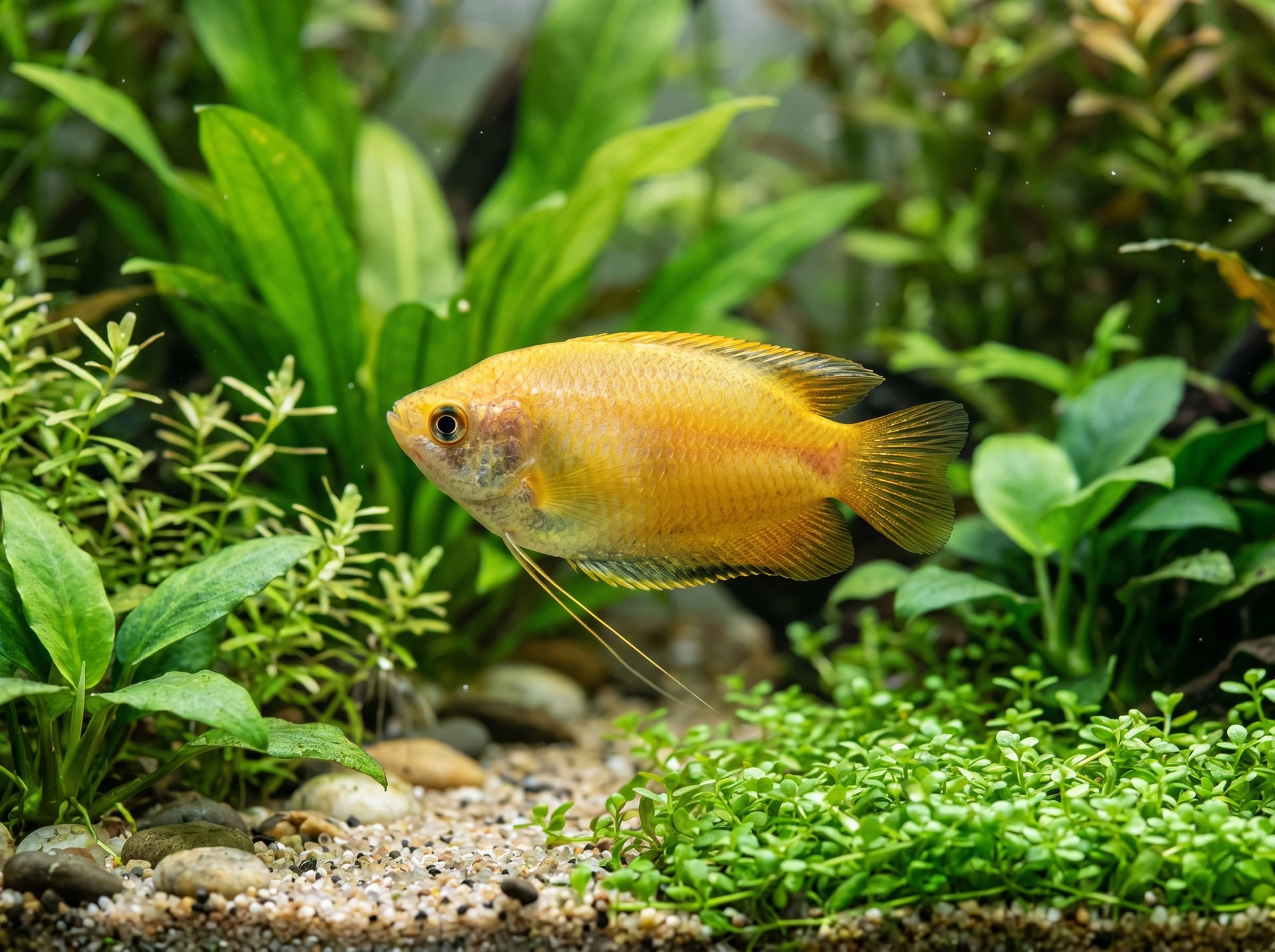
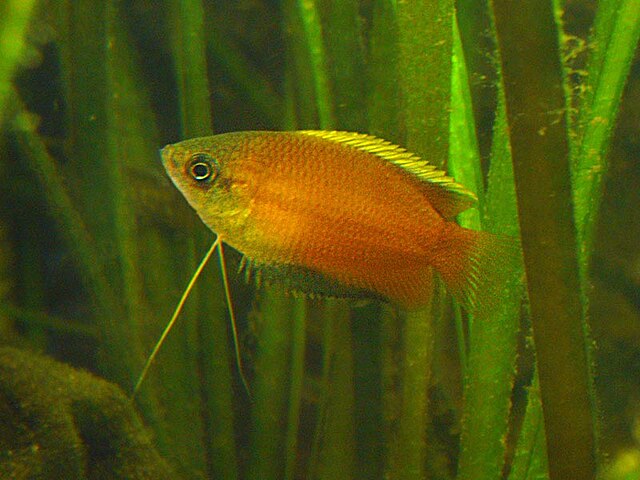
About Golden Honey Dwarf Gouramis
The Golden Honey Dwarf Gourami (scientific name: Trichogaster chuna, also known as Honey Gourami) is a small tropical fish native to India and Bangladesh. With a body length of just 4–5 cm, it is extremely compact, and males' nuptial coloration transforms into a vibrant orange to golden hue, making them beloved by aquarium enthusiasts for their stunning appearance.
Basic Information
| Item | Information |
|---|
| Scientific Name | Trichogaster chuna (formerly: Colisa chuna) |
| Alternative Names | Honey Gourami, Honey Dwarf Gourami |
| Origin | Northeast India to Bangladesh |
| Body Length | 4–5 cm |
| Lifespan | 3–5 years (in captivity) |
| Classification | Order Perciformes, Family Osphronemidae |
| Difficulty Level | Beginner to Intermediate |
Characteristics of the Labyrinth Organ
The greatest characteristic of gouramis, including Golden Honey Dwarf Gouramis, is that they possess a labyrinth organ (auxiliary respiratory organ).
The labyrinth organ is an auxiliary lung with a complex structure located in the posterior region of the head, above the gills, and can directly absorb oxygen from air at the water surface. This allows them to survive in stagnant waters with low dissolved oxygen, a trait they evolved to handle.
Care Considerations
- Ensure access to the water surface: The tank needs sufficient space (several centimeters from water surface to cover)
- Avoid exposing them to cold air: If the air above the water surface is significantly cooler than the water temperature (such as in uncovered tanks during winter), it can cause pneumonia-like symptoms
- Don't seal the cover too tightly: In an airtight environment, the air at the water surface deteriorates; keep the cover slightly open or use a breathable cover
Tank Setup
Tank Size
Because Golden Honey Dwarf Gouramis are small, they can be kept in tanks 30–60 cm in length.
| Number | Recommended Tank Size |
|---|
| 1–2 fish (solo or pair) | 30 cm (12 L or larger) |
| 3–5 fish | 45 cm (30 L or larger) |
| 6 or more fish (for breeding) | 60 cm (60 L or larger) |
Water Parameter Guidelines
| Parameter | Target Range |
|---|
| Temperature | 24–28°C (75–82°F) |
| pH | 6.0–7.5 |
| Hardness (GH) | 5–12 dGH (soft to moderately hard water) |
| Nitrite & Ammonia | Undetectable |
| Nitrate | ≤40 mg/L |
Filtration and Water Flow
Golden Honey Dwarf Gouramis prefer weak water currents.
- Sponge filter: Creates gentle flow and is most recommended
- External filter: Reduce flow rate and direct the outflow toward the tank wall to minimize current strength
Strong currents cause fatigue and stress, leading to compromised immunity.
Layout
- Floating plants: Water lettuce, frogbit, and Amazon frogbit serve as platforms for bubble nest building
- Stem plants (background and midground): Dense plants like anacharis, vallisneria, and hygrophila provide hiding spots and a sense of security
- Driftwood and rocks: Serve as territorial markers for males
Distinguishing Males from Females
When aiming to breed, accurate sex determination is crucial.
| Feature | Male | Female |
|---|
| Body Color (normal) | Yellow-orange to golden hue | Pale beige to pale yellow |
| Body Color (nuptial) | Vibrant orange to golden + throat and belly turn black | Minimal change |
| Body Shape | Slightly elongated | Rounded with swollen belly (when mature) |
| Dorsal Fin | Pointed shape | Rounded shape |
Males in nuptial coloration are exceptionally vibrant and beautiful, with striking contrast between the golden hue and black belly. This coloration is a breeding-season signal and becomes prominent when temperature, lighting, and feeding conditions are optimal.
Feeding
Golden Honey Dwarf Gouramis are omnivorous and consume a wide variety of foods from prepared diets to live food.
Recommended Foods
| Food Type | Characteristics |
|---|
| Small flakes or micro pellets | Ideal as staple food; choose sizes that aren't too large |
| Frozen brine shrimp | High palatability; regular feeding improves coloration |
| Frozen bloodworms | Effective for building strength and promoting breeding |
| Dried daphnia | Convenient protein source |
Feed twice daily in amounts that can be consumed in 3–5 minutes.
Breeding Behavior and Bubble Nest Spawning
One of the greatest attractions of Golden Honey Dwarf Gouramis is their unique breeding behavior of building bubble nests for spawning and fry care.
Breeding Preparation
- Prepare a mature pair: Individuals 6–8 months or older are ideal
- Raise water temperature slightly (26–28°C / 79–82°F)
- Add floating plants to the surface: They serve as platforms for bubble nest building (water lettuce or frogbit work best)
- Increase feeding with frozen brine shrimp or bloodworms: These trigger spawning
- Stimulate with water changes (partial 10–20% water change)
Bubble Nest Construction
When conditions are right, the male begins building a bubble nest at the water surface.
- He continuously expels mucus-coated bubbles from his mouth, building a mass of foam over several hours to days beneath floating plants or at the water surface
- The nest typically reaches 5–15 cm in diameter
- During this period, the male's territorial behavior intensifies, and he may chase away females and other fish
Spawning and Fertilization
- The male guides the female beneath the bubble nest, and together they perform embrace spawning, with his body wrapped around hers in a C-shape
- Each embrace releases 20–100 eggs; the male immediately fertilizes them with his sperm
- Eggs float to the surface, and the male retrieves those that fall, placing them back in the nest
- Spawning occurs intermittently over several hours, resulting in a total of 200–600 eggs or more
Egg to Hatch Management
After spawning, it is recommended to move the female to a separate tank, as the male becomes highly aggressive toward her once he begins his parental care.
| Timeline | Status |
|---|
| 24–36 hours after spawning | Eggs hatch; fry hang in the bubble nest while absorbing their yolk sacs |
| 36–72 hours after hatching | Fry begin free-swimming |
| Day 3–4 after hatching | Begin feeding initial foods |
Move the male to a separate tank 2–3 days after hatching, as he may consume fry once they begin free-swimming.
Rearing Fry
Initial Food (First 1–2 Weeks After Hatching)
- Infusoria (ciliate protozoa): Essential for the first two weeks, as fry mouths are extremely small and require microscopic organisms
- Commercial liquid fry food (such as First Bites): A substitute if infusoria is unavailable
Progressive Food Transition as Fry Grow
| Fry Age | Appropriate Food |
|---|
| Weeks 0–2 | Infusoria, liquid fry food |
| Weeks 2–4 | Newly hatched brine shrimp (nauplii) |
| Weeks 4–8 | Brine shrimp + fine-grade flakes |
| Week 8 onwards | Small flakes, daphnia, finely crushed pellets |
Fry Tank Management
- Minimize water current: Use only a sponge filter
- Maintain water temperature around 28°C (82°F); warmer temperatures promote growth
- Perform small daily water changes (approximately 10%) to maintain water quality
- No tank mates: Raise fry in a dedicated tank to prevent them from being consumed by adults
Common Diseases and Treatment
Ich (White Spot Disease)
- Symptoms: Small white spots (less than 1 mm) appear on the body
- Treatment: Gradually raise temperature to 28–30°C (in increments of 3°C or less) and treat with commercial ich medication at recommended dosage
Velvet Disease
- Symptoms: Body appears dusted with gold powder
- Treatment: Same as ich—raise temperature plus medication bath. Early intervention is critical
Fin Rot
- Symptoms: Fin edges become pale and fray; advanced cases show missing fin tissue
- Treatment: Treat with Green F Gold or commercial antibacterial medication. Water quality improvement is the top priority
Summary: The Appeal of Golden Honey Dwarf Gouramis
Golden Honey Dwarf Gouramis are recommended to a wide range of aquarists for the following reasons:
- Stunning nuptial coloration: Males' vibrant orange-to-golden hue ranks among the most impressive colors of small fish
- Suitable for small tanks: Can be kept in 30 cm tanks and are ideal for apartments or small living spaces
- Breeding observable in aquariums: Their unique bubble nest spawning behavior can be observed at home
- Peaceful temperament: Compatible with other gentle tropical fish
- Unique labyrinth organ biology: An opportunity to observe a remarkable evolutionary adaptation up close
The joy of successfully breeding and raising fry is incomparable. We encourage you to take on the challenge of keeping Golden Honey Dwarf Gouramis.