Guppy Genetics and Selective Breeding Basics | Understanding Color Pattern Mechanisms
Explaining the fundamentals of guppy color genetics. We introduce breeding crosses for selective breeding and tips for maintaining stable strains.
Key Takeaways
Explaining the fundamentals of guppy color genetics. We introduce breeding crosses for selective breeding and tips for maintaining stable strains.
Related Species
Among tropical fish, guppies are exceptionally easy to breed, and they offer the rare opportunity to directly observe the principles of genetics through visible changes. The pleasure of watching how color and tail fin patterns change across generations is difficult to experience when raising other animals. In this article, we explain everything from the fundamentals of guppy genetics to practical selective breeding techniques in a way that beginners can understand.
Basic Knowledge of Guppy Genetics
Sex Chromosomes and Color Inheritance
The first thing to understand about guppy genetics is how sex chromosomes work. Like mammals, male guppies have XY chromosomes while females have XX chromosomes. Importantly, many of the color genes in guppies are located on the Y chromosome.
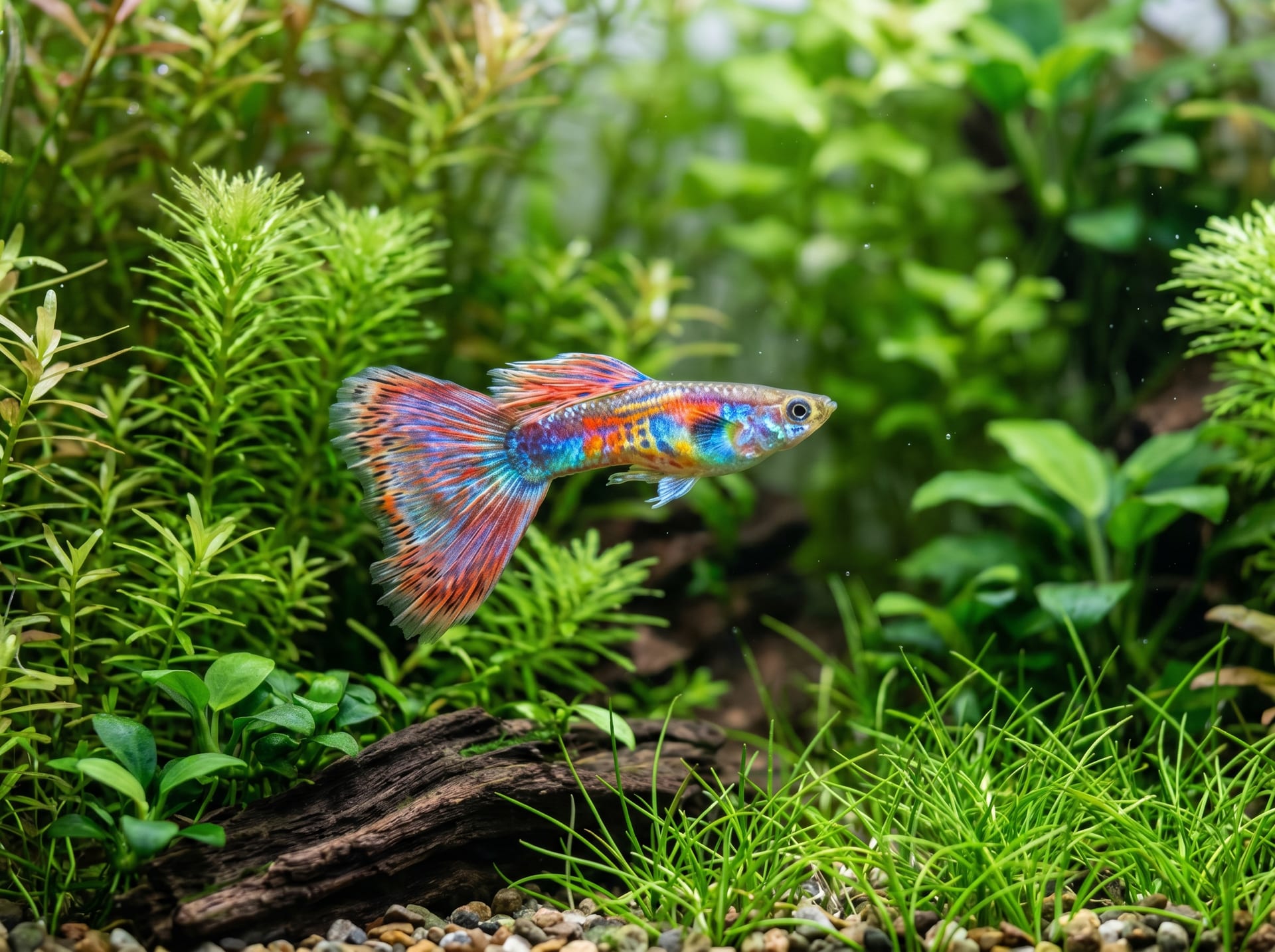
Since the Y chromosome is inherited only from father to son, a male's color pattern is easily passed directly to his sons. Females may also carry color genes on their X chromosomes, but these are rarely expressed visibly, and most females have duller coloration. This sex-linked inheritance mechanism forms the foundation of guppy color diversity.
Dominant and Recessive Inheritance
The basic principles of genetics include the concepts of "dominant" and "recessive" traits.
- Dominant genes: Traits appear when inherited from just one parent
- Recessive genes: Traits only appear when both parents pass on the same gene
Most guppy color pattern genes are located on sex chromosomes, are dominant, and are expressed only in males (sex-linked inheritance). Base color traits like albinism follow a different system on autosomes and are recessive. For example, albinism is recessive, and offspring are guaranteed to be albino only when two albinos are crossed. This is why "carriers" exist—individuals that appear normal but carry recessive genes hidden—which is part of what makes selective breeding interesting.
Major Color and Body Type Genes
Here are the genetic traits frequently dealt with in guppy selective breeding.
Basic Body Colors
| Color | Inheritance | Characteristics |
|---|---|---|
| Gray (Wild-type) | Dominant | The most basic color; forms the background for other traits |
| Golden | Recessive | Reduced melanin; appears golden-colored |
| Albino | Recessive | Complete lack of melanin; eyes appear red |
| Full Black | Multiple genes | Black pigment extends across the body; difficult to establish |
Tail Fin Patterns
Tail fin patterns are another major focus of guppy selective breeding. Representative patterns include:
- Solid: Single color. Clean and simple appearance
- Mosaic: Irregular spotted pattern. High individual variation
- Grass: Grass-like pattern with glass-like clarity
- Cobra: Net-like pattern. Wild appearance; popular
- Lace: Delicate pattern spread across the entire fin; elegant expression
These patterns result from multiple genes interacting, making each cross outcome different—and that's part of the thrill of breeding.
Basic Crossing Quick Reference
| Cross | Expected Result |
|---|---|
| Male's color × Female | Color passes to sons via Y chromosome linkage |
| Albino × Albino | All offspring are albino (fixed recessive) |
| Albino × Normal (non-carrier) | All normal appearance; offspring are carriers |
| Carrier × Carrier | ~25% albino, ~50% carrier |
| Introducing new strain (outcross) | Diversity recovered; re-establishes in 3–5 generations |
Practical Steps for Selective Breeding
Selective breeding is a cycle of "setting goals → selecting parents → crossing → selection." Success comes from being patient and keeping records.
Step 1: Set Your Goal Clearly
First, decide specifically what kind of individual you want to create. Set your goal by combining body color, pattern, and tail fin shape—for example, "albino with cobra pattern and long tail." Vague goals lead to inconsistent selection criteria and scattered lineages.
Step 2: Parent Selection and F1 Generation Crossing
Select a male and female with traits close to your goal and cross them in a separate tank. At this point, selecting parents with clear bloodline information makes selection dramatically easier in subsequent generations.
Step 3: Observing and Selecting F1 Generation
Raise the offspring (F1) to maturity and select individuals closest to your target traits. If you're targeting recessive traits, they may not appear in the F1 generation, but those individuals can be used as carriers in the next generation.
Step 4: Establishing Traits in F2 and F3 Generations
Repeat crosses between selected F1 individuals or backcrosses between F1 and parent fish. It typically takes 3–5 generations until target traits appear consistently. Keeping photo records and individual notes for each generation reveals which strains are superior.
Risks of Inbreeding and Solutions
As selective breeding continues, the proportion of inbreeding naturally increases. This carries the following risks:
- Inbreeding depression: Loss of vigor and immune function; susceptibility to disease increases
- Increased deformity rate: Congenital abnormalities like spinal curvature (spinal) become more common
- Reduced fertility: Decreased fry count or lower fertilization rates
To prevent this, outcrossing (introducing outside bloodlines) is effective. Introducing individuals from a different strain of the same variety every 3–5 generations restores genetic diversity. At this point, obtaining individuals with clear pedigrees from trusted breeders is extremely important. Introducing individuals from unknown sources can destroy traits you've worked to establish.
Get Bloodline-Managed Guppies on BreederDirect
For serious guppy selective breeding, the quality of the parent fish you start with is critical. Individuals sold at pet shops often lack clear bloodline information, and it's common not to know what genes they carry.
On BreederDirect, you can purchase guppies directly from breeders engaged in breeding every day.
- Confirm bloodline and strain information directly, making breeding plans much easier
- Ask breeders about rearing conditions and feeding methods, preventing trouble after moving to your environment
- When looking for fresh bloodlines for outcrossing, you can choose from diverse breeder offerings
- Payment terms can be arranged in advance, allowing you to pay after arrival and inspecting condition, making payment and shipping issues less likely
The first step in creating your own original strain is obtaining individuals with trusted bloodlines. Take advantage of BreederDirect and enjoy the world of guppy selective breeding.