Before Understanding Gourami Breeding—Basic Ecology of Labyrinth Fish
Gouramis belong to the "labyrinth fish" family, the same as bettas, and possess an auxiliary breathing organ called the "labyrinth organ." This organ allows them to take air directly from the water surface, enabling survival even in low-oxygen environments. This characteristic is deeply connected to their breeding behavior.
There are primarily two types of gourami spawning methods: bubble nest spawning and mouthbrooding. Depending on which type your species is, breeding equipment and management methods differ greatly, making it important to confirm the breeding method of your species in advance.
Dwarf Gourami Breeding—Representative Bubble Nest Type
Basic Information
- Scientific name: Trichogaster lalius
- Spawning type: Bubble nest (males build and guard nests)
- Egg count: 100-800 eggs
- Hatching period: 24-48 hours (based on 28°C water temperature)
Tips for Pair Formation
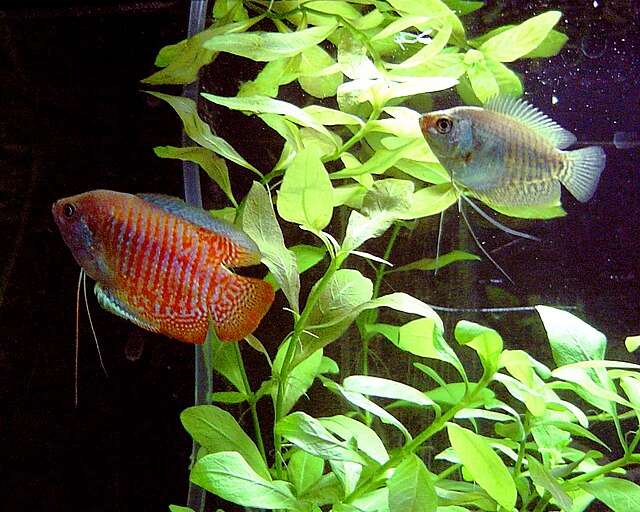
Dwarf gouramis take approximately 4-6 months to reach sexual maturity. Males display clear red and blue stripes on their body sides, while females are overall silvery-gray and drab. Obtain one male-female pair at purchase and condition them with high-protein live food (brine shrimp, bloodworms) for 2-3 weeks before spawning.
Setting Up the Spawning Tank
Prepare a dedicated spawning tank (10-20L) and lower the water level to 15-20cm. Floating plants (water sprite, Amazon frogbit, etc.) on the water surface make it easier for males to build bubble nests. Use a gentle hang-on filter or sponge filter; strong water currents are strictly prohibited as they destroy bubble nests.
From Spawning to Hatching
Males build bubble nests by stacking viscous bubbles mixed with saliva at the base of floating plants. Once the nest is complete, the male attracts the female and repeatedly performs embracing spawns below the surface, where the male wraps around the female's body to release sperm. The male carries fertilized eggs to the bubble nest in his mouth, and they hatch within 24-48 hours.
Remove the female immediately after hatching and allow the male to guard the fry alone. After 2-3 days of hatching, the fry leave the nest and begin swimming (free-swimming); at this point, remove the male as well.
Pearl Gourami Breeding—An Advanced Species with Pearlescent Brilliance
Basic Information
- Scientific name: Trichopodus leerii
- Spawning type: Bubble nest
- Egg count: 500-2,000 eggs
- Maximum size: 12cm (larger than dwarf gourami)
Pearl gouramis are a more cautious breeding species than dwarf gouramis. To induce breeding, gradually raise water temperature to 27-29°C and prepare soft water with pH 6.0-7.0. A spawning tank of 30-45L or larger is ideal; including stem plants (such as hygrophila) along with floating plants improves nest stability.
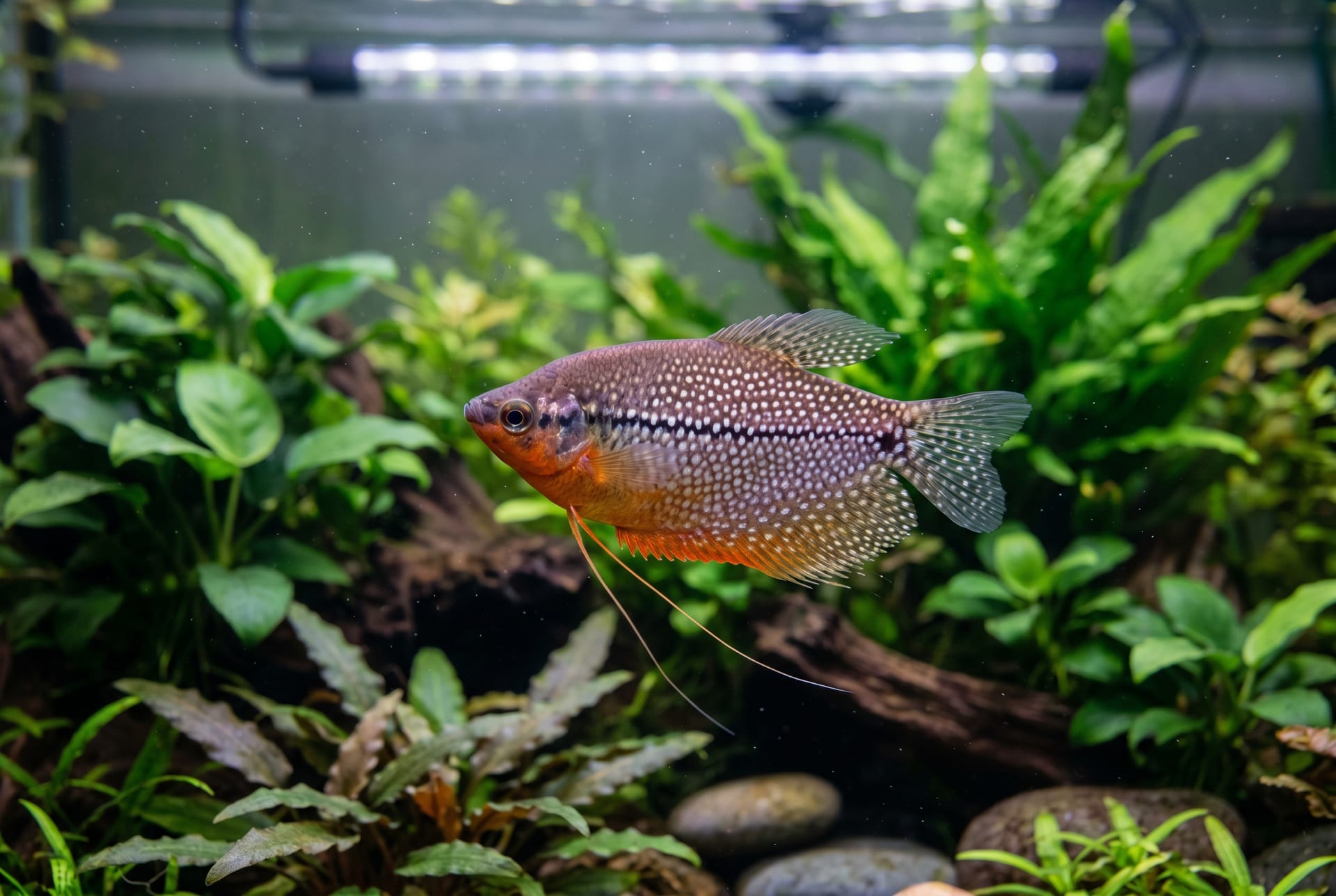
Male spawning readiness can be confirmed by darkening body color, where the abdomen turns orange to red. A round, swollen abdomen in females indicates they are gravid with eggs. Placing them together in the same tank at this point will initiate spawning within days.
Kissing Gourami Breeding—Unique Ecology of Floating Egg Type
Basic Information
- Scientific name: Helostoma temminckii
- Spawning type: Floating egg spawning (no bubble nest; eggs float on surface)
- Egg count: 1,000-several thousand eggs
- Characteristic: No parental care of eggs
The mouth-locking behavior famous in kissing gouramis is not actually courtship but rather territorial dispute and strength comparison. During breeding, males and females may come together as an extension of this behavior, but they do not form a clear pair bond like bettas.
Spawning occurs near the water surface, and fertilized eggs float at the surface enclosed in buoyant egg membranes. Parent fish do not care for the eggs and may eat them; therefore, after confirming spawning, move the parents to a separate tank. Fry hatch in 2-3 days and require infusoria as their first food.
Mouthbrooding Gourami: Chocolate Gourami Breeding
Chocolate gouramis (Sphaerichthys osphromenoides) are among the most difficult gourami species to breed but possess a unique mouthbrooding reproductive strategy.
- After the female spawns, the male broods the eggs in his mouth (approximately 2 weeks)
- Males in brooding condition fast completely
- Fry are quite well-developed when released from the male's mouth
- Weakly acidic (pH 4.5-6.0), warm (28-30°C) soft water is essential
To breed chocolate gouramis, preparation of extremely soft water (TDS 50 or below) and recreation of blackwater conditions are essential. Commercial blackwater additives or Indian almond leaves are effective.
Fry Rearing Tips—Species-Common Considerations
Initial Food
The period immediately after hatching is the most difficult stage to manage for gourami fry. Their mouths are extremely small, so commercially available fry food cannot be eaten as-is.
- Days 1-5 after hatching: Infusoria (microorganisms) or commercially available infusoria cultures
- Days 5-10: Brine shrimp nauplii
- After 2 weeks: Finely crushed flake food, microworms
Water Quality Management
Fry are extremely sensitive to water quality changes. Large water changes are prohibited; perform small 5-10% daily water changes instead. Maintain water temperature at 28-30°C, avoiding sudden temperature fluctuations of 2°C or more.
Development of the Labyrinth Organ
Gourami fry begin developing their labyrinth organ around 3-5 weeks of age. Blocking access to the water surface during this period hinders organ development; ensure the fry tank cover has gaps or adequate ventilation to prevent condensation.
Summary: Understanding Species Breeding Methods is Key to Success
Gourami breeding varies by species—bubble nest, floating egg, and mouthbrooding types—each requiring appropriate equipment and management. Dwarf gouramis are ideal for beginners to experience breeding, pearl gouramis offer a challenge for intermediates, and chocolate gourami mouthbrooding provides an advanced experience.
Three points are universally important: "pre-spawning nutritional conditioning," "proper spawning tank setup," and "infusoria feeding during early fry stages." In particular, beginning preparation of initial food (infusoria culture) one week before planned spawning greatly affects fry survival rates.