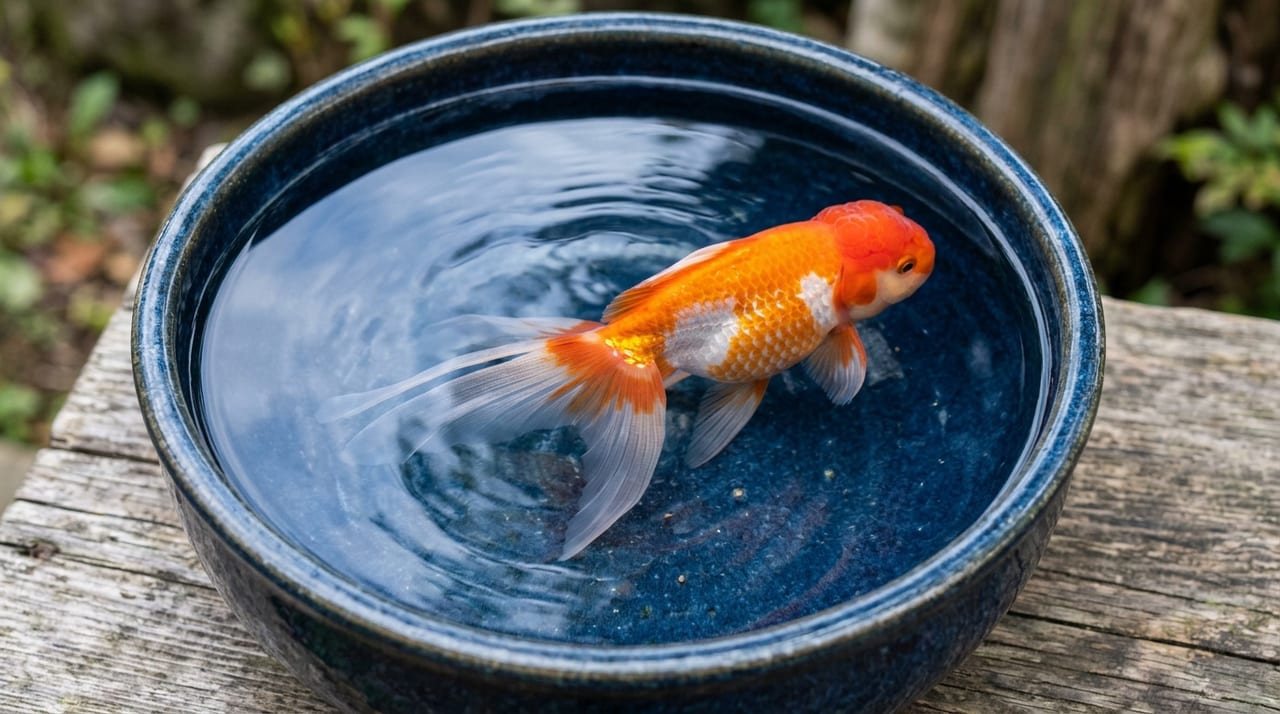
Salt Bathing for Goldfish Explained
Salt bathing (en-yoku) is one of the oldest treatment and recovery methods used in goldfish care. By adding salt to the aquarium water to adjust osmotic pressure, it reduces the osmotic stress on the goldfish's body, promoting recovery, immune enhancement, and mild pathogen suppression.
Compared to medicated baths, salt bathing is safer and less likely to cause significant damage to goldfish, making "salt bathing as a first step" a widely adopted approach. However, salt bathing has clear "effective diseases" and "ineffective diseases," and some organisms can be harmed by salt. This article explains how to practice salt bathing based on accurate knowledge.
How Salt Bathing Works and Its Effects
Since goldfish are freshwater fish, their internal salt concentration (approximately 0.9%) is higher than that of their aquarium water (typically 0.01% or less), and water constantly enters their bodies from the outside. Goldfish consume energy to maintain this osmotic pressure difference, and when in poor health, this cost becomes a burden.
By raising the salt concentration of the aquarium water to 0.3–0.5%, the osmotic pressure difference is reduced, allowing goldfish to conserve energy used for osmotic regulation. This results in:
- Recovery and maintenance of immune function
- Reduced infection risk from wounds (mild suppression of bacterial growth)
- Promoted mucosal regeneration
- Reduced strain on the swim bladder and kidney function
These mechanisms work together to aid healing.
Diseases Where Salt Bathing Is Effective and Where It Is Not
Cases Where Salt Bathing Is Effective (or Supportively Effective)
- Poor health / loss of vitality (unexplained loss of stamina)
- Stress recovery after transport or new introduction
- Mild ich disease (as support in early stages)
- Mild bacterial infection / wound disinfection support
- Early gill disease / abnormal body surface mucus
Cases Where Salt Bathing Has Limited or No Effect
- Severe ich disease (requires specialized medication)
- Fungal infections (requires antifungal drugs like Green-F)
- Advanced cases of hole-in-the-head disease and tail rot (requires antibiotics)
- Parasitic diseases (requires antiparasitic drugs like Rift Fish)
- Dropsy (often an organ problem rather than an osmotic issue)
It is accurate to think of salt bathing as a "tonic or stamina recovery aid," and in most cases it should be combined with medicated baths or used in the early stages of mild illness.
How to Choose Salt
The salts that can be used for goldfish salt bathing are as follows:
| Salt Type | Suitable | Reason |
|---|
| Refined salt (table salt) NaCl 99%+ | ✓ | Stable effect, no excess minerals |
| Natural salt (rock salt, sea salt) | △ | Inconsistent mineral content with risk of over-supplementation |
| Bittern salt | ✗ | Excessive Mg is harmful to goldfish |
| Sea salt (mineral-rich) | ✗ | Components too complex |
| Aquarium-specific salt tablets | ✓ | Easy to measure, clear composition |
Recommended choices are "refined salt" or "aquarium-specific salt tablets." Refined salt sold at supermarkets with "99%+ sodium chloride" offers the best value and safety.
How to Set the Correct Concentration
Basic Concentration Settings
| Purpose | Concentration | Salt per 10L |
|---|
| Prevention and stamina recovery | 0.2–0.3% | 20–30g |
| Support for mild illness | 0.3–0.5% | 30–50g |
| Emergency short-term bath | 1–3% | 100–300g (max 30 minutes, constant monitoring) |
The standard concentration for goldfish salt bathing is 0.3–0.5%. Beyond 0.5%, osmotic stress begins to affect the goldfish itself, so concentrations of 1% or higher should be reserved for short-term emergency measures.
How to Measure Salt
Most salt bathing failures are due to "concentration calculation errors."
Formula: Required salt amount (g) = Water volume (L) × Concentration (%) × 10
Example: To make 0.5% salt bath water with 20L → 20 × 0.5 × 10 = 100g
It is strongly recommended to measure precisely with a kitchen scale. Spoon measuring has large errors and is dangerous.
Salt Bathing Procedure
Materials You Will Need
- Isolation tank (5–20L) or clean bucket
- Refined salt (pre-measured)
- Aeration equipment
- Heater (maintain water temperature at 25–28°C)
- Thermometer and pH test strips
Step-by-Step
Step 1: Prepare the Isolation Tank
Fill the isolation tank with 50–70% of the water from the main tank, and top up with dechlorinated tap water. Do not use a filter (to avoid damaging bacteria); use only aeration.
Step 2: How to Dissolve the Salt
Completely dissolve the measured salt in a small amount of warm water (50°C or less) or aquarium water before adding it to the tank. If salt crystals directly touch the goldfish, it can cause localized osmotic shock, so always dissolve the salt first before adding it.
Step 3: Gradual Increase of Concentration
Sudden changes in salinity can stress fish in poor health. Ideally, increase the concentration gradually over 2–3 hours: 0.1% → 0.3% → 0.5%.
Step 4: Observation and Maintenance
During salt bathing, observe the goldfish every 1–2 hours. If the fish is lying on the bottom and not moving, hyperventilating, or its color is extremely faded, consider reducing the concentration or returning it to fresh water.
Step 5: Ending and Returning to the Main Tank
When finishing the salt bath, gradually reduce the salt concentration over 2–3 hours by slowly changing the water, bringing it closer to the main tank's water conditions before returning the fish. Perform this slowly, as sudden environmental changes add additional stress.
Effects on Bacteria, Aquatic Plants, and Tank Mates
This is the primary reason salt bathing should be done in an isolation tank, not the main tank.
Bacteria (filter bacteria): Nitrifying bacteria weaken at 0.3–0.5% salinity. Salt bathing in the main tank risks biological filter collapse.
Aquatic Plants: Most freshwater aquatic plants begin to die at 0.3% salinity or higher. If your main tank has plants, absolutely avoid salt bathing in the main tank.
Tank Mates: Shrimp and snails are extremely salt-sensitive, and some species weaken even at 0.1–0.2%. If they coexist with goldfish, they must always be treated separately in an isolation tank.
How to Combine with Medicated Baths
In actual treatment, "salt bathing + medicated bathing" is often done simultaneously.
- Green-F Gold granules + 0.3% salt bath: Standard treatment for tail rot and hole-in-the-head disease
- Green-F (liquid) + 0.3% salt bath: Combined treatment for ich and fungal infections
However, some medications may have their efficacy changed by interaction with salt. Check the package instructions, and if unclear, start with salt bathing alone; if there is no improvement, consider switching to medicated bathing.
Summary
Goldfish salt bathing is an extremely safe and effective recovery method when three points are observed: "correct salt selection," "proper concentration calculation," and "implementation in an isolation tank." While salt bathing is not a cure-all and serious bacterial, fungal, or parasitic diseases require specialized medication, it is an essential basic technique for stamina recovery, supporting mild illnesses, and reducing stress upon new introduction. Keep refined salt on hand and use it as an initial response when abnormalities are detected.