Giant Clam (Tridacna) Care Guide | Light Intensity, Water Flow, and Water Quality Management
A comprehensive guide to caring for Giant Clams (Tridacna) with beautiful mantles. We introduce the characteristics of representative species such as Maxima Clams and Fluted Giant Clams, necessary light intensity, water quality, attachment methods to substrate, and tips for long-term care in detail.
Key Takeaways
A comprehensive guide to caring for Giant Clams (Tridacna) with beautiful mantles. We introduce the characteristics of representative species such as Maxima Clams and Fluted Giant Clams, necessary light intensity, water quality, attachment methods to substrate, and tips for long-term care in detail.
Related Species

About Giant Clams
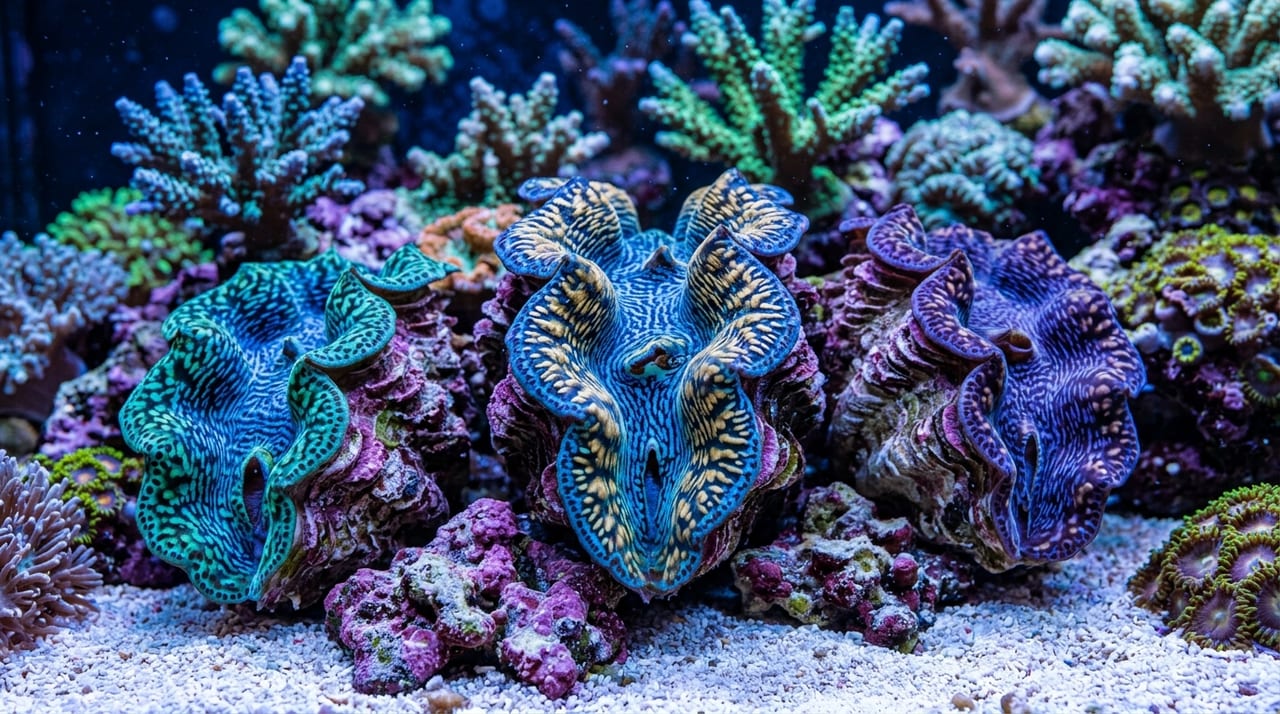
Giant Clams (Tridacna) are known as a group of the world's largest bivalves, but those kept in aquariums are mainly small to medium-sized species. They inhabit coral reefs in the tropical Indo-Pacific, housing zooxanthellae (symbiotic algae) in their mantle (outer body tissue) that perform photosynthesis, giving them a unique ecology where they can obtain nutrients from light alone.
Their colorful mantles with abundant pattern variations are the greatest attraction, and they are popular invertebrates in marine aquariums alongside corals. In Japan, they are listed in Appendix II of the Washington Convention (CITES), so it is important to purchase legally farmed and imported specimens.
Characteristics of Major Aquarium Species
Maxima Clam (Tridacna crocea)
A small species measuring 15-20 cm in body length and the most commonly available in the market. It has "boring" ability, meaning it can bore holes into live rock or substrate with its shell to establish itself. It comes in abundant color variations such as fluorescent blue, green, and gold, with relatively affordable pricing.
It requires high light levels, and keeping it under LED reef lights (PAR values of 150-250 μmol/m²/s or higher) is ideal.
Fluted Giant Clam (Tridacna squamosa)
A medium-sized species measuring 20-30 cm in body length. It is characterized by prominent, scale-like ribs on the shell. It has lower light requirements than the Maxima Clam (PAR 100-200) and is easier for beginners to keep. It can be kept directly on the substrate and has the ability to move.
Derasa Clam (Tridacna derasa)
A large species that can grow over 50 cm, and can be kept in relatively stable water conditions. Due to lower light requirements, it is better suited for intermediate to advanced aquarists with larger tanks. While it can adapt to lower light environments, high-intensity lighting is recommended for long-term care.
Setting Up the Aquarium Environment
Tank Size and Lighting
Even for small species (Maxima Clams), a minimum of 60 cm tank or larger is recommended. As Giant Clams grow, they require more space in the tank, so choose a tank with future expansion in mind.
Lighting must be a high-output LED designed for reef tanks. Use PAR (photosynthetically active radiation) values as a guide:
| Species | Recommended PAR |
|---|---|
| Maxima Clam | 150-300 |
| Fluted Giant Clam | 100-200 |
| Derasa Clam | 80-150 |
Light placement is also important; position them where the mantle is continuously exposed to light. Light intensity is stronger at higher positions (upper part of the tank), so it's best to place Maxima Clams that require high light in the upper area of the tank.
Water Quality Management
| Parameter | Target Value |
|---|---|
| Temperature | 24-26°C |
| Specific Gravity | 1.025-1.026 |
| pH | 8.1-8.3 |
| Alkalinity (KH) | 8-11 dKH |
| Calcium | 380-430 ppm |
| Magnesium | 1280-1350 ppm |
| Nitrate | 5 ppm or below |
| Phosphate | 0.05 ppm or below |
Calcium and alkalinity directly affect shell growth. Keep them stable using a calcium reactor or two-part dosing system. High nitrate and phosphate levels reduce the photosynthetic efficiency of zooxanthellae, leading to mantle discoloration and shrinkage.
Water Flow
Giant Clams prefer moderate water flow. Gentle, random flow (without disturbing the mantle) is ideal, utilizing a wavemaker pump. Avoid direct strong currents and arrange circulation to flow throughout the entire tank.
Substrate Attachment and Placement
Since Maxima Clams are burrowing clams, fix them to live rock or specialized clam holders for placement. Be careful if placing them directly on substrate, as their boring activity can cause sand to enter the sump.
Fluted Giant Clams and Derasa Clams can be placed directly on the substrate, but ensure their mantles have enough space to open fully. Since Giant Clams create powerful water currents when closing, check that nearby corals are secure and won't be blown away.
Feeding
Since zooxanthellae photosynthesis provides most nutrition, additional feeding is often unnecessary with proper lighting. However, in ultra-low nutrient systems (ULNS), growth may slow, so adding small amounts of phytoplankton once or twice weekly can promote growth.
Precautions and Common Issues
Mantle Shrinking or Closing: A sign of insufficient light, poor water quality, or stress (such as excessive water flow). Review placement and check water quality.
Mantle Discoloration (Whitening): Caused by excessive light or zooxanthellae death (thermal bleaching). Check cooling equipment to ensure temperature doesn't exceed 27°C.
Mouth Open and Won't Close: Likely deceased. Remove immediately (it can cause water quality deterioration).
Conclusion
Giant Clams are fascinating invertebrates that add living jewels to coral reef aquariums. They require high light and stable water quality, but with proper conditions, long-term care of several years or more is entirely possible. When purchasing, confirm they are legally farmed specimens and practice responsible care.