Dragonfly & Naiad Collection and Rearing Observation Guide | Enjoying Aquatic Insects from Larva to Adult Emergence
A beginner's guide to rearing dragonfly naiads in aquariums and observing the moment of emergence. Explains collection locations, tank setup, feeding methods, and emergence support.
Key Takeaways
A beginner's guide to rearing dragonfly naiads in aquariums and observing the moment of emergence. Explains collection locations, tank setup, feeding methods, and emergence support.
Dragonflies are one of the insects that epitomize a Japanese summer. Have you ever seen them skimming across ponds and rivers and thought, "I'd like to keep one"? In fact, it is relatively easy to raise dragonfly naiads in an aquarium and observe the moment of emergence in your own home. This article explains in detail how to enjoy dragonflies, from collecting naiads to observing adults.
Dragonfly Ecology and Species
Dragonflies belong to the order Odonata, and approximately 200 species inhabit Japan. Broadly, they are classified into two groups: those that rest with wings open, called "Anisoptera," and those that rest with wings closed, called "Zygoptera."
Typical species suitable for home rearing observation:
- Common Darter: Widely distributed throughout Japan. Naiads are the easiest to collect and recommended for beginners.
- Golden Ringed Dragonfly: A large species. A beautiful dragonfly that flies in a swimming-like manner.
- Ogre Darner: Japan's largest dragonfly. Naiads inhabit flowing water.
- Elegant Damselfly: A slender and graceful damselfly. Can be reared even in small tanks.
- Asian Damselfly: A versatile species found even in urban ponds and water channels.
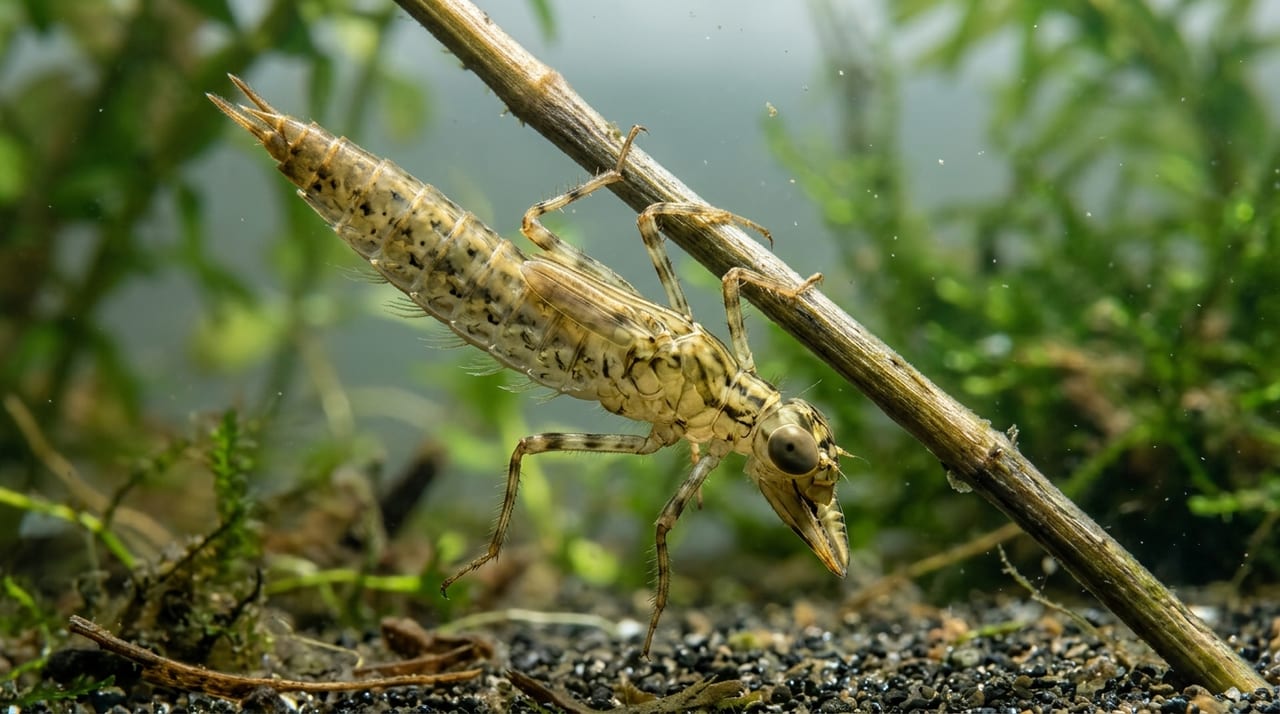
Dragonflies are insects that undergo "incomplete metamorphosis," progressing from egg to naiad to adult without a pupal stage. Naiads breathe underwater using gills located in the abdomen. Species such as the Ogre Darner and Golden Ringed Dragonfly use internal gills, while damselflies use gills located at the tips of their tails to absorb oxygen. As they grow, they repeatedly molt, gradually increasing in size, and when they reach their final instar, they prepare for emergence.
Methods for Collecting Naiads
Naiads are carnivorous aquatic larvae. They can be collected from ponds, rivers, rice paddies, irrigation canals, and similar locations during spring and summer.
Tools needed for collection
- A dip net (with fine mesh)
- A bucket (for holding collected naiads)
- A dropper (for fine-work tasks)
- Waders or chest waders
Tips for collection Quickly sweep a dip net along the bottom of water where aquatic plants and fallen leaves have accumulated. Since naiads move quickly, transfer them to the bucket immediately after capturing them. The edges of ponds and the areas around reed roots are good collection spots. Because naiads often remain hidden in dark places, you'll have better luck searching around the roots of aquatic plants and in the crevices of rocks. When bringing them home, separate them by species and size to make feeding management and observation easier later.
Precautions when collecting
- Before collecting, check whether collection is prohibited under the "Natural Parks Law" or local ordinances
- Taking non-native species is prohibited (Invasive Alien Species Act)
- Collecting insects within national parks may be prohibited
Setting Up the Rearing Environment
An aquarium is necessary for rearing naiads. While water conditions vary depending on species, the basic setup is the same.
Tools needed
- An aquarium (approximately 30 cm) or insect cage (deep type)
- An air pump and undergravel or sponge filter
- Substrate (fine gravel or clay pellets)
- Aquatic plants (Hornwort, Cabomba, etc.)
- A lid (essential for preventing escape and to provide emergence space)
Water quality and temperature The ideal water temperature is 15-25°C. During summer when room temperature exceeds 30°C, cooling may be necessary. Dechlorinate tap water before use. Perform water changes once or twice weekly, changing 1/3 to half of the water.
Density and cannibalism prevention Naiads are carnivorous and will cannibalize each other. Ideally, one naiad per container is best, but multiple naiads can be kept in a larger tank if you provide plenty of aquatic plants to create hiding spaces for the naiads.
Tank placement considerations Choose a location for the tank that avoids prolonged direct sunlight from a window and instead receives indirect light in a bright room—this helps keep water temperature and quality stable. If raising naiads outdoors, choose a location where rainwater won't flow directly in and where the tank won't be exposed to intense sunlight.
Feeding Methods
Naiads possess a special predatory organ called the "lower jaw (mask)" with which they instantly snatch and consume their prey.
Appropriate foods
- Bloodworms (Chironomid larvae): The easiest to obtain and easy to portion for naiads of different sizes. Frozen bloodworms are also acceptable.
- Tubifex worms: High in nutrition and ideal for small naiads.
- Medaka fry or brine shrimp: Larger naiads can also be fed small fish.
- Crickets (small): Naiads in their final instar can also eat terrestrial insects.
Feeding frequency The basic rule is once every 2-3 days. Promptly remove uneaten food to prevent water quality deterioration. Because naiads have a predatory instinct to snatch moving prey, they may respond sluggishly if food remains still. If you notice a decrease in appetite or movement, also check whether there have been any changes in water temperature or quality.
Supporting Emergence and Observation Points
As naiads approach their final instar, their frequency of surfacing increases. This is a sign that emergence is imminent.
Preparing for emergence
- Replace the tank lid with a mesh lid with holes cut in it, or remove the lid entirely to create space for emergence
- Lean a stick or wooden branch vertically against the tank wall where it can serve as an emergence platform
- Since a dry emergence platform is necessary, adjust the setup so that part of it is exposed above the water surface
Observing emergence Emergence typically occurs at night or in the early morning. The naiad climbs onto the emergence platform, its back splits open, and the adult emerges. It takes 2-4 hours for the wings to dry completely. During emergence, it is important to observe only and not touch. If the emergence platform is unstable or lacks adequate footing, the wings may not fully extend and may harden in a contracted state. To be safe, prepare multiple sturdy, securely fixed sticks or branches. When observing, be careful not to use flash photography or create vibrations.
Releasing the adult Once the wings are fully expanded, release the dragonfly into a natural environment close to where it was collected. Indoor rearing of adult dragonflies is difficult because it requires a continuous supply of live insects, so release is recommended.
Recording Your Observations
When recording naiad growth for science projects or similar purposes, it helps to keep notes of the collection date, changes in body size, molting progress, and behavior while eating. Adding photos or sketches makes the record of changes even clearer. Developing the habit of observing at roughly the same time each day makes it easier to notice differences in behavior.
Frequently Asked Questions
How many days does it take for a naiad to emerge? The timeline varies depending on the growth stage and species at the time of collection, so there is no single answer. When you notice naiads surfacing more frequently, intensify your observations as a sign that emergence is near.
Is it okay to keep multiple naiads together? Because of the risk of cannibalism, it is necessary to take measures such as providing plenty of aquatic plants as hiding places. If you are concerned, it is safer to rear each naiad in a separate container.
Can I keep adult dragonflies in my home after emergence? Caring for adult dragonflies is difficult because it requires a continuous supply of live insects. Releasing them near the collection site is the common practice.
Summary
The emergence of dragonflies from naiads offers a rare opportunity to witness the mystery of insect metamorphosis up close. Collect naiads while being mindful of the natural environment, and release them in an appropriate location after rearing. This rearing experience is ideal as a subject for children's science projects and nature observation, allowing for a deeper understanding of dragonfly ecology.