Coral Tank PAR·PPFD Measurement and Light Spectrum Optimization Guide | Species-Specific LED Adjustment and Breeding Promotion
Practical protocol for PAR·PPFD measurement using quantum sensors, spectrum optimization for SPS·LPS·NPS categories, LED multi-channel adjustment procedures, photoperiod scheduling for breeding induction, and detailed explanation of continuous measurement data monitoring methods.
Key Takeaways
Practical protocol for PAR·PPFD measurement using quantum sensors, spectrum optimization for SPS·LPS·NPS categories, LED multi-channel adjustment procedures, photoperiod scheduling for breeding induction, and detailed explanation of continuous measurement data monitoring methods.
Related Species
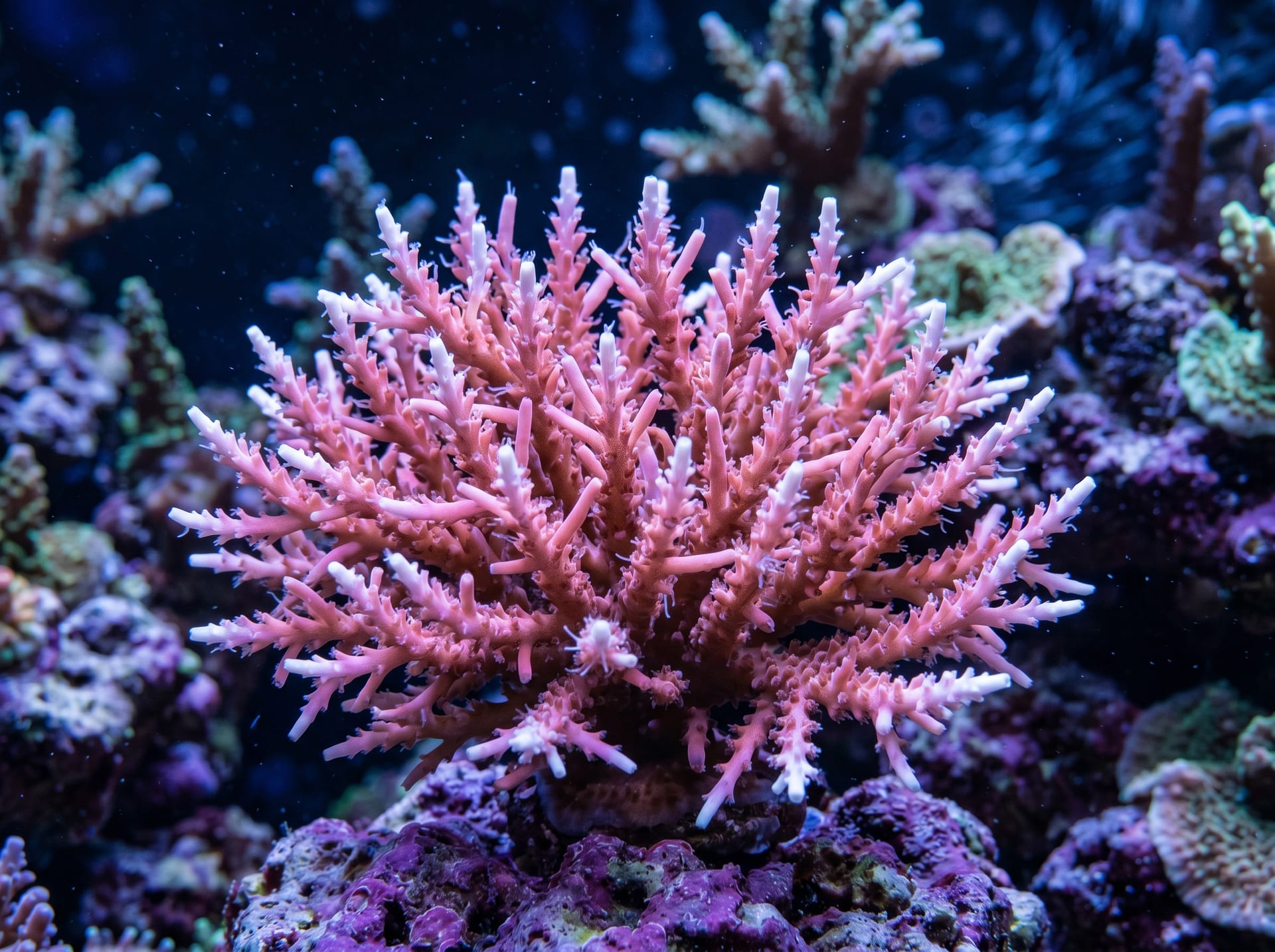
The era when "brighter is better" in coral keeping is over. Modern reef keepers, equipped with quantum sensors, quantify the light environment within their tanks and precisely adjust it to species-specific requirements. This article systematically covers practical PAR·PPFD measurement, spectrum optimization by SPS·LPS·NPS category, and photoperiod programs that induce breeding.
Fundamentals of PAR·PPFD Measurement and Practical Protocol
PAR (Photosynthetically Active Radiation) refers to photosynthetically active radiation in the 400–700 nm range, while PPFD is expressed as photon flux density per unit area per unit time (μmol/m²/s). The "PAR value" used in coral keeping is strictly a PPFD value; avoiding confusion between the two is essential for measurement accuracy.
Always use a waterproof quantum sensor for measurement. Apogee MQ-510 and Li-COR LI-192 are industry standards, though Seneye Reef is also an option from a cost perspective. However, since Seneye has accuracy limitations underwater, comparison verification with calibrated equipment is recommended.
Follow these steps for practical measurement. First, measure with water circulating and pumps running in the tank. Keep the sensor horizontal and measure at minimum three points: the substrate surface, midwater, and just below the water surface. For a standard 60 cm tank, a 9-point grid (3×3) is ideal; for 90 cm or larger, 16 points (4×4) or more is recommended. Record measurements in a spreadsheet and visualize hot spots and shadow zones to identify lighting placement bias.
General reference values are as follows: SPS (Acropora spp.) upper zones: 200–400 PPFD; LPS (corals such as Euphyllia and Catalaphyllia): 50–150 PPFD; NPS (non-photosynthetic corals, including Sarcophyton spp.): 10–50 PPFD. These are merely starting points; adjust gradually while observing individual polyp coloration, tissue necrosis, and polyp extension.
Spectrum Optimization by SPS·LPS·NPS Category
Spectrum selection is independent of brightness. The ratio of each channel directly affects the photochemical system of the coral's symbiotic zooxanthellae.
SPS corals (Acropora, Montipora, Acanthastrea) respond strongly to blue wavelengths (420–460 nm), while UV bands (380–420 nm) promote polyp extension and pigment production. The basic approach is to set the combined output of royal blue (450 nm) and violet (420 nm) at 1.5–2× that of white channels. Red wavelengths (620–700 nm) enhance zooxanthellae photosynthetic efficiency but cause browning if excessive; keep them to 5–10% of total output.
LPS corals (Euphyllia, Catalaphyllia, Tubastraea) tend to prefer broad-spectrum light at moderate PPFD levels. In many cases, polyp extension improves when white and cyan (490–510 nm) wavelengths are increased over blue-dominant spectra. Deep-water LPS are UV-sensitive, so keep 380–400 nm output modest.
NPS corals (Plesiastrea, Paragorgia, Ellisella) have low photosynthetic dependence but should never be kept in complete darkness. Weak blue-to-cyan illumination (20–50 PPFD) is effective for pigment maintenance; avoid near-infrared wavelengths. In tanks containing NPS, feeding volume and water flow design take priority over lighting.
Practical LED Multi-Channel Adjustment Procedure
Modern reef-grade LEDs (Orphek Atlantik, AI Hydra, Ecotech Radion, etc.) support independent control of 6–16 channels. Here is the basic approach for per-channel adjustment.
Start with the manufacturer's SPS preset at 70% output and observe over two weeks. If bleaching (whitening) appears, reduce PPFD by 10% increments; if browning progresses, increase blue-channel output. Color changes appear on 2–4 week timescales, so weekly photo documentation is essential for comparison.
Increasing UV and violet (380–420 nm) triggers coral fluorescence but may cause excess mucus production or tissue irritation. Keep these wavelengths below 20% immediately after introducing new specimens, then increase gradually as they acclimate.
Photoperiod Scheduling for Breeding Induction
In nature, corals spawn in response to lunar cycles and seasonal changes. Planned photoperiod manipulation in aquariums can induce spawning as well.
Establish a natural-like 12-hour photoperiod (simulating sunrise to sunset). Set 30–60 minute ramp-up and ramp-down periods around dawn and dusk to avoid abrupt light changes. Most controllers can auto-generate these curves.
Controllers with lunar cycle simulation (Apex, IKS, etc.) can turn off or greatly dim nighttime lighting during the new moon phase, then recreate low nighttime levels (equivalent to 1–5 PPFD) around the full moon. Acropora spawning often concentrates within days after the full moon; combined water temperature and photoperiod manipulation improves induction precision.
To simulate seasonal change, gradually shift from summer (14-hour photoperiod, full output) to winter (10-hour photoperiod, 80% output) over three months. This gradual transition synchronizes coral metabolic rhythms with the spawning cycle.
Measurement Data Analysis and Continuous Monitoring
Don't treat PAR measurement as a one-time task; perform it every six months to track lighting degradation over time. LEDs often see 10–20% PPFD loss after one year of use; actual output declines even if the output percentage hasn't changed. Comparing records reveals when compensation is needed.
Abnormal algae growth, coral color changes, and poor polyp extension are early signals of lighting environment shifts. Measuring when these appear helps separate the root cause among lighting, water quality, and flow. Data-driven management improves coral husbandry reproducibility and breeding success rates.