Lighting, Water Quality, and Feeding Techniques to Maximize Coral Coloration
Explains practical techniques for lighting spectrum, water quality parameters (NO3/PO4), and targeted feeding to bring out vibrant coral colors.
Key Takeaways
Explains practical techniques for lighting spectrum, water quality parameters (NO3/PO4), and targeted feeding to bring out vibrant coral colors.
Why Do Coral Colors Change?
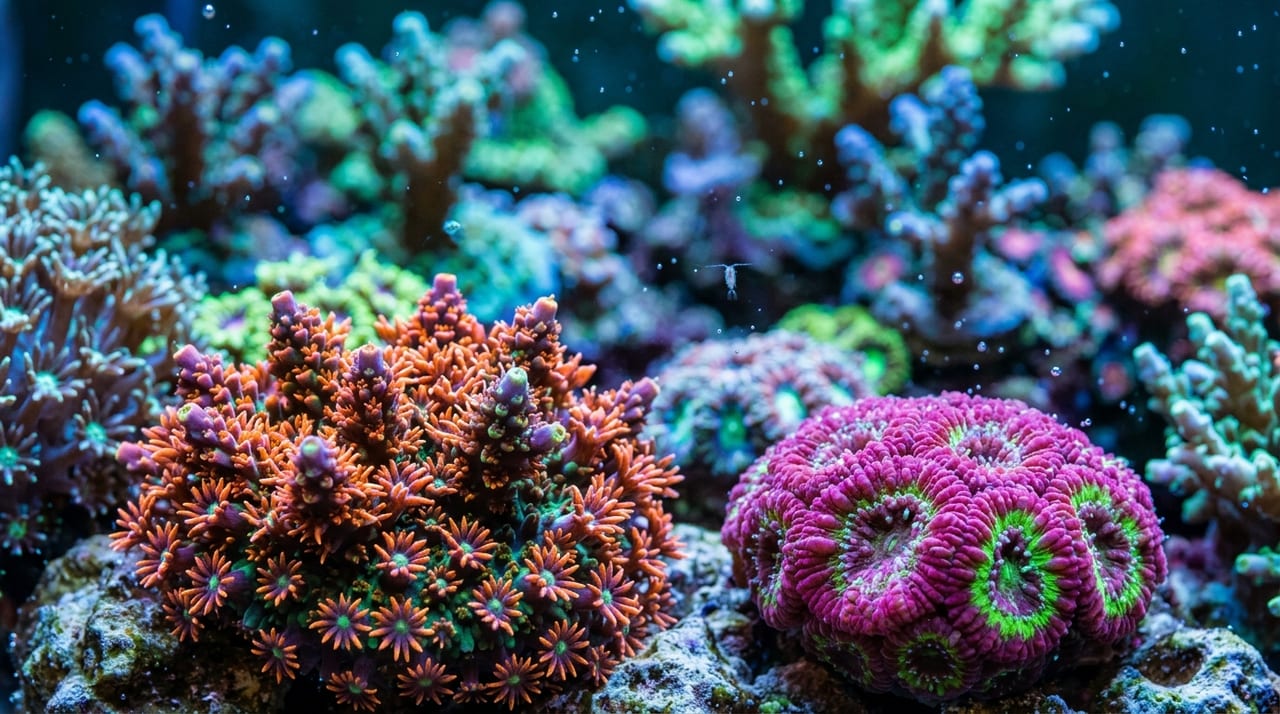
Coral's vibrant colors are determined primarily by the amount of "fluorescent proteins (FP)" and "zooxanthellae" present. Fluorescent proteins are produced by the coral itself and absorb ultraviolet and blue light to fluoresce in shades of green, red, orange, and more. Zooxanthellae carry brown to brownish pigments and supply energy to the coral through photosynthesis; however, when they proliferate excessively, they can obscure the coral's natural colors.
✍️
BreederDirect Editorial
The BreederDirect editorial team specializes in care information for animals, covering veterinary care and breeding to deliver beginner-friendly guides.
Find Coral on BreederDirect
Buy directly from verified breeders
Browse Related Listings
Find Coral listings related to this article on BreederDirect. Buy directly from verified breeders.
In other words, poor coloration means either "there are too many zooxanthellae" or "fluorescent protein expression is low," and the essence of color management is to intentionally control the balance between these two factors. Coral color is not fixed—it constantly fluctuates depending on the rearing environment. With the same individual specimen, it is possible to achieve far more vibrant results than at the time of acquisition by optimizing three elements: lighting, water quality, and feeding.
Optimizing Lighting Spectrum
Lighting spectrum has the most direct impact on coral coloration. While PAR values (photosynthetically active radiation) are often the focus, in reality "which wavelengths are present and in what quantities" is often what determines coloration.
Blue (420–470 nm): The wavelength that most effectively excites fluorescent proteins and is essential for the coloration of most corals. SPS corals such as Acropora and Montipora show particularly strong responses to blue-spectrum light.
Ultraviolet and Violet (380–420 nm): Promotes the expression of green and red fluorescent pigments. Increasing the UV ratio often results in "popping colors," and this spectral range is now standard in modern reef-tank LEDs.
White Light (5000–7000 K): Recreates a natural light environment and corrects the monotone appearance that blue light alone can create. It is best combined during peak daytime hours.
Sample practical lighting schedule:
Morning (2 hours): Ramp up gradually at 20% blue and 10% ultraviolet
Evening (2 hours): Gradually transition to blue only
Lights off: Ramp down slowly to 0% over 30 minutes or more (sudden shut-off is a stressor)
LED output declines over 2–3 years, so it is recommended to measure PAR annually and review settings accordingly.
Water Quality Parameters and Coloration
Controlling Nutrients (NO3 and PO4)
In ultra-low nutrient environments (NO3: 0–1 ppm, PO4: below 0.01 ppm), zooxanthellae density decreases and fluorescent colors tend to stand out more prominently. However, this extreme low-nutrient state increases the risk of RTN (rapid tissue necrosis) and STN, and growth rates drop significantly. Realistic target values that balance coloration with health are as follows:
SPS corals: NO3 1–5 ppm, PO4 0.02–0.05 ppm
LPS corals: NO3 5–10 ppm, PO4 0.05–0.1 ppm (many species can maintain coloration even at slightly higher levels)
When using low-nutrient maintenance systems such as zeolite or balling methods, it is important to transition gradually over several weeks without dropping levels too rapidly during initial implementation.
Stable Maintenance of Calcium and Alkalinity (KH)
When Ca (400–450 ppm), KH (8–10 dKH), and Mg (1250–1350 ppm)—needed for skeletal formation—are insufficient, metabolism becomes disrupted and fluorescent protein production declines. Rapid KH fluctuations (more than 1 dKH per day) are particularly stressful for corals and can directly cause poor coloration. Even if not done daily, measuring parameters about three times per week enables early detection of problems.
Impact of Water Flow Design on Coloration
Often overlooked, water flow also affects coral coloration. Proper water flow promotes polyp extension and enhances the efficiency of light and food absorption. Conversely, weak water flow causes metabolism to stagnate and zooxanthellae to proliferate more readily.
Recommended water flow settings:
Random Pulsed Flow: Irregular flow mimicking natural waves is effective for both SPS and LPS
Flow Rate Guide: Aim for 20–40× the tank volume per hour from multiple directions
Eliminate Dead Spots: Stagnant areas at the base and in rock crevices accumulate harmful substances, so address these with supplementary pumps
Branching SPS such as Acropora are ideally in a state where polyps are constantly moving. If polyps remain retracted, prioritize reviewing water flow direction and intensity.
Color Enhancement Through Targeted Feeding
Feeding directly impacts coloration as well as growth rate. Feeds rich in amino acids and proteins are known to promote fluorescent protein synthesis, and in SPS corals particularly, clear differences in coloration may be seen depending on whether feeding occurs.
Effective feeding items:
Frozen Copepods and Rotifers: Ideal for Acropora and other corals with small polyps. Feed 3–5 times per week
Amino Acid-Based Liquid Feeds (Acropower, Reef Roids, etc.): Well-regarded for enhancing SPS coloration. Start with half the recommended dose to avoid water quality degradation from overfeeding
Mysis Shrimp and Brine Shrimp: For LPS. Feed 2–3 times per week; targeted feeding applied directly at the polyp mouth is most effective
Phytoplankton: Effective for boosting soft corals and the natural system as a whole
After feeding, it is standard practice to turn off the protein skimmer for 1–2 hours to allow absorption, then restart it. However, attention must be paid to oxygen depletion during high-temperature summer months.
Importance of Color Monitoring and Record-Keeping
By photographing your tank once a month from the same angle under the same lighting settings and comparing images, you can objectively track color changes. Vague impressions like "the colors seem to have gotten worse somehow" are difficult to judge, but with records you can cross-reference the timing of changes to identify causes more easily.
Checklist if coloration declines:
LED degradation (measure with a PAR meter even with LEDs, as output declines over 2–3 years)
KH drift (sudden changes from missed measurements)
Post-introduction stress (repositioning, chemical warfare from neighboring corals)
Water flow stagnation (clogged filters or pumps)
By carefully managing four elements—lighting, water quality, feeding, and water flow—you can draw out your corals' full potential. Vibrantly colored corals elevate the entire tank to a different dimension of beauty and bring a sense of accomplishment from years of husbandry.