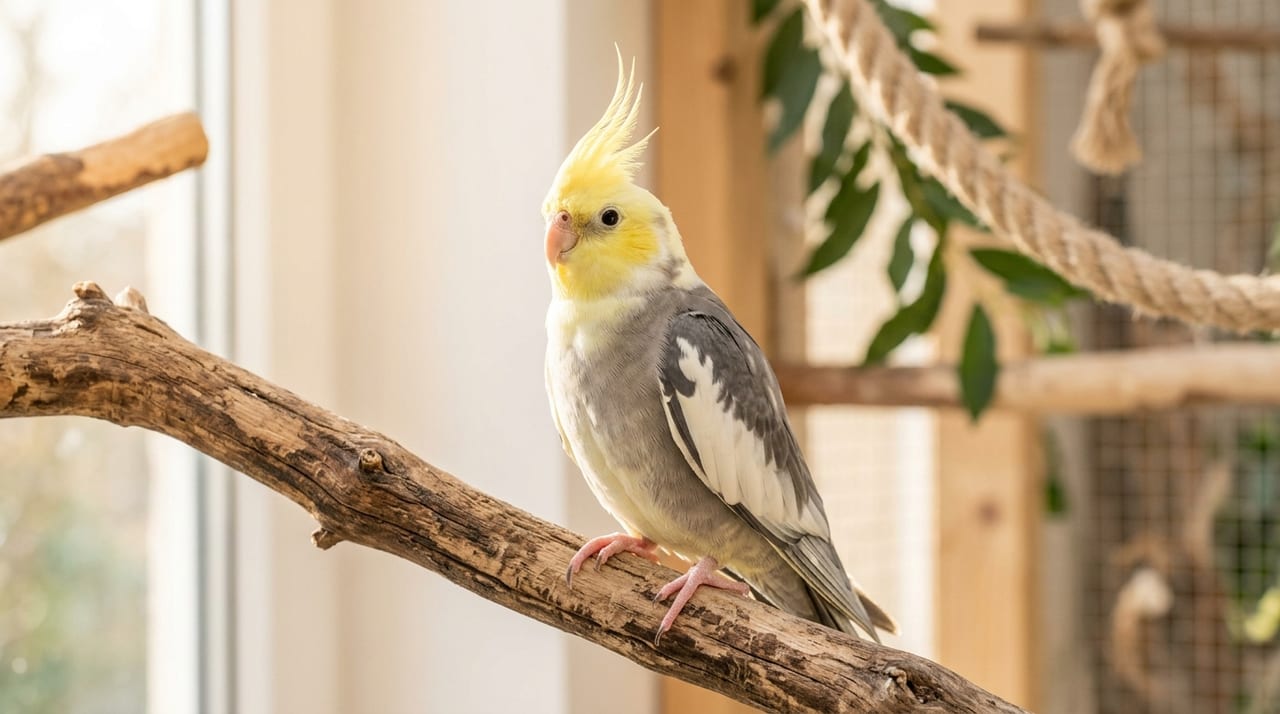
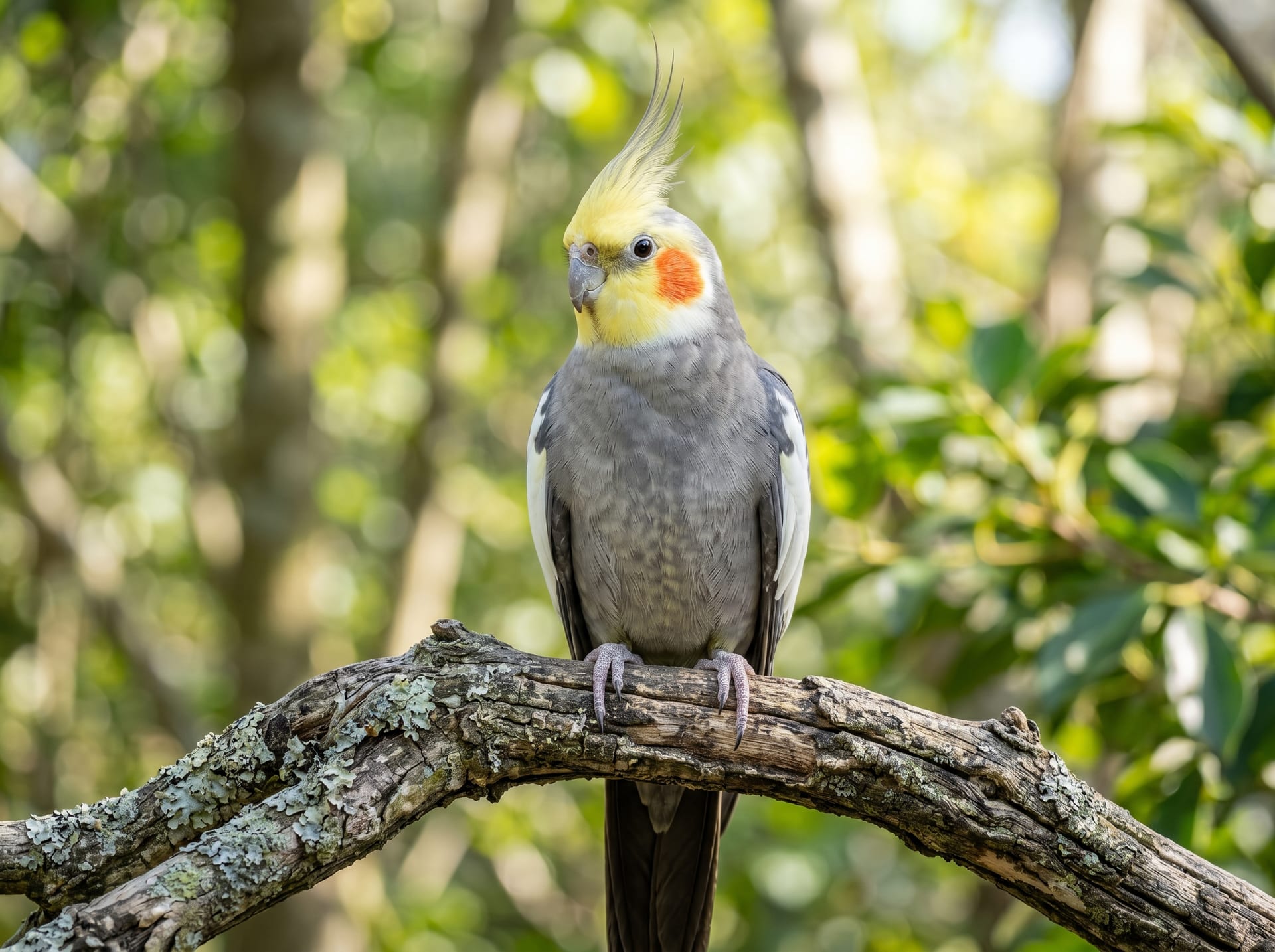
Cockatiels are among the most widely kept parrot-family birds in the world, and over their long history, many color mutations (color morphs) have been established. Many people have seen names like "Lutino," "Pearl," and "White Face" on shop and breeder listings. This article explains the characteristics of major color mutations and how their inheritance works.
Normal Gray (Wild Type)
Normal Gray is the wild-type color of cockatiels. The back, wings, and entire body are gray, with a striking orange "cheek" (cheek patch) on the face and a yellow crest on the head.
Sexual dimorphism is pronounced:
- Males: Bright yellow head, bright orange cheeks, uniform gray underside of tail feathers
- Females: Dull grayish-yellow head, muted orange cheeks, barring (horizontal stripes) on the underside of tail feathers
Normal Gray is the genetic foundation for all cockatiel mutations, and diverse colors are produced through combinations with other mutations.
Lutino (Yellow Face)
Lutino is one of the most widely recognized mutations in cockatiels. The expression of eumelanin (black and gray pigment) is inhibited, causing the gray body color to disappear and the entire body to become yellow to cream-colored. The orange cheek is preserved, creating a striking appearance of vibrant orange cheeks against a whitish body—a beautiful morph.
Lutino Inheritance
Lutino is a recessive trait linked to the Z chromosome (Z-linked recessive = sex-linked inheritance).
★Here's where birds differ from mammals. Birds have ZW-type sex chromosomes, with males being ZZ and females being ZW (mammals use XY chromosomes, with males being XY and females being XX). Therefore, what corresponds to "X-linked" in mammals is "Z-linked" in birds.
- Females (ZW): Expresses the trait if the Z chromosome carries the Lutino gene
- Males (ZZ): Expresses only if both Z chromosomes carry the Lutino gene
For this reason, in a cross between a Normal male and a Lutino female, male offspring become carriers (splits) of the Lutino gene and appear Normal Gray. To produce Lutino males, pairing a Lutino female with a Normal split male is necessary.
Lutino Sex Determination Challenge
Because Lutino lacks black pigment, sex determination by tail feather barring is difficult in this morph. Using genetic testing or DNA sex determination provides more reliable identification.
Pearl (Pearled)
Pearl is a mutation where parts of the feathers become white or yellow, with scallop (fan-shaped) patterns on the feather edges. Each feather develops spots lacking black pigment, creating a delicate lace-like pattern overall—a beautiful and distinctive appearance.
Pearl and the Male Fading Pearl Phenomenon
Pearl is Z-linked recessive, but notably, males lose their pearl pattern as they mature—a phenomenon called "fading pearl". Males that were pearled as chicks return to Normal Gray as they mature. Females, however, retain the pearl pattern throughout their lives. This phenomenon is believed to be influenced by testosterone levels.
Cinnamon (Fallow)
Cinnamon is a mutation where the chemical structure of eumelanin changes, causing black and gray to shift to chocolate or warm brown tones. The gray body becomes warm brown tones overall, and the eye color is also more reddish.
Cinnamon is also Z-linked recessive and, like Lutino, tends to express more readily in females. When combined with Normal Gray, complex mutations like Cinnamon Pearl are produced.
White Face
White Face is a mutation where the orange color pigment in the cheek (cheek patch) disappears. The cockatiel lacks its characteristic orange cheek, replaced instead by a white face.
- Normal × White Face: White face with gray body
- Lutino × White Face (Albino): No cheek, all-white body, red eyes
White Face is autosomal recessive. It expresses when homozygous (both parents carry the White Face gene), while heterozygotes (carriers) show little visible difference.
Albino
Albino is a mutation combining Lutino and White Face. Loss of black pigment (Lutino) plus loss of cheek pigment (White Face) result in an all-white body, red eyes, and no cheek patch. The pure white body with red eyes is distinctive, and this is one of the rarer, highly valued morphs.
Examples of Combined Mutations
When multiple mutation genes express simultaneously, even more diverse colors are produced.
| Mutation Combination | Name |
|---|
| Lutino + Pearl | Lutino Pearl |
| Cinnamon + Pearl | Cinnamon Pearl |
| Lutino + White Face | Albino |
| Cinnamon + White Face | Cinnamon White Face |
| Lutino + Pearl + Cinnamon | Lutino Pearl Cinnamon |
Tips for Purchasing from Breeders
When purchasing color mutation cockatiels from breeders, confirm the following information:
- Phenotype: Visual color name (Lutino, Pearl, etc.)
- Sex: Whether DNA-tested
- Split (carrier) information: For breeding purposes, the parent's potential hidden genes are important
- Hatch date (age): Whether the bird is a chick/hand-fed stage or a self-feeding juvenile
On BreederDirect, breeders list color mutation information and breeding history clearly, allowing you to make selections based on reliable information.
Cockatiel Major Color Morphs—Quick Reference Table
Major color mutations are compiled here. Use this as a quick reference when comparing breeder listings.
| Color Name | Body Color Traits | Cheek (Cheek Patch) | Inheritance |
|---|
| Normal Gray | Entire body gray | Orange | Wild type |
| Lutino | Entire body yellow to cream, red eyes | Orange | Z-linked recessive (sex-linked) |
| Pearl | Feather edges with scallop/lace pattern | Orange | Z-linked recessive (sex-linked) |
| Cinnamon | Gray becomes chocolate/brown | Orange | Z-linked recessive (sex-linked) |
| White Face | Normal colors but cheek is white | None (white) | Autosomal recessive |
| Albino |
Z-linked recessive colors (Lutino, Pearl, Cinnamon, Yellow Cheek) express readily in females (ZW) because they carry only one Z chromosome—if that chromosome carries the gene, it expresses. As a result, these traits appear more readily in females. Conversely, to express in males (ZZ), the gene must be on both Z chromosomes, which requires the mother bird to carry the color (females cannot be splits/carriers). In contrast, White Face, Pied, Fallow, and Emerald are autosomal recessive and express regardless of sex when the bird inherits the genes from both parents.
Other Color Mutations
Beyond the major six morphs, the following colors are also in circulation:
- Pied (mottled): Gray and yellow mixed irregularly in a pattern. The placement of spots varies by individual, and no two birds have identical markings. Autosomal recessive.
- Fallow: Melanin is partially reduced, creating an overall faded appearance. A subtle red tint in the eyes is characteristic.
- Emerald (Olive): A mutation with a greenish tint to the feathers, sometimes called Spangle.
- Yellow Cheek: A relatively new mutation where the normally orange cheek becomes yellowish. Beautiful combinations with other colors have also been created.
These combine with major morphs to produce even more varied possibilities.
Sex Determination by Color
Questions like "How do you tell male and female cockatiels apart?" and "Which colors are easier to distinguish?" are common. In fact, the ease of sex determination varies greatly by color.
| Color | Ease of Adult Sex Determination | Male Tendency | Female Tendency |
|---|
| Normal Gray | Easy | Bright yellow face, uniform tail underside | Dull face, horizontal barring on tail/wing underside |
| Cinnamon | Easy | Bright face, stripes fade | Stripes remain on tail/wing underside |
| Pearl | Easy | Fading occurs as it matures (fading pearl) | Maintains spots throughout life |
| Lutino | Difficult | No black pigment, stripes not visible | Same as above |
| White Face, Albino | Difficult | Faint pigmentation, hard to distinguish | Same as above |
Why most adult pearls are female: Males experience fading pearl during maturation, where pearl patterns disappear. A bird that retains pearl patterns into adulthood is almost always female. This is believed to result from testosterone's influence.
Colors with less black pigment—Lutino, White Face, Albino—cannot be determined by feather barring. For definitive sex identification, use DNA sex determination (genetic testing).
Conclusion
Cockatiel color mutations involve multiple mechanisms: Z-linked recessive (sex-linked), autosomal recessive, and complex inheritance. Understanding genetic basics helps reliably breed your desired color. Start by welcoming a color mutation cockatiel that appeals to you, and experience its unique beauty firsthand.