Cheirotonus Care Guide | The Secrets of Long Front Legs, Larval Rearing, and Breeding Guide | ブリちょく
Insects| ✍️ BreederDirect Editorial
Cheirotonus Care Guide | The Secrets of Long Front Legs, Larval Rearing, and Breeding Guide
A comprehensive guide to caring for Cheirotonus beetles. Learn how to create the ideal environment for these remarkable insects with front legs nearly twice their body length, manage larval humus substrate, and understand adult characteristics and essential care practices.
Key Takeaways
A comprehensive guide to caring for Cheirotonus beetles. Learn how to create the ideal environment for these remarkable insects with front legs nearly twice their body length, manage larval humus substrate, and understand adult characteristics and essential care practices.
Cheirotonus (long-armed beetle), as the name suggests, is a highly distinctive insect with front legs that far exceed its body length. Several species are distributed across Asia, and in Japan, the slender long-armed beetle (Tokara Islands and Okinawa Prefecture) inhabits the region. In particular, the large long-armed beetle (Cheirotonus jansoni) found in India and Southeast Asia is notable for its exceptionally long front legs and is highly prized among specimen collectors and live-insect enthusiasts.
✍️
BreederDirect Editorial
The BreederDirect editorial team specializes in care information for animals, covering veterinary care and breeding to deliver beginner-friendly guides.
Find Insects on BreederDirect
Buy directly from verified breeders
Browse Related Listings
Find Insects listings related to this article on BreederDirect. Buy directly from verified breeders.
Related Tools
Related Articles
Browse by Category
🪸Coral
🐠Marine Fish
🐟Tropical Fish
🐡Goldfish
🐟Medaka
🦎Reptiles
Share
Basic Characteristics of Cheirotonus
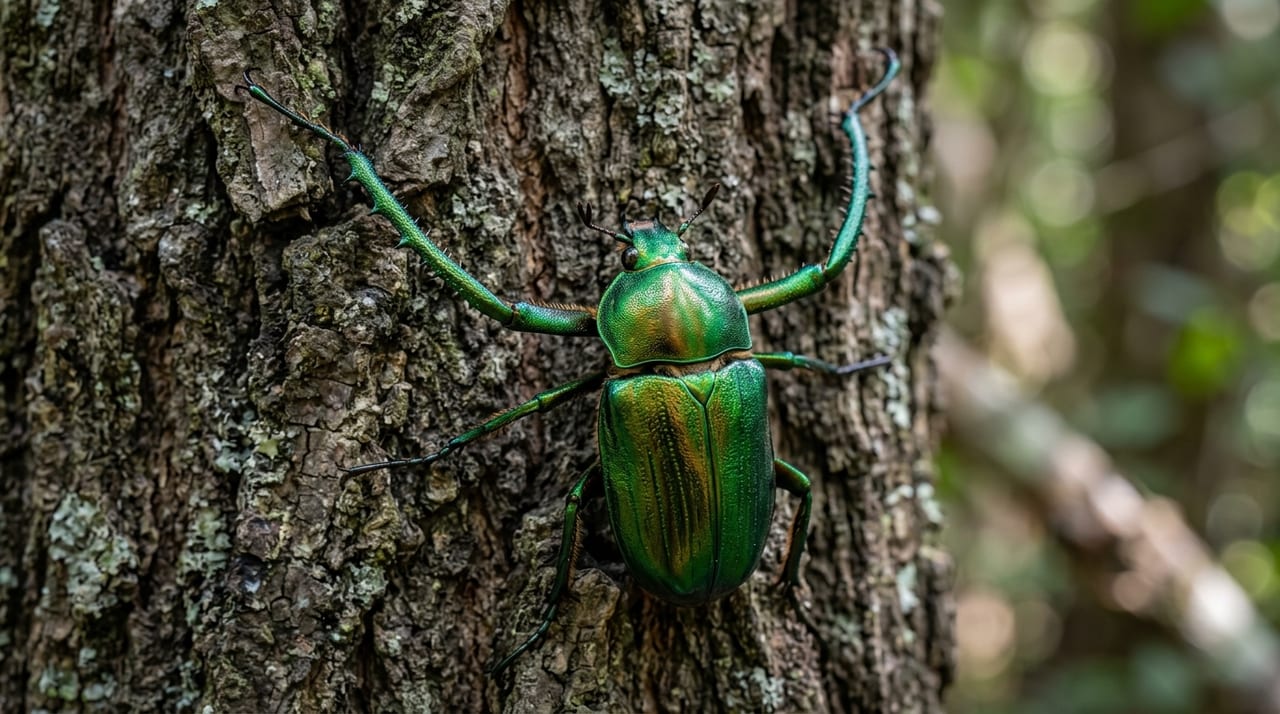
Cheirotonus is a beetle belonging to the Scarabaeidae family. Adult body length varies by species, but the typical large long-armed beetle (C. jansoni) measures approximately 30–45 mm. However, the male's front legs are equal to or longer than the body length itself, making the overall impression quite impressive. The body color displays a beautiful green metallic luster that shimmers differently depending on the angle of light.
Long-armed Cheirotonus spreading its long front legs on bark
The long front legs are believed to be used for male-to-male combat and mating behavior. They are adapted for arboreal life, moving quickly along tree trunks and branches. Even in captivity, they will attempt to climb mesh lids and dividers using these long legs, making escape prevention particularly important.
Lifespan as adults is relatively short, typically 2–4 months. During the adult phase, some species feed minimally or not at all, relying primarily on liquid tree sap or fruit juices as nutritional sources.
Adult Housing and Care Environment
For adult care, use an insect container with a fine-mesh lid to prevent small flying insects (medium to large size). Since Cheirotonus are large-bodied with exceptionally long front legs, they can become stuck if they flip over. Place driftwood or bark pieces inside the container to provide adequate footholds and climbing surfaces.
For substrate, use shallowly-layered humus soil or broad-leaved tree sawdust, approximately 5 cm deep. Substrate that is too deep poses a suffocation risk if the beetle burrows into it.
Optimal temperature is 24–28°C. High temperatures above 30°C shorten lifespan, so careful temperature management is essential during summer months. Maintain humidity at 60–70%. If the container becomes too dry, mortality risk increases significantly.
Commercial insect jelly is the easiest food to manage. High-sugar fruits such as banana and watermelon are also favored, but spoil quickly and require careful monitoring. Replace jelly every 1–2 days to maintain cleanliness.
Keeping male-female pairs is possible, but housing multiple males together will result in intense combat with their front legs, so avoid this. For pair breeding, a spacious container (45 cm or larger) is recommended.
Larval Rearing and Substrate Management
Raising Cheirotonus larvae requires completely different management from adults. The larval stage is lengthy, lasting 1–2 years or more depending on the species.
High-quality fermented humus soil (fermentation mat) is essential for larval rearing. Use "Kunugi/Konara fermented mat" made from broad-leaved tree decomposition, or specialized "Scarab beetle larval rearing mat." Standard beetle mats can work as substitutes, but selecting finely-textured, nutrient-rich substrates is critical for proper development.
Use 800–1,400 cc plastic cups or specialized containers for rearing. Pack the substrate firmly to about 80% full before adding larvae. Since larvae burrow and feed from within, regular maintenance (substrate changes) is necessary.
Plan for substrate changes every 2–3 months. When larval feces accumulate and substrate deteriorates, it's time for a change. During replacement, carefully remove the larva without injury and transfer it to fresh substrate. Immediately after changing, mix in a small amount of old substrate to prevent sudden environmental stress.
Temperature management is equally critical for larvae, with 20–26°C being optimal. Temperatures above 30°C can be fatal to larvae, especially during summer months.
Breeding and Egg-Laying Setup
Breeding Cheirotonus is moderately challenging but achievable with proper conditions.
Successful breeding requires a mature male-female pair. After emergence, they begin feeding (post-eclosion feeding) within 2–4 weeks, and become capable of mating and egg-laying approximately 1–2 months later.
For breeding setup, use a deep container (45 cm or larger) packed firmly with fermented substrate to a depth of 20–25 cm. The female burrows into soil to lay eggs, so insufficient depth will prevent oviposition. Place driftwood or bark on the surface to create hiding spots for the female.
After laying, keep the container in a quiet location for 1–2 months. Then carefully excavate the substrate to locate eggs or newly-hatched larvae. Eggs are white, spherical, and approximately 3–5 mm in diameter.
Transfer hatched larvae to individual rearing containers and raise them using the larval care methods described above. To prevent cannibalism, separate first-instar larvae into individual containers.
Important Considerations for Purchase and Care
Several important points apply when purchasing and keeping Cheirotonus. First, the slender long-armed beetle species native to Japan may be legally protected or regulated in certain regions, with collection and breeding restrictions in place. For Southeast Asian species (such as C. jansoni), verify compliance with the Convention on International Trade in Endangered Species (CITES) before purchase, and obtain only legally imported individuals.
When selecting specimens, health assessment is critical. Check that all legs are intact—front legs are particularly prone to breakage—observe if movement is active, and confirm there are no injuries or missing parts. Individuals with front leg damage may be less valuable, but often function adequately for care purposes.
With their distinctive appearance and breeding behavior, Cheirotonus are popular among advanced insect keepers. By carefully observing their brief adult stage and enjoying the long-term larval rearing process, you'll experience the depth and rewards of scarab beetle keeping. Sourcing healthy specimens and larvae directly from breeders ensures a safer start to your Cheirotonus collection.